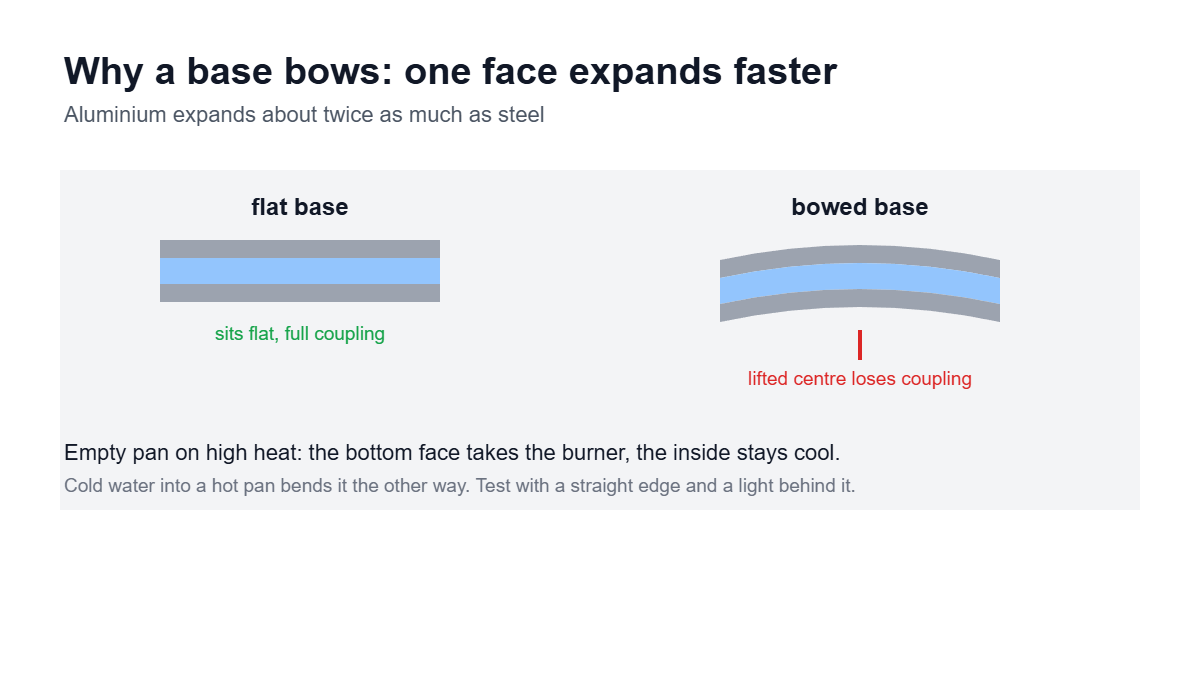
A warped pan is usually blamed on the pan. More often it is a temperature difference across the base: one part of the metal expanded more than another, and the base took a permanent set. Once you see it as differential expansion, the causes stop being mysterious.
Why a clad base bows
A clad base is a sandwich of stainless, aluminium (or copper) and stainless. Aluminium expands roughly twice as much as steel for the same temperature rise. Heat the sandwich evenly and it grows evenly; heat the bottom face much faster than the top and the two layers want different lengths. The bond holds, so the whole base curves — concave or convex depending on which face got hotter.
Repeat that cycle enough times and some of the curve becomes permanent. That is the pan that rocks on the hob.
The three reliable causes
- An empty pan on high heat. No food or water to absorb energy, so the base face takes the full burner output while the inside stays comparatively cool. This is the single most common cause.
- Cold water into a hot pan. Thermal shock bends the base the other way. It is the same mechanism in reverse, and it is why the pan that warped is often the one that was deglazed or rinsed too early.
- A base thinner than the burner can handle. Thin bases reach higher temperature gradients faster, and they have less material to resist the bend.
Measuring the warp
Put a straight edge across the base, hold it up to a light, and look for a gap. A gap you can see but not slide a sheet of paper into is small. A gap that takes a business card is enough to matter on induction, and enough to make the pan spin on a flat ceramic hob.
The other test is a spin test: set the pan on a flat surface and press the rim on one side. A warped pan pivots; a flat pan sits.
Prevention, in order of effect
- Never preheat empty on high. Medium, with oil in the pan.
- Let the pan cool to warm before washing, or deglaze with hot liquid rather than cold water.
- Match base diameter to burner. A small pan on a big burner heats a small area hard.
- Choose a base thick enough to hold its shape: thin sandwich bases warp first.
What can be fixed
Light warping in a disc-bottom pan can sometimes be pressed back. Clad pans rarely can: the deformation is distributed through the bonded layers, and hammering one face does not restore the other. If the pan no longer sits flat and it is used on induction, replacement is usually the honest answer.
FAQ
Does a warped pan still cook?
On gas, mostly yes, unevenly. On induction, the lifted area loses coupling and the pan heats in a ring.
Can I flatten it with a mallet?
You can move metal, but not restore a bonded base. Expect to make it worse.
Do expensive pans warp?
They resist it better because there is more material and a more even core. No pan is immune to an empty pan on high heat.
The expansion difference between aluminium and steel is roughly a factor of two; the exact figure depends on the alloy and the temperature range.
Compare on Amazon — this category usually has more brands, sizes and price points there.
Check current prices on Amazon →
As an Amazon Associate we earn from qualifying purchases. The price you pay is unchanged. Disclosure
[…] are not about cork at all. A stopper standing proud of the lip is a thermal expansion problem — the expansion arithmetic that dishes a stainless pan is the same one that leaves 2.3 ml of wine with nowhere to go. A cork that comes out in flakes is […]