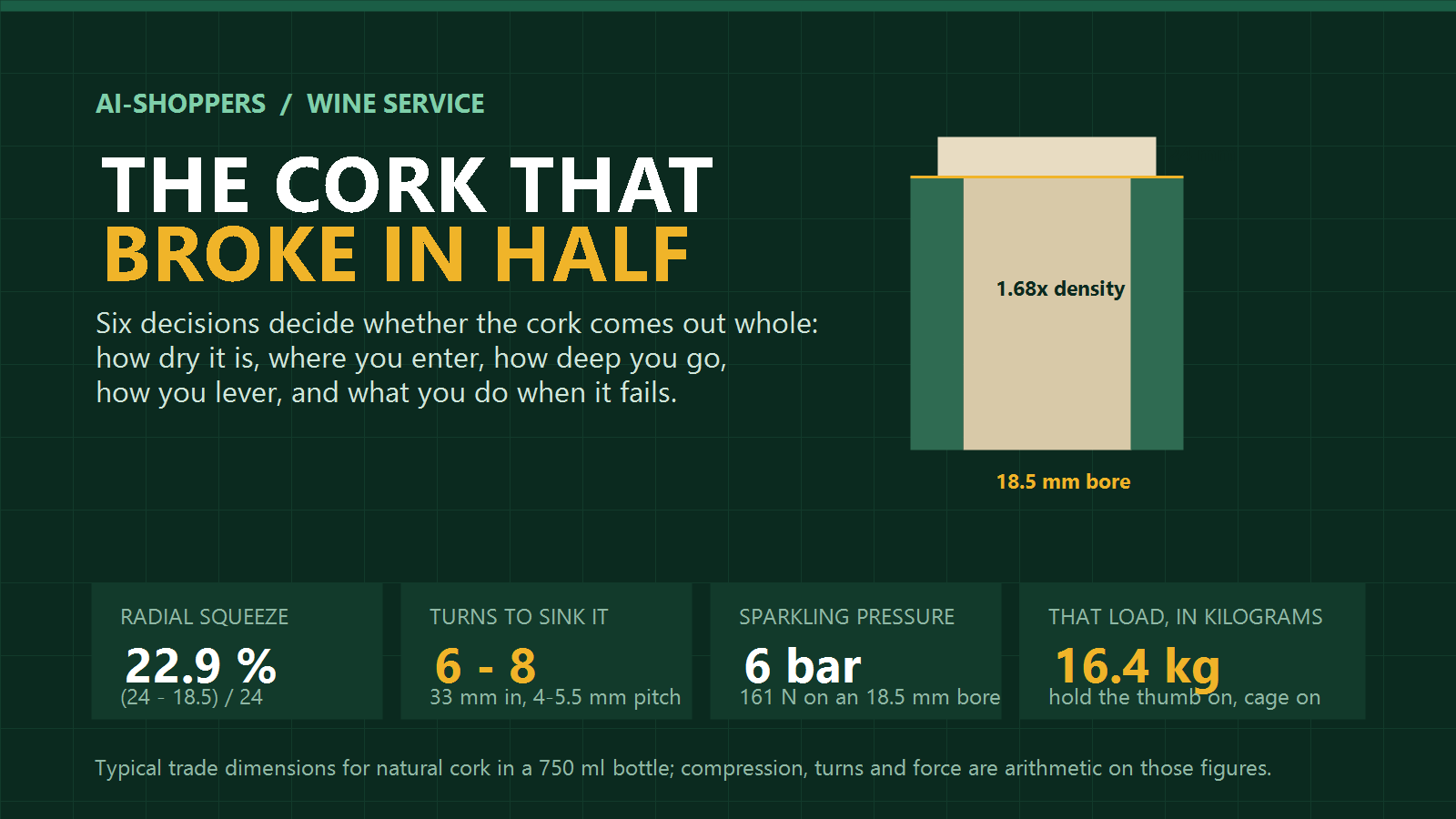
A cork almost never breaks because the wine is old. It breaks because of six decisions taken in the ninety seconds before the screw touches it: whether the stopper is still elastic, where you start the worm, how deep you sink it, how you apply the lever, what you do in the first ten seconds after it fails, and whether the bottle you are holding is pressurised. Each of those decisions has a number attached. This guide gives the numbers and the order, and it starts with the one thing most people skip — looking at the cork before they open the bottle.
1. Read the cork before the screw goes in
Cut the capsule and look at the top of the cork, not just at the foil. Four things are visible in about four seconds, and each one changes what you do next.
The level. A cork that sits flush with the lip is a bottle that has been handled normally. A cork standing proud of the lip, even by a millimetre or two, has been pushed from below — which means the wine inside expanded after the bottle was closed, which in practice means heat. Wine expands by roughly 0.2 millilitres per litre per degree Celsius, so a 750 ml bottle moved from a 15 °C cellar to a 30 °C car boot wants about 2.3 millilitres of room it does not have. It finds that room by pushing the cork out. A cork sunk below the lip is the opposite case: pressure has been lost, or the closure was never seated properly.
The seepage trail. A dark line running up the side of the cork, under where the capsule used to be, is wine that has climbed. Some climb is normal in a bottle that has travelled. A trail that reaches the top face is not.
The face itself. Mould on the outside of a cork is far more common than most people expect, and it is usually a cellar-humidity story rather than a wine fault: the mould is growing on the cork, not in the bottle, and it wipes off. It is not evidence of anything you can taste.
The end you can smell. This is the most overrated test in wine service. A cork that smells of damp cardboard or a mouldy basement is worth noting — the compound behind that smell, 2,4,6-trichloroanisole, is detectable in the low nanograms per litre, which is parts per trillion — but a cork that smells fine proves nothing, and a cork that smells of wine is simply a cork that has been in wine. The glass is the test. Sniff the wine, not the stopper.
2. Twenty-four millimetres into eighteen and a half
Here is the geometry that decides everything else. A natural cork for a 750 ml still-wine bottle is commonly supplied at 24 mm in diameter and 44 mm long, and the neck it is driven into is bored to about 18.5 mm. Suppliers also list 38 mm and 49 mm lengths, and the bore varies by bottle maker, but those two figures are the standard case, and they are enough to see what the cork is being asked to do.
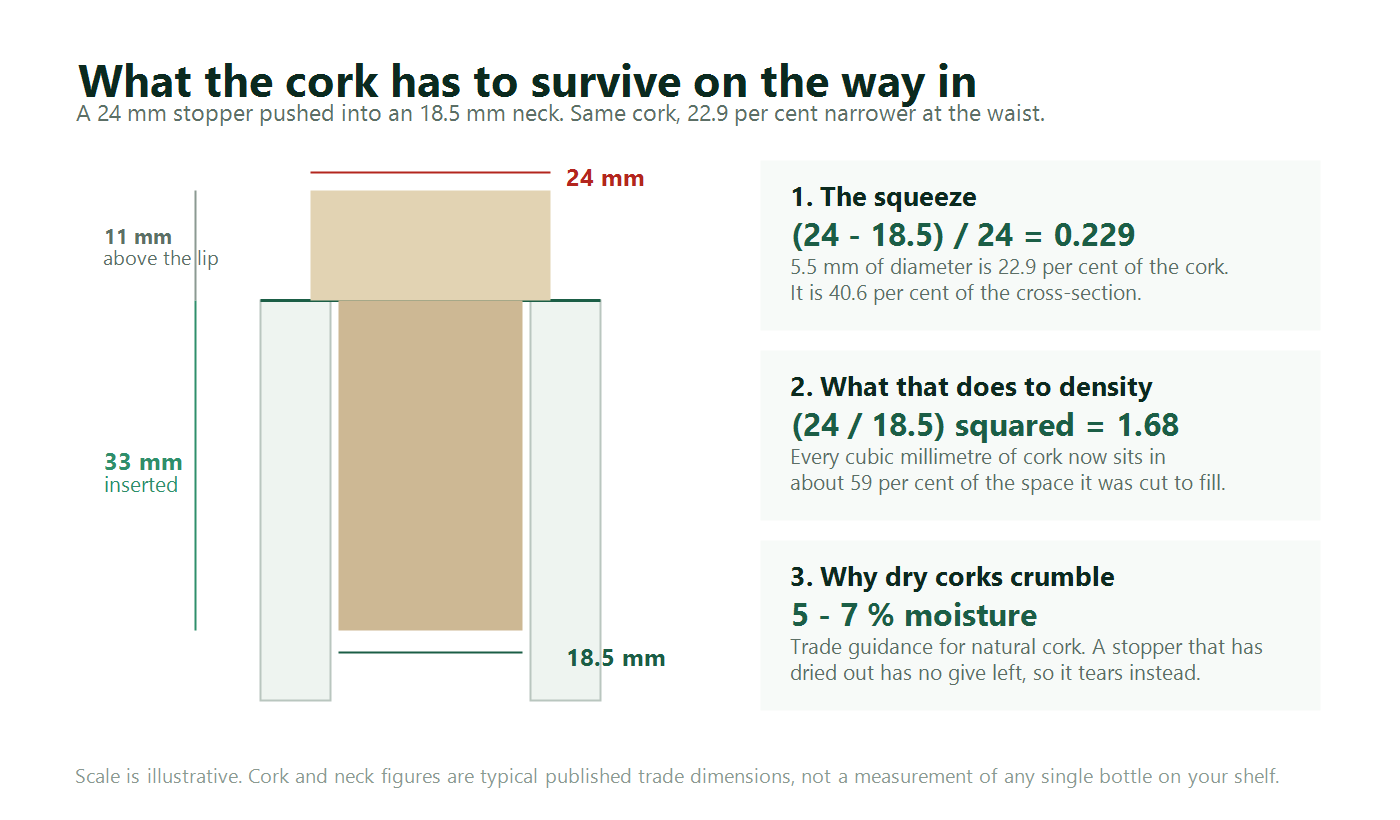
The arithmetic is short. The diameter has to lose 5.5 mm, which is 22.9 per cent of 24. But diameter is a length, and the cork is a solid, so what matters is the area: the cross-section falls from 452 mm² to 269 mm², a loss of 40.6 per cent. The cork is not being gently squeezed. It is being compressed into about 59 per cent of the space it was cut to fill, and its density at the waist rises by a factor of (24 ÷ 18.5)², or 1.68.
That compression is only possible because of what cork is: a foam of sealed cells, mostly gas, that bends rather than tears. It is also why moisture matters. Natural cork is specified at roughly 5 to 7 per cent moisture, and a stopper that has dried below that range loses the flexibility that lets it deform. It does not compress into the neck; it fractures. Which is exactly what you see when a cork comes out in flakes: the failure happened before the screw, during ten years of storage in a cupboard that was too dry.
3. Count the coils: how deep, and how many turns
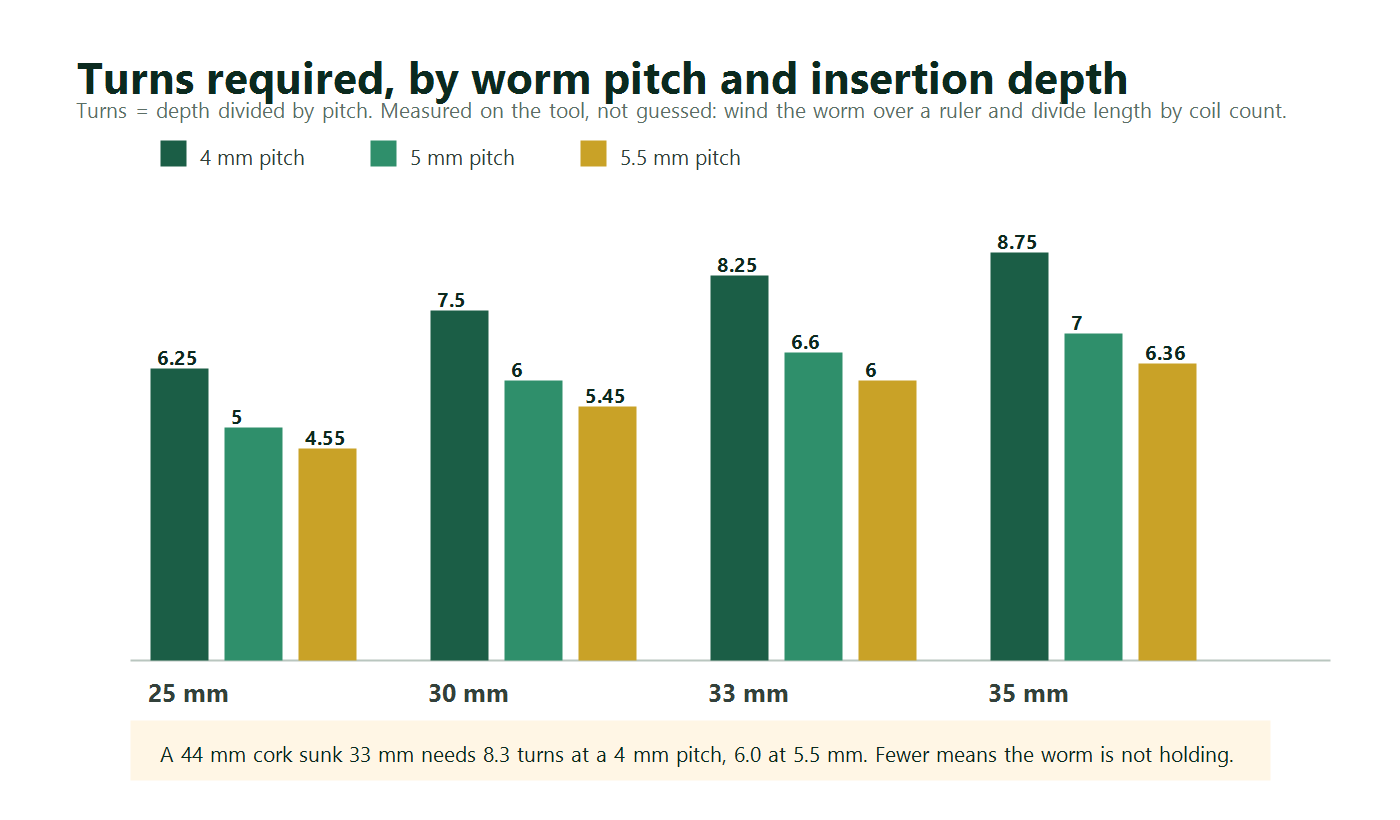
Most people sink a corkscrew until it stops feeling like it is going in, then pull. That is one or two turns short of what the tool needs. The worm is a helix with a fixed pitch — the distance between one coil and the next — and the number of turns required is simply depth divided by pitch.
At a 4 mm pitch, 33 mm needs 8.25 turns. At 5.5 mm, the same depth needs 6.0. Both are more than the three or four turns most of us give it, and the difference is not cosmetic: a worm that has only cut three turns is gripping maybe 12 mm of cork, and a 12 mm grip on a stopper that has to be dragged 33 mm through a neck with 22.9 per cent of radial compression will tear a plug out of the middle.
There is a second reason to stop short of the end. A worm that passes through the bottom face of the cork opens a channel straight into the wine, and every crumb the helix has loosened now has a route down. Stopping 10 to 12 mm above the wine-side face keeps the last third of the stopper intact and gives the lever something solid to work against.
Keep the worm vertical while you wind it. The most common cause of a cork that breaks in the middle is not a dry cork — it is an entry angle a few degrees off the axis, which loads one side of the stopper and starts a crack that the pull then finishes.
4. Where the force goes
A waiter’s friend is a lever, and the two-stage fold-out is the reason it works. The first notch lifts the cork a few millimetres and breaks the seal; the second, higher notch takes over once the cork is moving and gives a longer arm. The pivot is the lip of the bottle, and the arm ratio on a typical waiter’s friend is somewhere near four to one, which is why a pull that would need two hands becomes a wrist movement.
Three habits keep the lever from doing damage. Keep the body of the tool flat against the neck, so the force runs down the axis rather than across it. Push down on the handle, do not pull up on the bottle — the bottle should be on a table, not in the air. And when the cork is halfway out, stop levering and finish with a slow twist of the wrist, because the top half of a cork has no neck around it to support it and is the part most likely to snap.
If the cork starts to rotate without rising, stop immediately. That is the worm turning inside a channel it has already cut, and every extra turn widens the hole. Withdraw it, and change tools rather than angles.
5. When it fails: six symptoms, six moves
The triage below is ordered by what you can see in the first seconds. The rule behind all six rows is the same: once the cork has failed, the goal changes from extraction to keeping cork and glass out of the wine.
| What you see | What it means | The next move |
|---|---|---|
| Top of the cork is dry and flaking | Stored too dry; the stopper has lost its 5–7 per cent moisture | Do not re-enter the same hole. Use a two-prong puller, or push the cork in and decant through a strainer. |
| Cork spins but will not rise | The worm has stripped a channel through the middle | Withdraw and switch tools. A wider-pitch worm or a two-prong will grip where the first one failed. |
| Cork breaks level with the lip | The upper half had no support; the pull was off-axis | Leave the stub. Levering against a broken stub drives force sideways into the glass. |
| Lower half stays in the neck | Insertion was too shallow for the compression | Push the remainder in with a clean dowel, then pour through a fine strainer into a jug. |
| Cork sits proud of the lip | Heat expansion pushed it out; expect a tired bottle | Chill to cellar temperature first, then open. Taste before you serve it to anyone. |
| Smells of wet cardboard | Taint, not breakage | No technique fixes it. Re-cork, keep the bottle, and take it back to where it came from. |
Two of those rows deserve a longer note. First, pushing a cork in is a perfectly good outcome. It feels like defeat and it is not: the wine is unaffected, the crumbs sink or float, and a strainer catches them. Second, never go fishing in a bottle with a knife or a fork. Glass is thinner at the neck than anywhere else on the bottle, and the tool that slips is the one that ruins the evening.
6. Six bar: why sparkling is a different job
Everything above assumes a still wine, where the cork is held in by friction alone. A sparkling wine cork is held in by a wire cage against 5 to 6 bar of carbon dioxide pressure — roughly five to six times atmospheric. The neck bore is the same 18.5 mm, so the force on the cork is pressure times area: 600,000 pascals across 269 mm², about 161 newtons, or 16.4 kilograms of load sitting behind a cage that is designed to be removed by hand.
That number explains the whole ritual. You do not lever a sparkling cork, because a lever converts a controlled pull into an uncontrolled one and the cork leaves at speed. You chill the bottle first — 6 to 10 °C is the serving range and it also lowers the pressure — keep a thumb over the cork while the cage is loosened, tilt the bottle to about 45 degrees, and turn the bottle rather than the cork. The aim is a sigh, not a pop: a pop is gas you paid for leaving the wine.
The same arithmetic explains why a sparkling cork that has been sitting in a warm car is genuinely dangerous, and why the moulded mushroom shape exists at all: the cork is compressed to 18.5 mm for years and expands back to roughly its original diameter the moment it clears the neck.
7. What a broken cork actually does to the wine
Less than most people fear. Cork is inert, the crumbs are tasteless, and a bottle opened with half a stopper in it will taste the same as one opened cleanly once the fragments are out. Decant through a fine mesh strainer, or through a coffee filter if the cork has crumbled badly, and drink it. The one thing that does change is time: a bottle with a broken or pushed-in closure has a damaged seal, so it should be finished within a day or two rather than left standing for a week.
What a broken cork does not tell you is whether the wine is tainted. Cork taint comes from 2,4,6-trichloroanisole, a compound formed when mould acts on chlorinated phenols, and it is measured in nanograms per litre — parts per trillion. At that concentration there is nothing to see on the cork and often nothing to smell on it either; the wine in the glass reads as damp cardboard, stripped fruit or a musty finish. Reported taint rates have fallen sharply since the 1990s, when a few per cent of bottles was routine and suppliers now claim well under one per cent, but the numbers come from the industry that sells the closures and should be read that way.
The alternative closure is worth understanding for the same reason. A standard screwcap for still wine is 30 mm across and about 60 mm tall, it cannot be tainted, and it cannot break — but it also lets a different and much more predictable amount of oxygen through, which is why the same wine under screwcap and under cork can taste different after five years. That is a winemaking decision, not a quality ranking.
8. The kit that lowers the odds
Three tools cover every case in this article. A waiter’s friend with a two-stage lever handles 95 per cent of bottles and is the only one you need for a young wine. A two-prong puller — the Ah-So — slides down both sides of a fragile cork and lifts it without a helix at all, which is the correct tool for anything older than about fifteen years. And a foil cutter, because a capsule cut with a knife leaves a ragged edge that catches the worm and pushes the entry off-axis.
Storage does the rest. Keep bottles on their side if they will sit for years, so the wine stays in contact with the cork and the stopper keeps its moisture; keep the room between roughly 10 and 18 °C and out of direct light; and accept that a bottle standing upright in a warm kitchen for a decade will hand you a dry cork no matter which tool you own.
Questions we get asked
Can I drink a bottle if the cork broke and fell in?
Yes. Cork is inert and the crumbs are harmless; strain them out through a fine mesh or a coffee filter and the wine is fine. What you should not do is leave the bottle standing for a week — a broken or pushed-in closure is a damaged seal, so finish it within a day or two.
How many turns should a corkscrew take?
Depth divided by pitch. On a 44 mm cork you want about 33 mm of travel, which is 8.25 turns at a 4 mm pitch and 6.0 turns at 5.5 mm. Measure the worm on your own tool once — coiled length divided by coil count — and you will know the number for every bottle after that.
Why did the cork break in half instead of coming out?
Almost always one of three things: the cork was too dry to compress and tore, the entry angle was a few degrees off the axis so one side carried the load, or the worm was sunk only three or four turns and gripped too little cork to drag it through a 22.9 per cent radial squeeze.
Does a broken cork mean the wine has gone off?
No. Breakage is mechanical; taint is chemical. Cork taint comes from 2,4,6-trichloroanisole at parts per trillion and shows up in the glass as damp cardboard or stripped fruit, not on the cork. Judge the wine, not the stopper.
Is it safe to open sparkling wine with a lever corkscrew?
No. A sparkling cork is held by a wire cage against 5 to 6 bar, which puts about 161 newtons — 16.4 kilograms — behind it. Chill the bottle to 6–10 °C, keep a thumb over the cork, tilt to about 45 degrees and turn the bottle, not the cork, until it sighs out.
Figures used here: natural cork at 24 mm diameter and 44 mm length, and a neck bore of 18.5 mm, are typical published trade dimensions for a 750 ml still-wine bottle, not measurements of any particular bottle; suppliers also list 38 mm and 49 mm corks and bottle makers vary the bore. The 22.9 per cent radial compression, the 40.6 per cent cross-section loss, the 1.68 density factor, the turn counts and the 161 N / 16.4 kg load on a sparkling cork are arithmetic on those dimensions, shown in the two charts so the sums can be checked. Cork moisture of 5–7 per cent and the 5–6 bar pressure range for sparkling wine are standard trade figures. The 0.2 ml per litre per degree expansion figure is the usual approximation for wine. Reported cork-taint rates are industry-reported and have fallen since the 1990s; treat them as an order of magnitude rather than a measurement. Product prices were read from our own listings on 30 October 2026.
Gear referenced in this guide
None of these are required for the method — a €2 waiter’s friend does everything in sections 1 to 5. They are the listings this article was written against, so the tools described can be checked against the same kit.
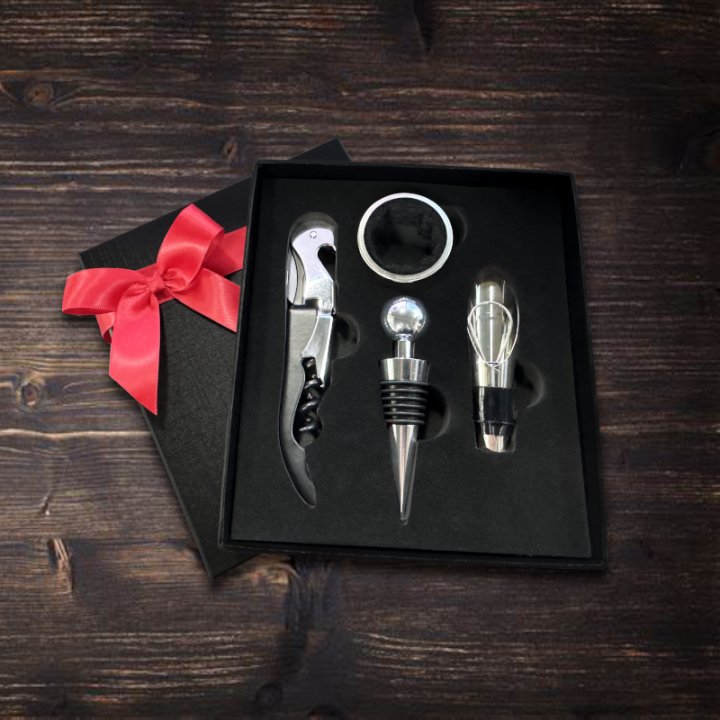 Wine Opener Set, Gift Box$79.99View details
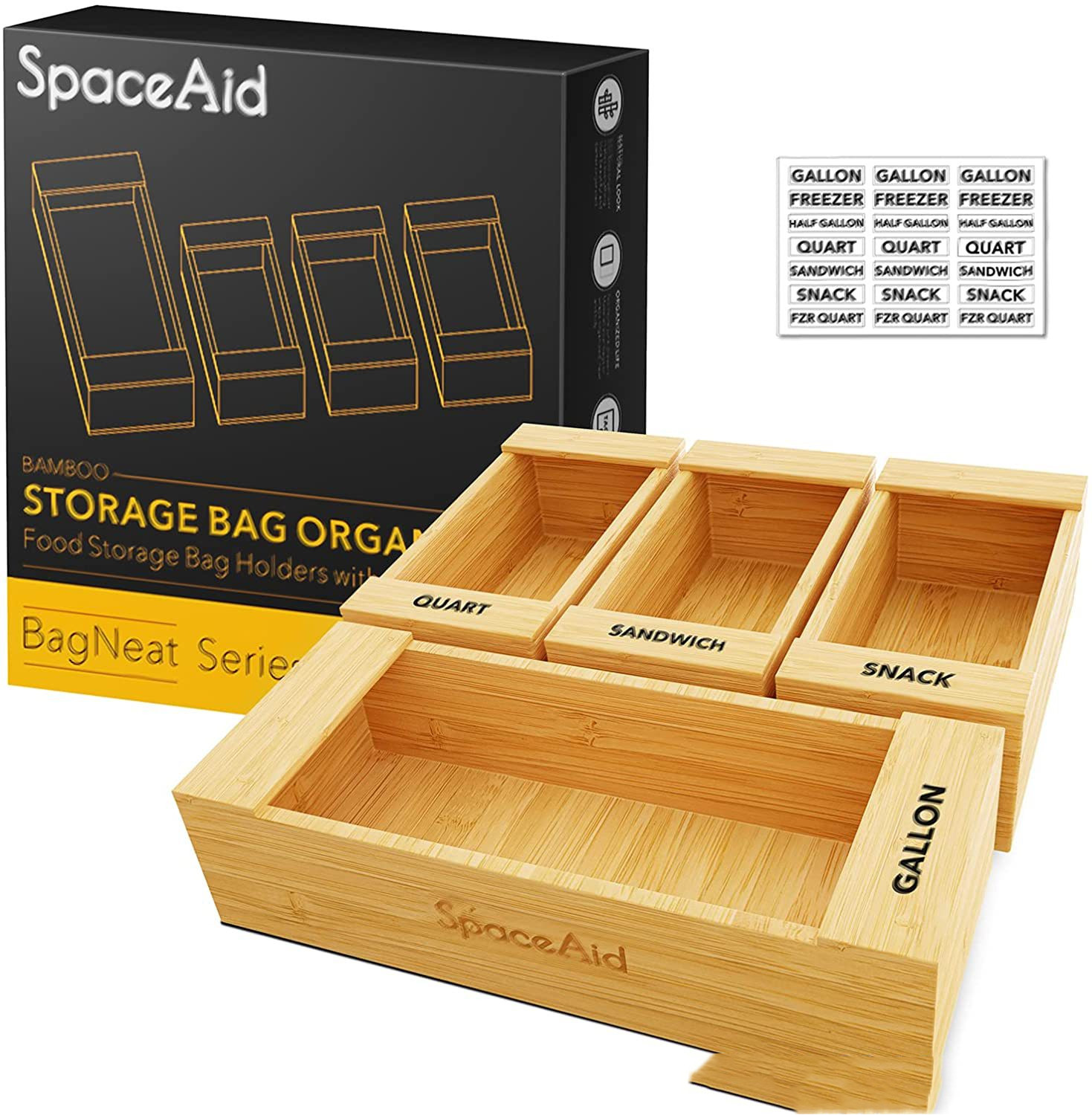 Bamboo Drawer Organizer, 30.5 cm$53.99View details
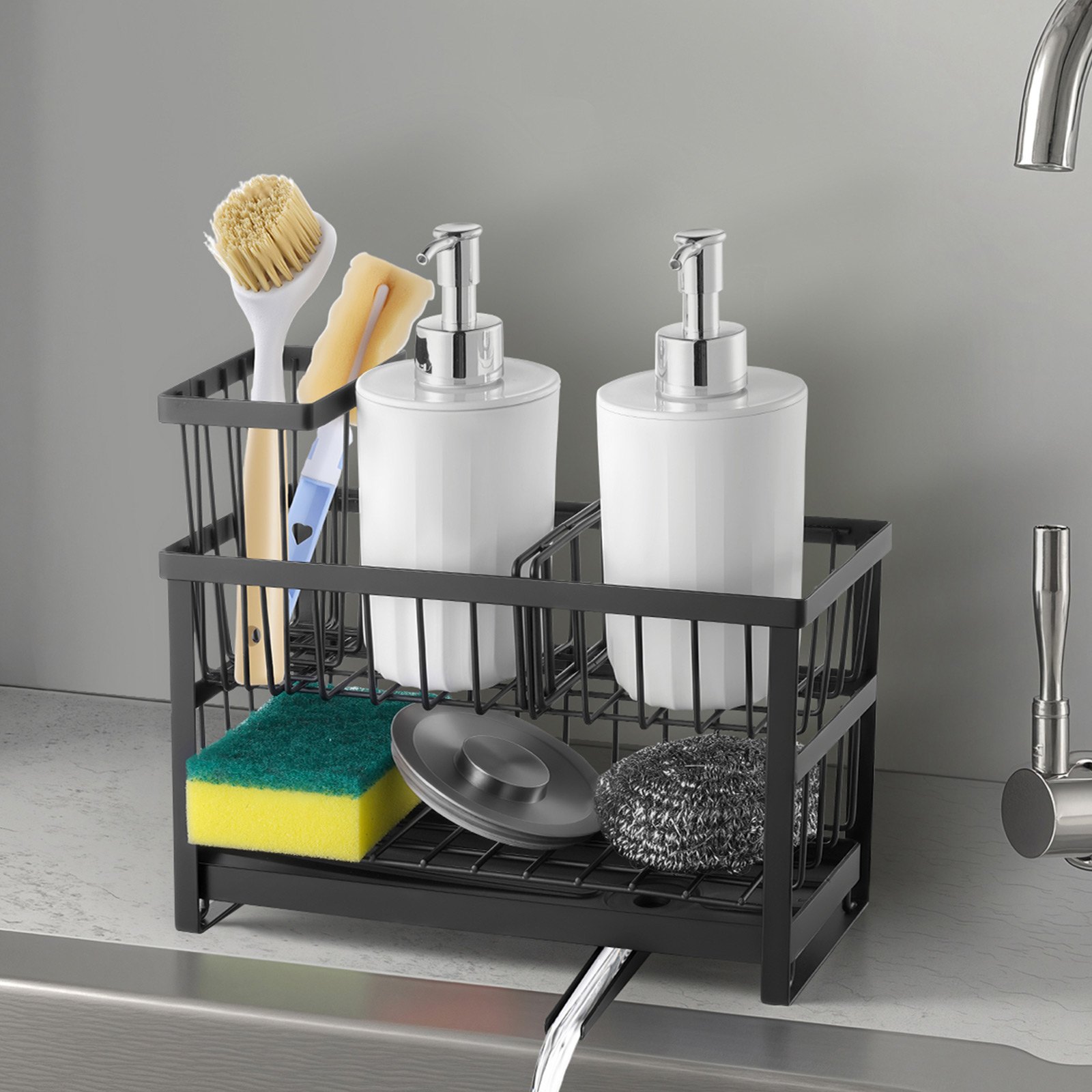 Kitchen Sink Caddy$65.99View details
The drawer box is 30.5 × 10.2 × 7.6 cm — long enough for a waiter’s friend and a foil cutter to lie flat instead of rattling loose among the cutlery, which is how worms get bent and how the entry angle goes off-axis in the first place. The sink caddy is not part of the method; it is where the pourer and the stopper drain after the bottle is finished.
Two of the mechanisms above are not about cork at all. A stopper standing proud of the lip is a thermal expansion problem — the expansion arithmetic that dishes a stainless pan is the same one that leaves 2.3 ml of wine with nowhere to go. A cork that comes out in flakes is the other failure mode: below about 5 per cent moisture the cells stop bending and start fracturing, which is the 3 per cent rule that cracks bamboo in winter, applied to a material with a much smaller margin.
Compare on Amazon — this category usually has more brands, sizes and price points there.
Check current prices on Amazon →
As an Amazon Associate we earn from qualifying purchases. The price you pay is unchanged. Disclosure
[…] fast the 112 milligrams get to work. If a cork does break on the way out, the recovery sequence is a separate set of decisions. What they do differ in is what they […]