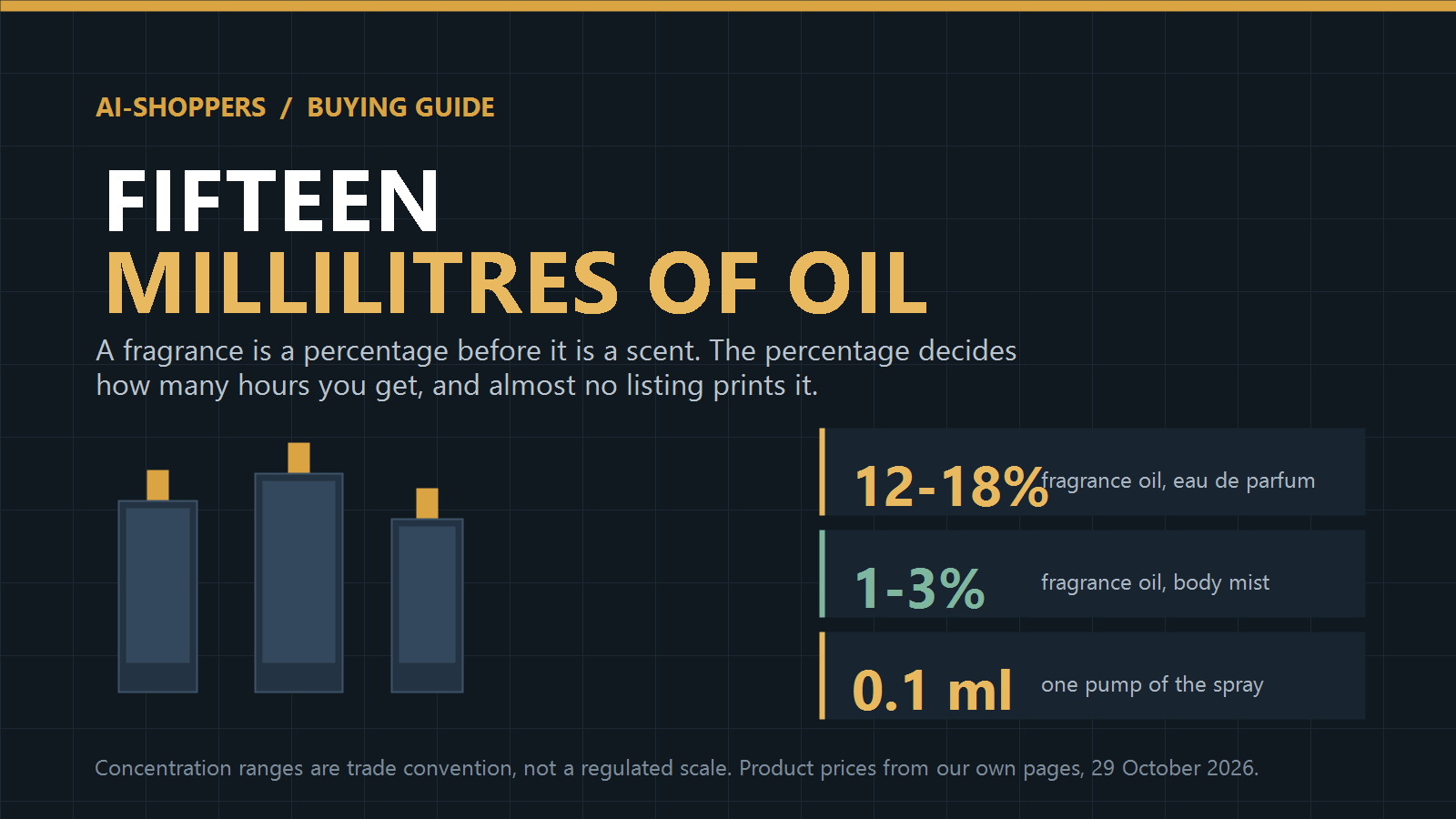
Two bottles can share a name, a photograph and a price and still hold ten times as much scent as each other. Fragrance is sold with mood words — fresh, cedar, luminous — and bought, in effect, by a percentage that almost no listing prints. That percentage decides whether you get forty minutes or eight hours, and it is the only number on the shelf you can check before spending money.
1. The front of the bottle is a mood, not a measurement
Walk along any fragrance shelf and the words you meet are cedar, orchid, ocean, jasmine. Not one of them is a quantity. The one quantity that governs how a fragrance behaves — the share of the bottle that is fragrance oil rather than alcohol and water — is usually absent, even on bottles costing more than a week of groceries.
This is not an accident of lazy copywriting. In the United States, ingredient labelling for cosmetics is governed by 21 CFR 701.3, and that rule permits a compound fragrance to be declared with the single word “fragrance”. A manufacturer can legally hide a list of forty materials behind one noun. In the European Union the rules are tighter: Regulation (EU) 2023/1545 expanded the list of fragrance allergens that must be declared, with a threshold of 0.001 percent in leave-on products. But even there, the concentration of the fragrance compound as a whole is not a required disclosure.
So the buyer is left with a class name — eau de toilette, eau de parfum, body mist — which is trade convention rather than law, and with the price. Both are readable. Neither is precise. What follows is how to get from those two things to an honest expectation of hours.
2. The ladder: five classes and the oil load behind them
The classes are not regulated bands, but the ranges below are the ones fragrance houses and formulators describe consistently, and they are close enough to plan around.
| Class on the label | Fragrance oil | Typical hours on skin | Where you meet it |
|---|---|---|---|
| Body mist, body fragrance, body spray | 1–3% | 0.5–2 h | Large bottles, low price per millilitre, often 200 ml and up |
| Eau de cologne | 2–5% | 1–2 h | Splashes, “refreshing” lines, classic citrus |
| Eau de toilette | 5–12% | 3–4 h | The default everyday bottle in most of Europe |
| Eau de parfum | 12–18% | 5–8 h | Most of what sells between $60 and $150 |
| Extrait, parfum | 20–30% | 8–24 h | Small bottles, very high price per millilitre |
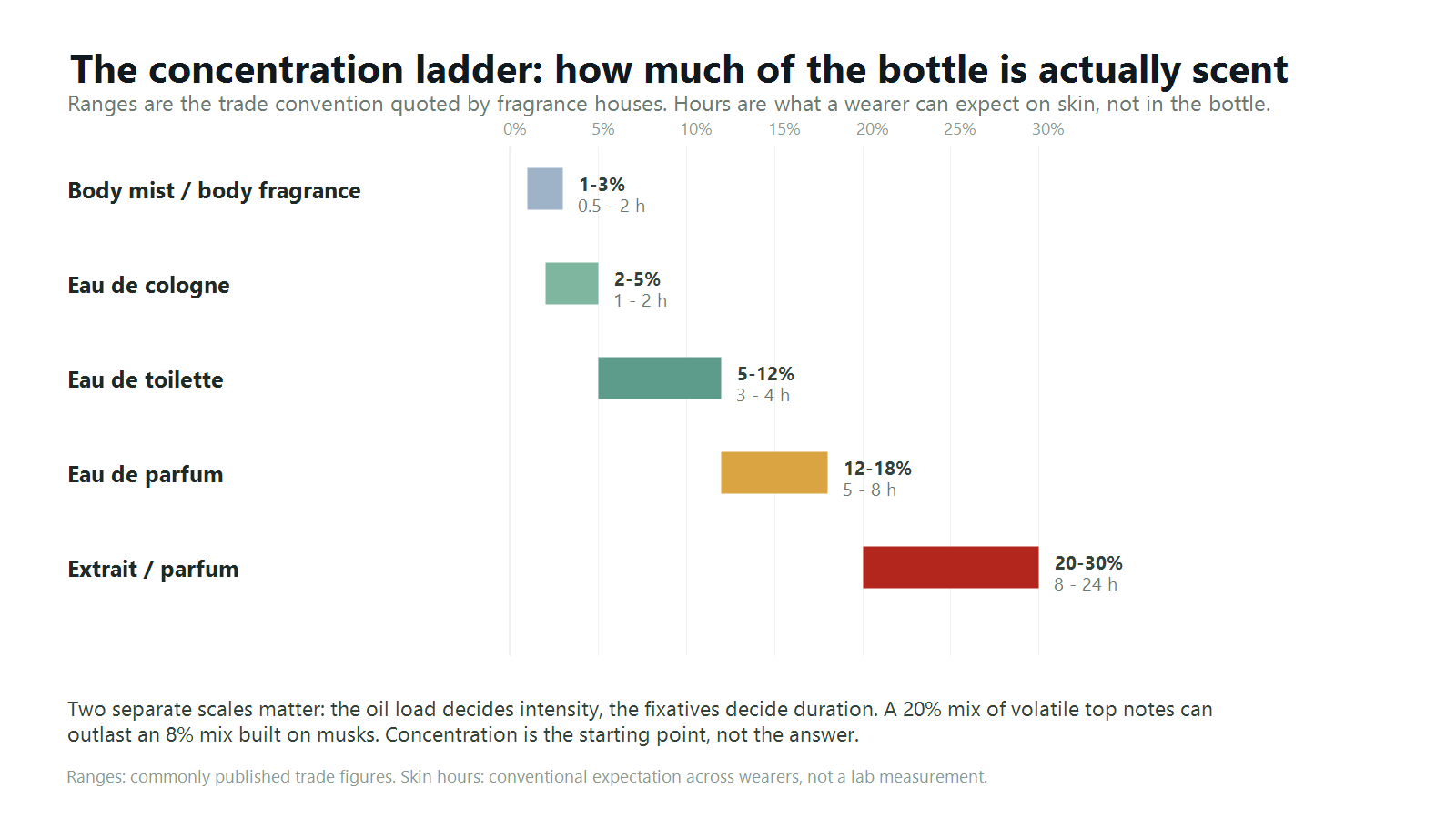
Note the overlap at the boundaries. A 12 percent mix can be sold as either an eau de toilette or an eau de parfum depending on the market and the marketing. That is why the class is a starting point for the arithmetic and not a substitute for it.
3. What the percentage does not predict
If concentration were the whole story, an extrait would always outlast a body mist, and buying would be simple. It is not, for three reasons.
Fixatives matter as much as load. A formula built on musks and woods holds to skin for hours because those materials evaporate slowly; a formula built on citrus terpenes is gone in twenty minutes no matter how much of it you put in. Twenty percent of volatile top notes can disappear faster than eight percent anchored by musks.
Skin decides the runway. Dry skin releases fragrance faster than moisturised skin, warm skin faster than cool, and the same bottle will behave differently on two people in the same room. This is the honest core of the “skin chemistry” claim that gets stretched into mysticism: oiliness, temperature and pH change evaporation rate, not destiny.
Nose adaptation is not fading. After about fifteen minutes you stop registering a scent you are wearing, while people a metre away still can. Half of what shoppers call “it doesn’t last” is the wearer going nose-blind, which is why the useful test is a second opinion at hour three, not a wrist sniff at hour one.
A paper strip in a shop shows you the opening, which is the least representative part of any fragrance. Spray once on skin, leave, and judge it after thirty minutes, then again after three hours. If a shop will not let you do that, you are buying the first thirty minutes and guessing at the rest.
4. How many pumps are actually in the bottle
A standard crimp pump delivers roughly 0.08 to 0.12 millilitres per actuation; 0.1 ml is a fair planning figure. That single number unlocks the rest of the arithmetic.
A 100 ml bottle therefore holds about 1,000 pumps. Three pumps — one per wrist, one at the neck — is 0.3 ml of juice per wearing, so the bottle is worth roughly 333 wearings. At 15 percent oil, each of those wearings carries 0.045 ml of fragrance oil, and the whole bottle carries 15 ml of it. The two calculations agree, which is a useful check that the numbers are being used correctly.
Now attach time instead of money. A six-hour average across 333 wearings is about 2,000 hours of scent from one 100 ml bottle, or 83 days if it never stopped. A 50 ml bottle halves all of it: 500 pumps, 167 wearings, 1,000 hours. Same product, same name, half the runway — and if the listing does not state the volume, the buyer cannot tell which one they are looking at.
This is the practical cost of the missing volume. Price per millilitre is the only fair comparison between two bottles, and it is a division you cannot perform without a denominator. When a listing gives you only a price, the honest conclusion is not “this is expensive” but “this is unpriced”.
5. Eight hours, three clocks
A fragrance is not one smell fading. It is at least three groups of materials leaving at different rates, which is why the same bottle smells different at minute two and hour five. The trade calls them top, heart and base notes; the physics calls them molecules of different size and vapour pressure.
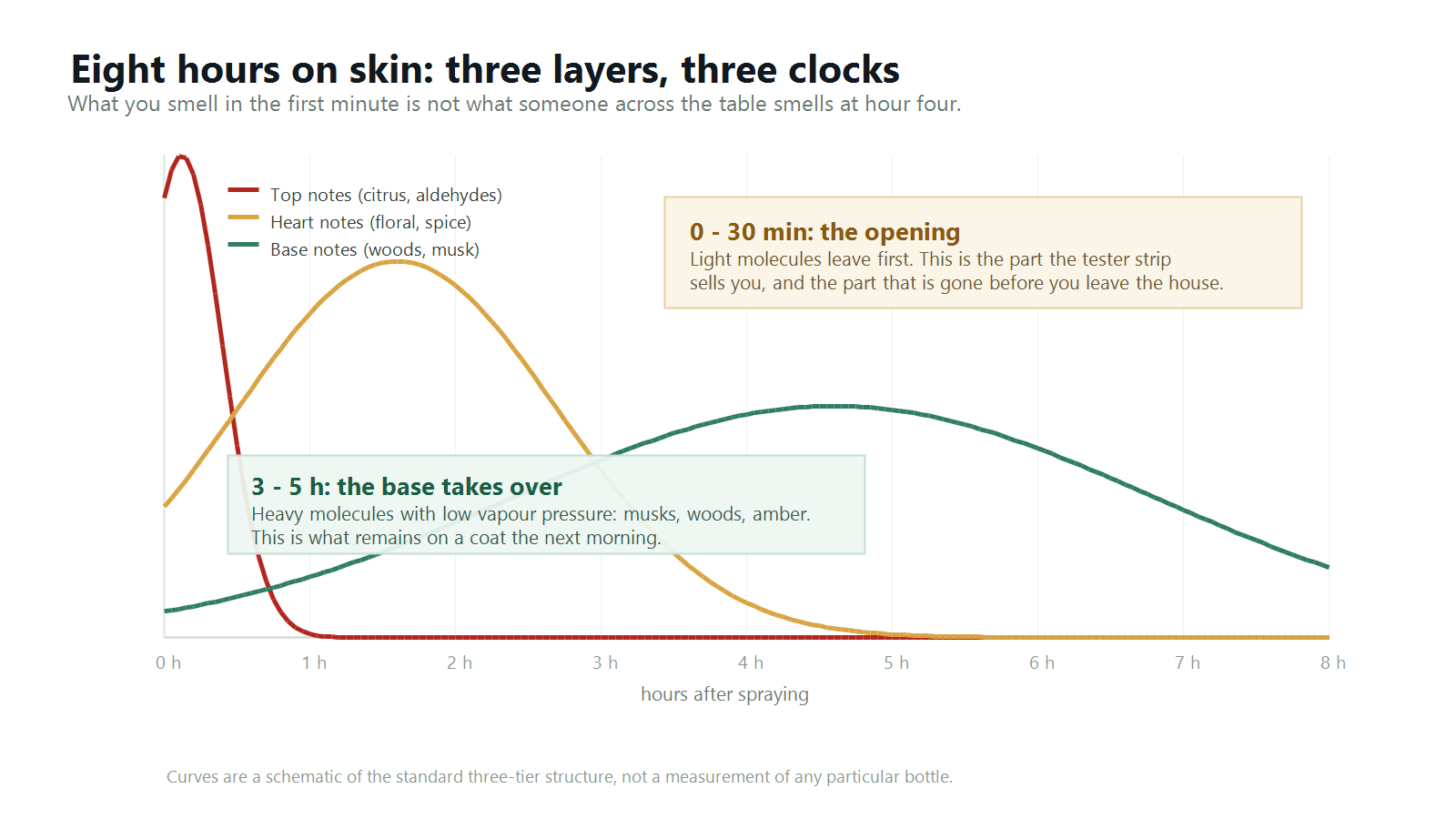
The practical reading of that timeline: judge a fragrance at hour three, because that is the version of it other people will spend the day with. If you dislike the three-hour stage, the beautiful first minute is irrelevant.
6. Why the citrus always leaves first
Limonene, the main component of citrus peel oil, has a molecular mass of about 136 grams per mole. Galaxolide, a workhorse musk, is about 258. Ambroxan sits near 236. Small molecules at skin temperature have far higher vapour pressure, which in plain terms means more of them leave the surface per second. Limonene’s vapour pressure is on the order of a couple of hectopascals at room temperature; a heavy musk is many orders of magnitude lower.
That gap, not the brand, is why a fresh fragrance is a short performance and a woody one is a long one. It also explains a piece of shopping advice that sounds like snobbery and is actually physics: if you want a scent that survives a working day, buy the dry-down you like, because the opening is a five-minute advertisement for a product you will wear for eight hours.
7. The bottle on the shelf has its own clock
Concentration decides what happens in the first eight hours. Storage decides what happens over the first three years.
Three things degrade a fragrance: heat, ultraviolet light and oxygen. Heat accelerates the reactions that turn a bright top note into something flat, and the rough rule of thumb from reaction kinetics — rate roughly doubles for every 10 °C — is enough to see why a car cabin at 60 °C in summer is a bad place for a bottle. Light does its own damage, which is why so much fragrance ships in opaque or amber glass and why a clear decorative bottle on a sunny windowsill is the worst of both.
Oxygen is the quiet one. Every time the bottle is opened, the air above the liquid is exchanged, and the headspace is where oxidation happens. A bottle kept half full for a year has far more exposure than one that is used up in months. Conventional guidance puts unopened shelf life at three to five years and opened life at one to three, which is long enough that most shoppers never notice the difference — and short enough that a bottle bought on clearance two summers ago may already be past its best.
- Keep it below about 21 °C, away from radiators, bathrooms and car gloveboxes
- Keep it dark: the box it came in is not packaging, it is the point
- Keep the cap on and the bottle upright; a loose cap is an open window
- Do not decant into a roller bottle for daily use — every transfer is a fresh dose of oxygen
- Skip the fridge: condensation introduces water, and water clouds an alcohol-based formula
8. What to check before you buy
Four questions, in order, resolve most of the uncertainty a listing creates.
Is the volume stated? If not, price is not comparable with anything. This is the single most common gap in cosmetic listings and the one that costs the most.
Is the class stated, or only a mood? “Body fragrance” usually means body mist, which usually means 1 to 3 percent oil and under two hours. That is a legitimate product — it is simply a different one from what most buyers picture when they read “perfume”.
What does the price per millilitre say? Divide the price by the millilitres. Under a dollar per millilitre is ordinary for an eau de parfum; a body mist at the same figure is being sold on presentation rather than content.
What is the return position on an opened bottle? Fragrance is a hygiene-adjacent product and many sellers exclude opened units. Knowing that before the parcel arrives is worth more than any note pyramid.
Gear referenced in this guide
None of these are needed to use the method above. They are the four fragrances in our catalogue that this article’s arithmetic was written against, listed so the labels can be read in the same order: mood word first, then price.
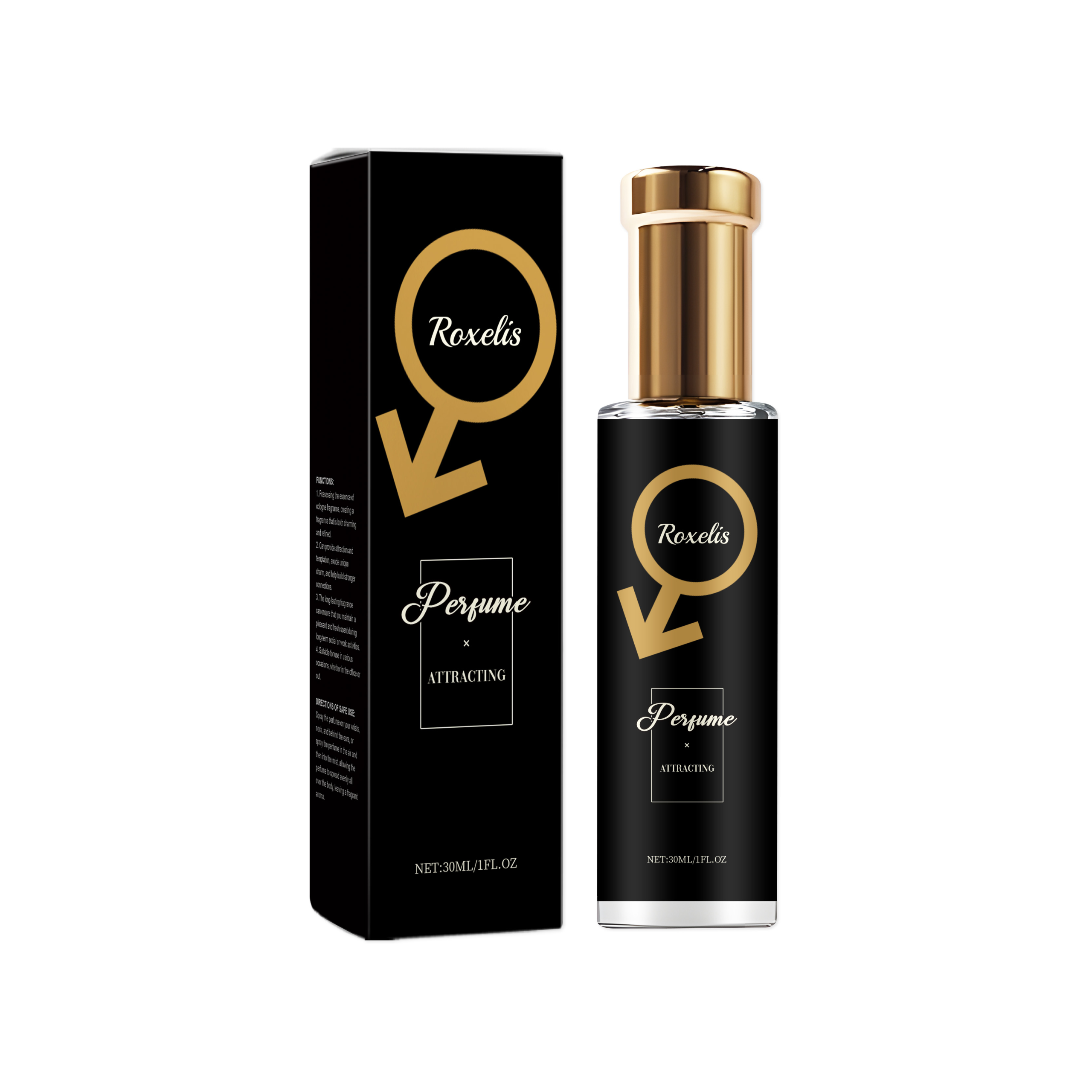 Roxelis Cedar Men’s Perfume$79.99View details
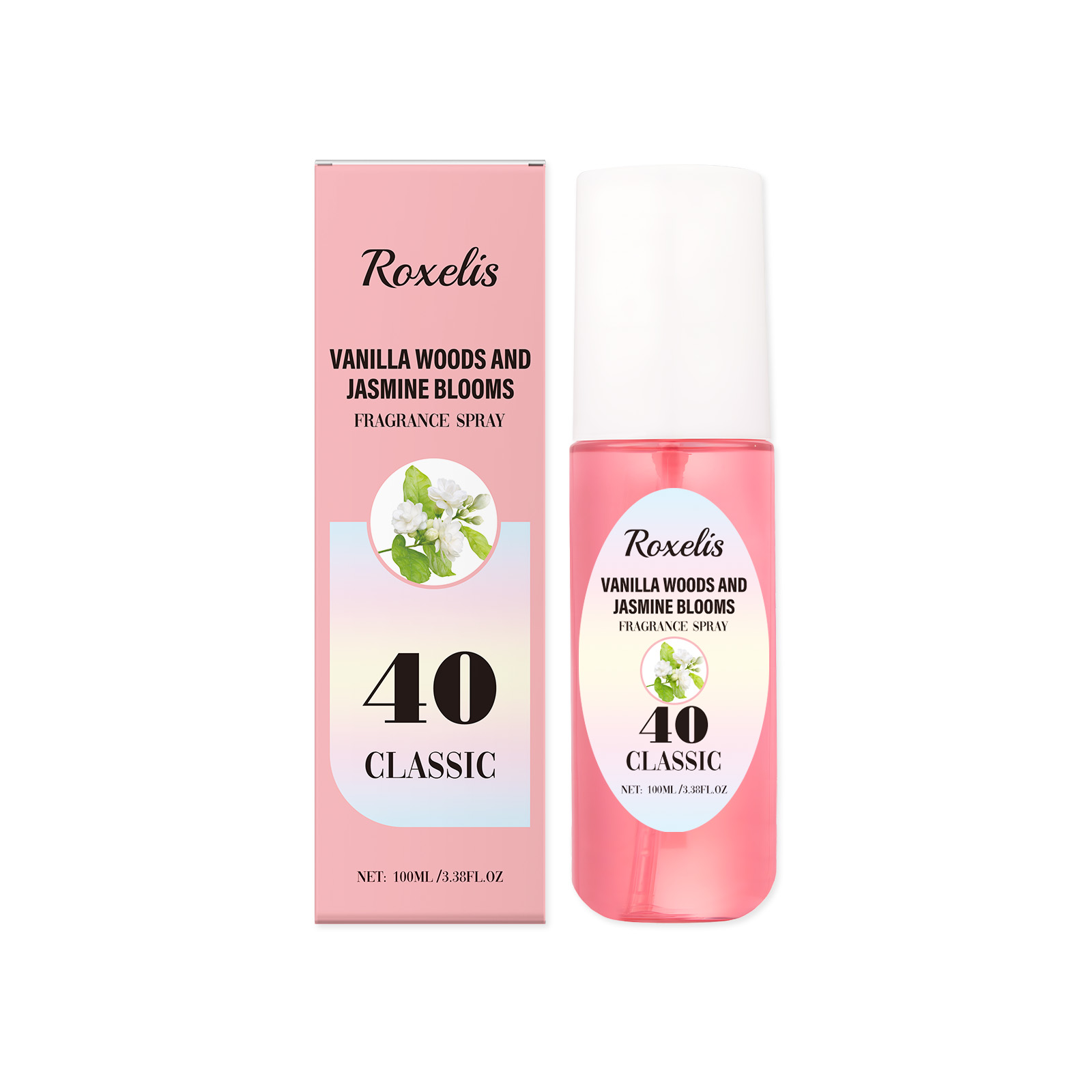 Roxelis Light Jasmine Body Fragrance$79.99View details
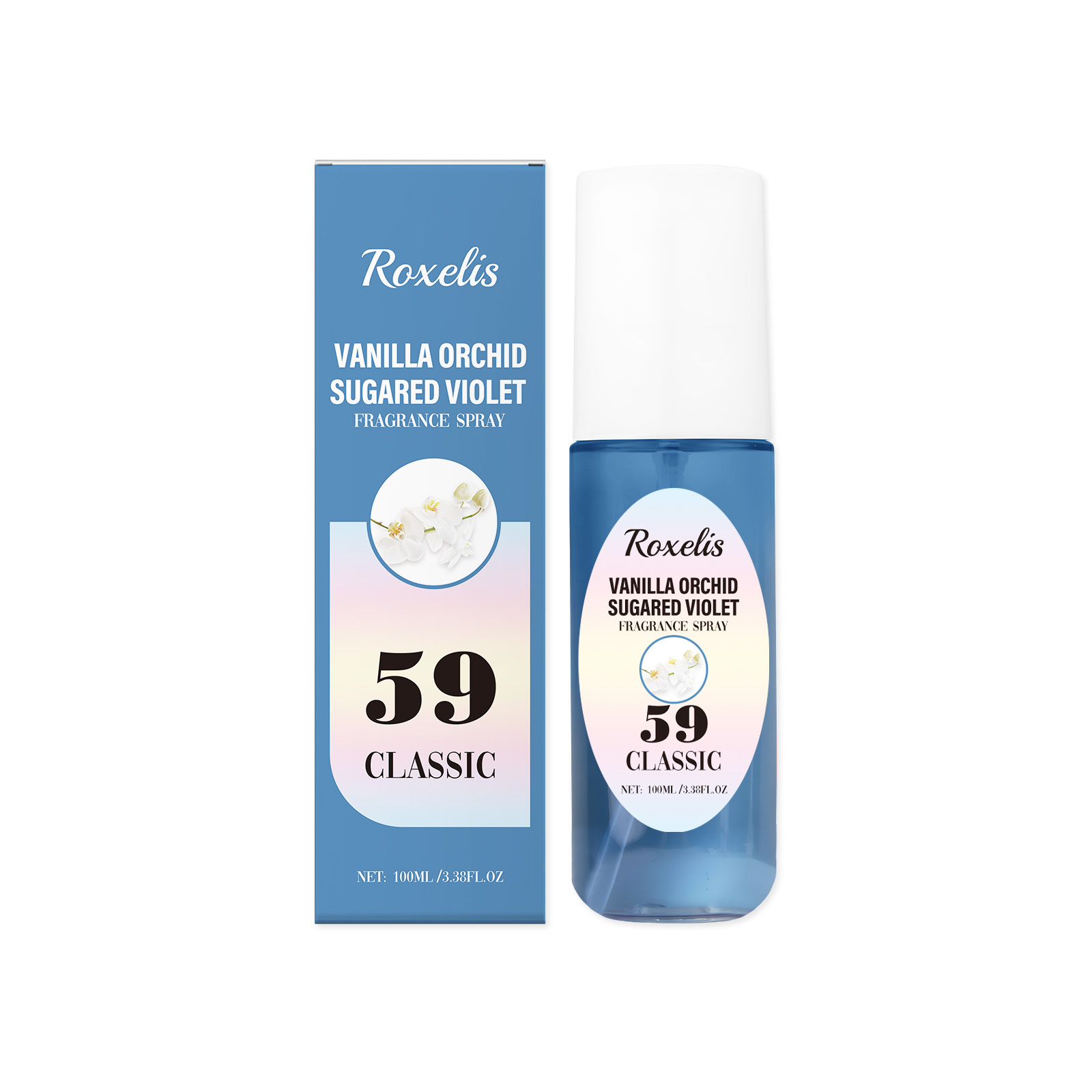 Roxelis Light Fragrant Orchid Body Fragrance$79.99View details
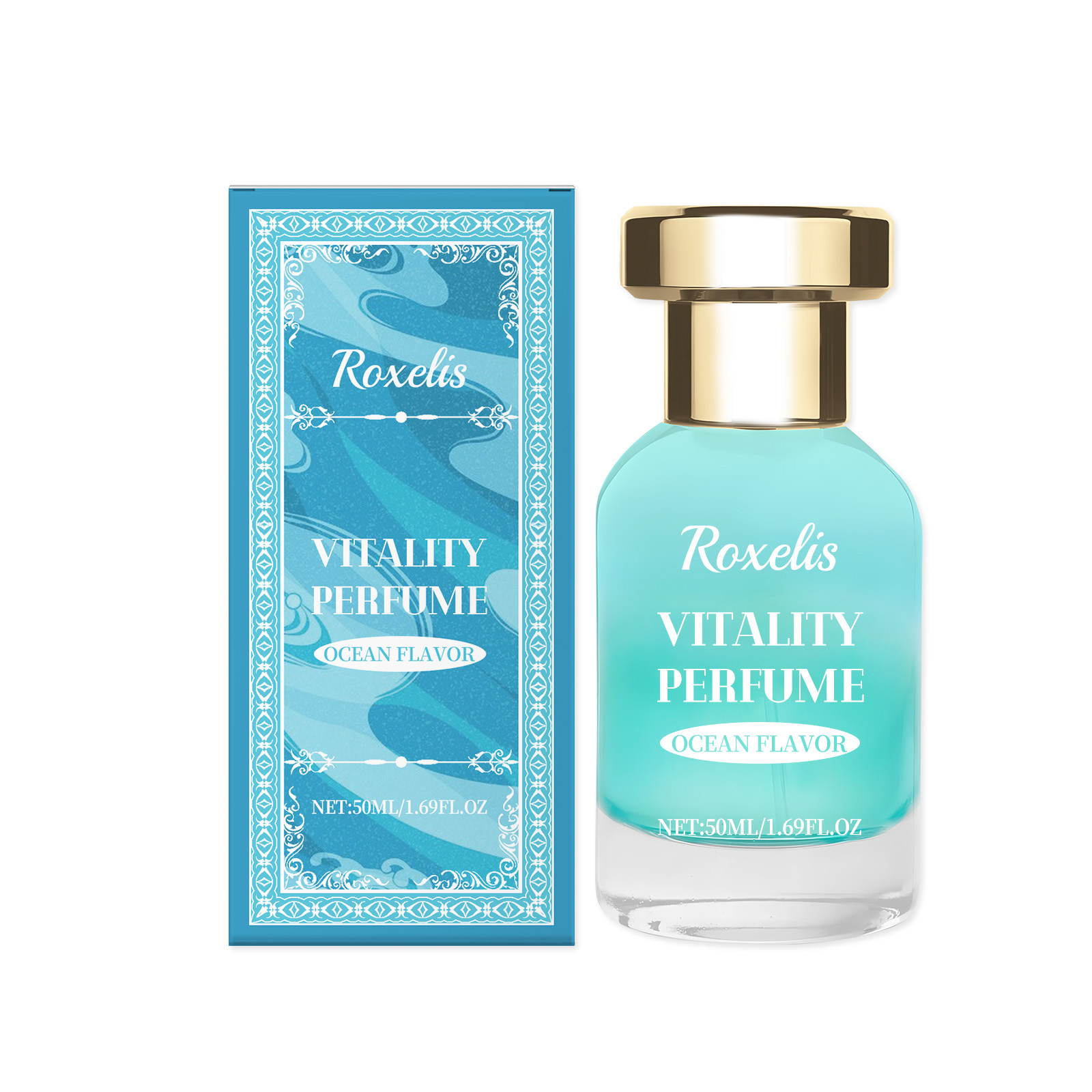 Roxelis Ocean Vitality Fragrance$79.99View details
Three of the four are labelled “body fragrance” rather than eau de parfum, which by the ladder above means a lighter oil load and a shorter wear. That is worth knowing before the price is judged, because the same $79.99 buys a different number of hours depending on which class the bottle actually is.
Frequently asked questions
Does a higher oil percentage always mean it lasts longer?
No. It means there is more material to evaporate, which raises the ceiling, but duration is set by which materials they are. A 20 percent formula built on citrus can be gone in under an hour, while an 8 percent formula anchored by musks can still be detectable the next morning. Concentration is the starting point, not the answer.
Is “body fragrance” a real category or just marketing?
It is a marketing term with a fairly consistent practice behind it: body mists and body fragrances are typically 1 to 3 percent fragrance oil, which is a fifth to a tenth of an eau de parfum. They are pleasant and cheap per millilitre, they last under about two hours, and they are not the same product as a perfume with a similar name.
How do I make a light fragrance last longer?
Apply to moisturised skin — an unscented lotion slows evaporation — spray two or three times rather than once, and let it dry without rubbing, since friction and heat push the top notes off faster. Layering a matching lotion helps more than any application trick, because it gives the fragrance something to hold on to.
Should I keep perfume in the fridge?
Usually not. The temperature is fine; the moisture is not. Moving a bottle in and out of a fridge produces condensation on the glass and around the neck, and water in an alcohol-based formula clouds it. A dark cupboard below about 21 °C does the same job with none of the risk.
How do I compare two bottles when the listing gives no volume?
You cannot, and that is the finding rather than a gap in the method. Ask the seller for the millilitres, or treat the price as unpriced information. If volume is stated but the class is not, assume eau de toilette strength for anything described simply as “perfume” and expect three to four hours.
Prices in this article are from our own product pages, checked 29 October 2026, and all four fragrances listed are $79.99. Concentration ranges, pump volumes, skin hours and shelf lives are trade conventions and planning figures, not laboratory measurements of any particular bottle; the arithmetic is written out so you can substitute your own numbers. Regulatory references are to 21 CFR 701.3 (US cosmetic ingredient labelling) and Regulation (EU) 2023/1545 (fragrance allergen declaration).
Compare on Amazon — this category usually has more brands, sizes and price points there.
Check current prices on Amazon →
As an Amazon Associate we earn from qualifying purchases. The price you pay is unchanged. Disclosure
[…] reading: how much oil is really in a body mist, in fifteen millilitres of oil; the dose arithmetic behind a 30 g sunscreen tube, in one point two grams; why price per use beats […]