A can of party hair colour, a twist-up glitter stick and a sheet of freckle stickers look like the same purchase: something that makes you look different for one night and then comes off. They are not the same purchase. Each one deposits a different kind of layer, of a different thickness, held by a different force, and the thickness is what decides whether it survives the pillow, the coat collar and the first shampoo. The numbers below are small enough to be worth writing down in micrometres.
The three products are three different mechanisms
The spray is an aerosol. A volatile silicone carries metal flakes and leaves them on the hair when the carrier evaporates. The glitter stick is a gel: glycerin thickened with carbomer, with mica platelets suspended in it, twisted up and wiped on. The freckle sheet is an adhesive transfer: pigment dots on a carrier film, pressed onto skin and peeled away, leaving the dots behind.
That difference matters more than the colour. An aerosol deposits a dry film measured in single micrometres. A gel deposits a wet film measured in tens or hundreds of micrometres, which then dries but never becomes as thin as a spray. A transfer sticker deposits an adhesive layer plus pigment, and its bond is chemical rather than mechanical.
So the useful question is not “which one looks best in the photo”. It is: how thick is what is left, and what holds it there?
One head is about five square metres of hair
Nobody sells hair colour by area, which is odd, because area is what a coating has to cover. It can be estimated from three figures that are stable enough to use: the number of terminal hairs on a scalp, the diameter of a hair, and its length.
A typical scalp carries 100,000 to 150,000 terminal hairs; use 120,000 for a mid-range head of medium-brown hair. A medium hair is about 0.07 mm across. Assume 200 mm of average length for shoulder-length hair. Treating each hair as a cylinder, the lateral surface is the circumference times the length: 3.14 × 0.07 mm × 200 mm = 44 mm² per hair. Multiply by 120,000 and you get 5.28 million mm², or 5.28 m².
That is roughly the floor area of a small bathroom. It is also the surface a 30 ml can is supposed to colour, which puts the whole category in perspective before a single gram is sprayed.
Ten micrometres is the whole budget
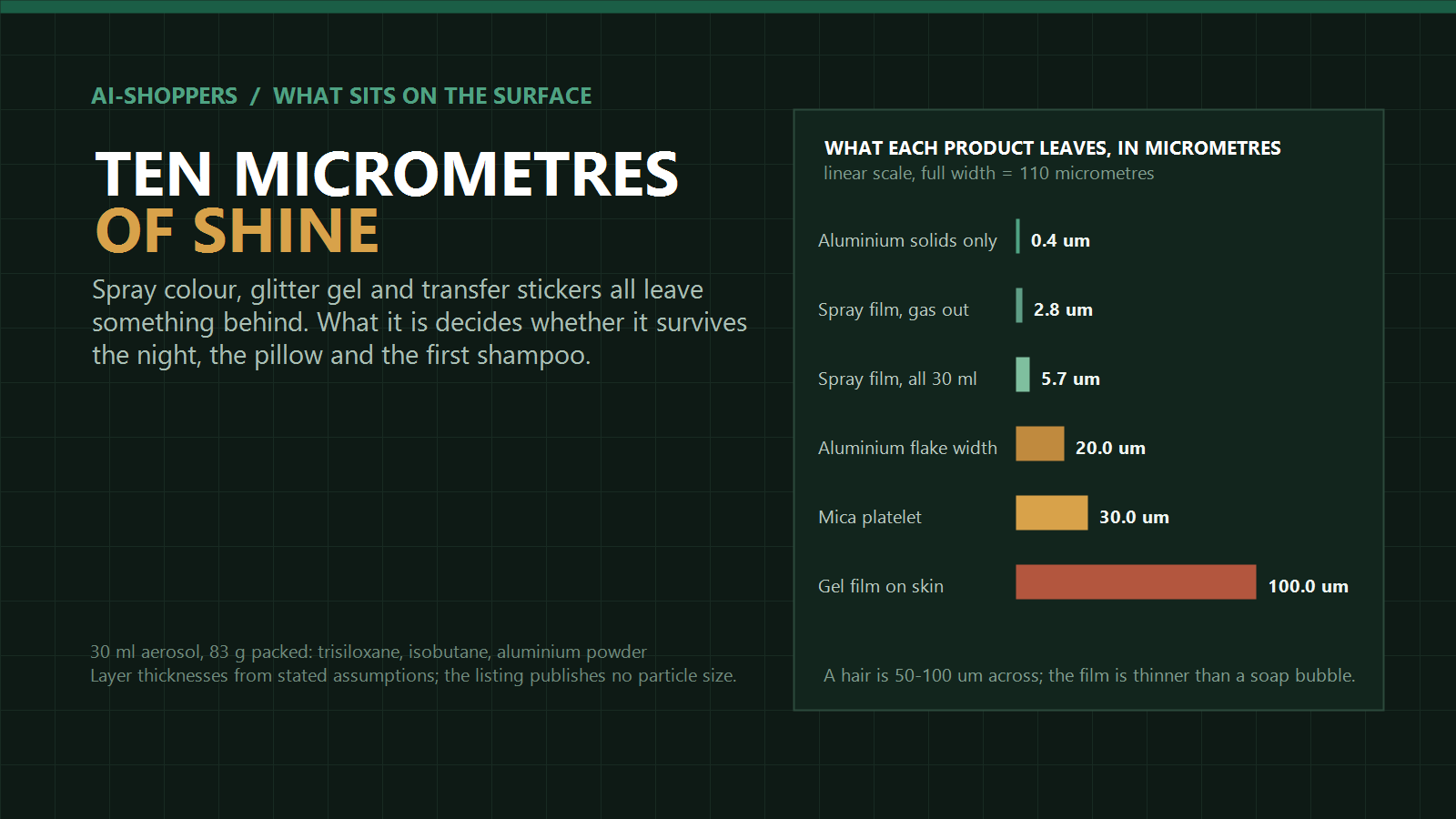
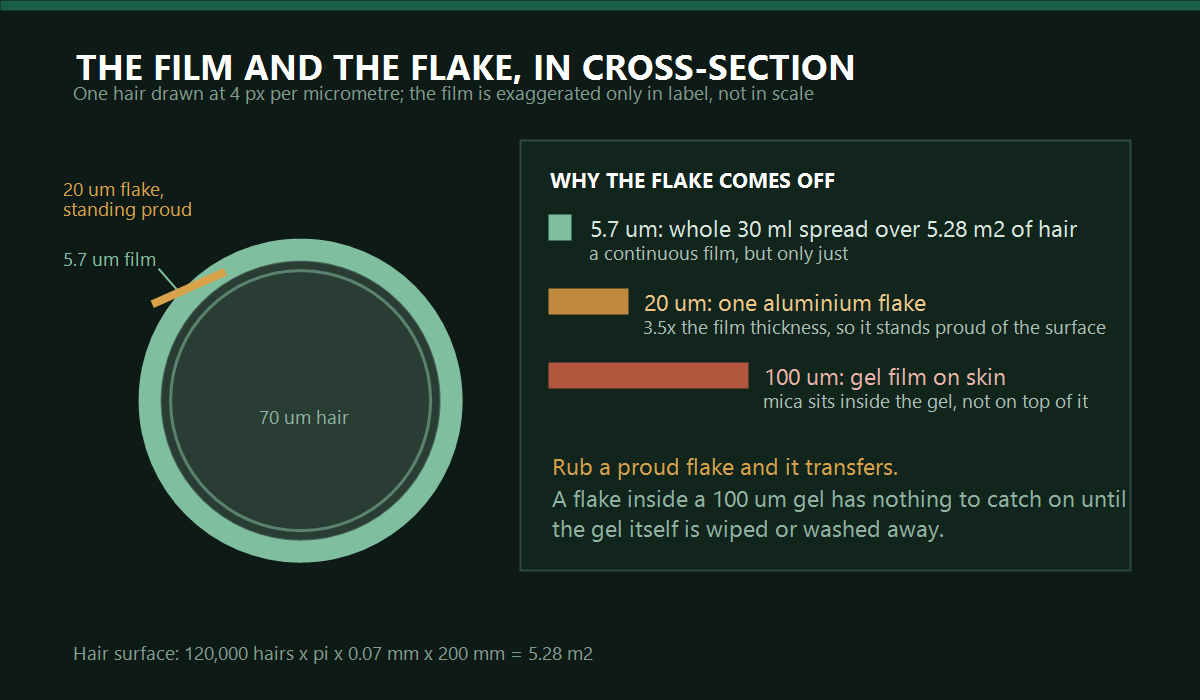
Divide the fill by the area and you get the average film thickness, assuming every millilitre lands and none is lost to overspray or the air. Thirty millilitres is 30,000 mm³. Spread over 5,280,000 mm², that is 0.0057 mm, or 5.7 micrometres.
Two corrections push it down. First, part of the can is propellant, which leaves as gas and deposits nothing; if half the fill is isobutane, the film is 2.8 micrometres. Second, overspray is real: spraying at 20 cm, a good share of the cloud misses the head entirely. So 5.7 micrometres is a ceiling, not an expectation.
For scale, a human hair is 50 to 100 micrometres across, so the entire colour layer is between one-twentieth and one-tenth of a hair’s width. Ink on a printed page is 1 to 2 micrometres. A coat of paint on a wall is 25 to 50. Party hair colour lives in the same thickness range as printing ink.
What that means in use. A film this thin cannot hide the hair underneath it; it tints it. On dark hair, a silver or blue metal film reads as a sheen in the right light and as nothing at all in the wrong one. If the plan is full coverage, this is the wrong product category, not a weak version of the right one.
Why the metal leaves before the colour does
The listing is unusually specific about what is in the can: trisiloxane, isobutane, aluminium powder. Aluminium powder in cosmetics is a flake, typically 10 to 50 micrometres across and around a micrometre thick. Take 20 micrometres as a working figure.
A 20 micrometre flake sitting on a 2.8 micrometre film is seven times thicker than the layer holding it. It does not sit inside the coating; it sits on top of it, like a coin on a tablecloth. Anything that brushes the surface catches the flake directly. That is the mechanism behind the two complaints that show up in every review section for this category: colour on the pillowcase, and colour on the collar of whatever you wore over it.
The gel behaves differently for the same geometric reason. A gel film on skin is on the order of 100 micrometres thick, so a 30 micrometre mica platelet is buried inside the matrix, not proud of it. It has nothing to catch on until the gel itself is wiped, sweated off or washed away. The trade is real: the gel transfers less, but it is also visible as a raised, slightly tacky layer, and it moves when you sweat.
| Product | What is deposited | Layer, micrometres | Particle versus layer | What removes it |
|---|---|---|---|---|
| Spray colour, 30 ml | Silicone film plus aluminium flakes | 2.8–5.7 | Flake 20 µm, 3.5–7× the film | Oil cleanser, then two shampoos |
| Glitter stick, 64 g | Glycerin and carbomer gel with mica | about 100 | Platelet 30 µm, buried in the gel | Warm water and mild soap |
| Freckle stickers | Adhesive dots transferred to skin | adhesive layer, tens of µm | Pigment held by adhesive, not by film | Oil-based cleanser, then peel |
How much metal is actually in the can
The listing does not publish a percentage, so treat the next figure as an estimate built on a stated assumption. If aluminium is 5 per cent of the fill by weight, a 30 g fill contains 1.5 g of aluminium. At a density of 2.7 g/cm³, that is 0.56 cm³ of metal.
Divide that by the volume of one 20 × 20 × 1 micrometre flake and you get about 1.4 billion flakes. Lay them side by side, each covering 400 square micrometres, and the total is 0.56 m² — about 10.6 per cent of the 5.28 m² of hair surface.
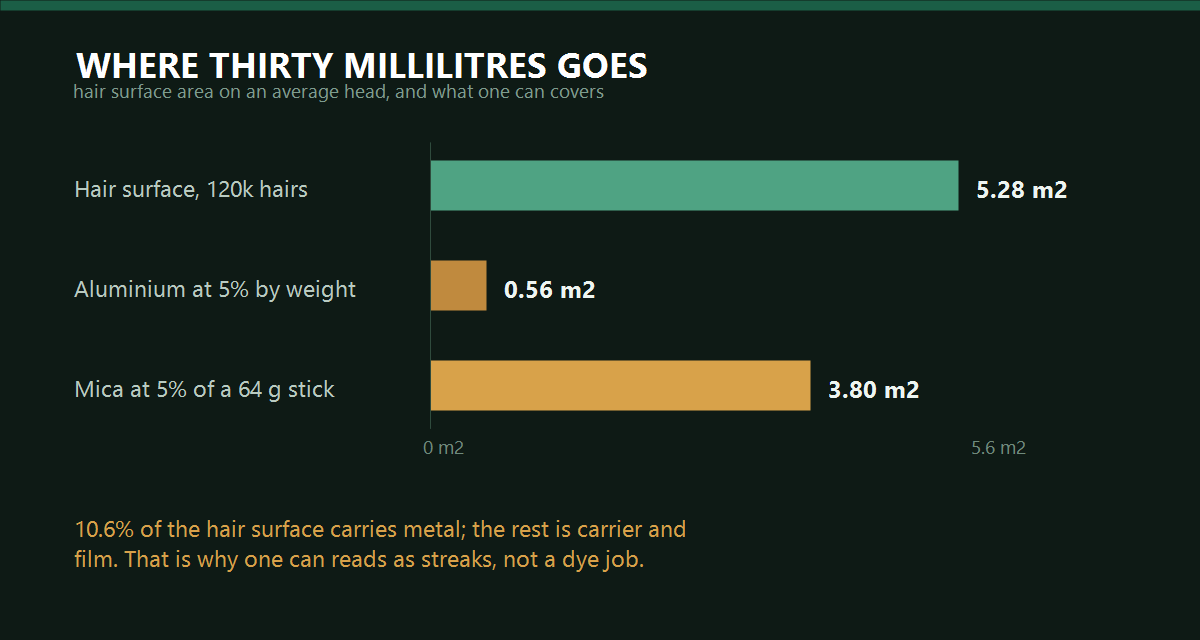
Run the same arithmetic on the gel stick. Five per cent of a 64 g stick is 3.2 g of mica. A 30 × 30 × 0.3 micrometre platelet weighs about 0.76 nanograms, so 3.2 g is roughly 4.2 billion platelets, covering 3.8 m² at one layer. The same money buys about seven times more pigment area in the gel, which is exactly why the two products feel different in the hand: one is a mist that disappears, the other is a paste you can see building up.
The propellant decides how it lands
Isobutane is the reason the can works and the reason it behaves badly in the cold. Its boiling point is −11.7 °C, and its vapour pressure is roughly 3 bar at 20 °C, falling to about 1.7 bar at 0 °C and rising past 5 bar at 40 °C.
Pressure is what atomises the liquid. At 3 bar the nozzle produces a fine mist; at 1.7 bar it produces spatter and larger droplets, which land wet, run, and deposit unevenly. A can left in a cold car or a garage in November does not fail, it just stops being an aerosol. Warm it in your hands or a pocket for ten minutes rather than near a radiator, and never above 50 °C.
The same number explains the safety line that matters most. Isobutane has a flash point near −83 °C and a lower explosive limit around 1.8 per cent in air. A candle, a gas hob, a cigarette or a hot straightener next to a spraying can is not a small risk. Spray in a ventilated room, away from ignition sources, and let the film dry before going near heat.
What a night actually costs
Cost per use is where these three products separate completely, because the spray has almost no repeat uses and the gel has hundreds.
| Spray colour | Glitter stick | Freckle stickers | |
|---|---|---|---|
| Price | $78.99 | $79.99 | $79.99 |
| Fill | 30 ml, 83 g packed | 64 g packed | 47 g packed |
| Uses per unit | 1–2 nights | roughly 300 at 0.2 g per use | one sheet, one night |
| Cost per night | $39–$79 | about $0.25 | $79.99 |
| Layer left behind | 2.8–5.7 µm film, metal on top | 100 µm gel with mica | adhesive dots |
Both prices are what the listings show on 2 November 2026. The point of the table is not that one product is better; it is that they are not substitutable. If the goal is a whole head of colour for one night, the spray is the only one of the three that attempts it, and it does so at the highest cost per night in the catalogue. If the goal is shine on a cheekbone, a shoulder or a collarbone, the stick does the same job at a fraction of the price and does not touch the hair at all.
Before you buy the spray: decide whether you are colouring a head or a streak. One can gives a tint over the whole head at 2.8 to 5.7 micrometres, or a denser pass over a section. Two cans is the honest quantity for full-head coverage on long hair, which doubles the cost per night.
Removal, in the right order
The film is silicone-based and the flakes are metal, so water alone is the wrong first move. Water beads on a silicone film; it does not dissolve it. Work in this order and the removal is two steps instead of five.
Oil first. A cleansing oil, or olive oil in a pinch, dissolves the trisiloxane film and lifts the aluminium with it. Massage it through dry hair for a minute, then add a little water to emulsify and rinse. Then shampoo twice. The first wash removes the oil and the loosened metal; the second removes what the first diluted and redistributed. Condition afterwards, because two washes on a silicone film will leave hair feeling stripped even though nothing harsh was used.
Do not reach for bleach, a colour remover or a clarifying treatment on the same night. None of them act on a metal-and-silicone film, and all of them change the hair itself, which is the one thing the product promised not to do. Do not use hot tools on hair that still has film on it either: the flakes conduct heat, and the silicone softens and migrates.
For the gel, the order is reversed: warm water and a mild soap remove carbomer gels, and oil makes the job worse by spreading the mica. For the stickers, oil is right again, because the adhesive is the thing to break down; peel slowly and at a low angle rather than pulling straight out.
What it will not do
It will not lighten. There is no peroxide and no ammonia in a spray that lists three ingredients, and without an oxidiser melanin does not change. Silver on dark hair is a metal film, not a lifted pigment, and it will read grey-blue rather than blonde.
It will not cover grey evenly. Grey hairs are coarser and often more porous, so they take a thicker film and read brighter than the pigmented hairs beside them. The result is a speckled effect that looks deliberate on a festival crowd and uneven in a photograph at a family dinner.
It will not survive a humid night. A 2.8 micrometre film has almost no reservoir, and sweat plus friction removes it from the areas that touch: temples, nape, the hairline under a hat.
It will not stay off your clothes. Plan the outfit around it. A dark collar and a pillowcase you do not mind washing are part of the purchase, not an accident.
It is not for children unsupervised, or for anyone with a scalp condition. Aluminium powder is a fine particulate; spray it in a ventilated room and keep it out of eyes. A 48-hour patch test behind the ear costs two days and settles the question for both the spray and the adhesive stickers.
Frequently asked questions
How long does spray-on party hair colour last?
One night, sometimes two, depending on how much you use and how much you touch your hair. The layer is 2.8 to 5.7 micrometres of silicone and metal, so it is removed by the first proper wash rather than fading like a dye. Expect the hairline and the nape to go first, because that is where skin contact and friction are highest.
Does it damage hair?
There is no developer, no ammonia and no oxidative chemistry, so it does not change the hair’s structure the way a permanent colour does. The risk is mechanical and chemical at the margins: alcohol-like volatile silicones can leave hair feeling dry, and rubbing the flakes out causes friction. Oil, then two gentle shampoos, avoids most of it.
Can I use it on dark hair?
Yes, but expect a sheen rather than a colour change. The film is thinner than a hair’s width and does not hide the pigment underneath. Silver and white read strongest; blue and purple read as a cool cast in direct light. For coverage on dark hair, nothing in this category will do what a dye does.
Is the aluminium powder safe on skin?
Aluminium powder is a permitted cosmetic colourant in many markets, and the quantity here is small: about 1.5 g in a 30 g fill on our estimate. The practical precautions are the ordinary ones for a fine particulate and a flammable propellant: ventilate the room, keep the can away from flames and hot tools, avoid the eyes, and patch test if your skin reacts to metals.
How much does one can cover?
At a 2.8 to 5.7 micrometre film, all 30 ml spread evenly would cover 5.28 m² of hair surface, which is a whole mid-length head at a single thin pass. Overspray and the propellant mean that is the ceiling. For a dense, even result on long hair, two cans is realistic.
Gear referenced in this guide
Three items from our own listings, priced on 2 November 2026. The arithmetic above does not depend on buying any of them: any aerosol temporary colour with a metal pigment behaves the same way, and any carbomer gel with mica transfers the same way.
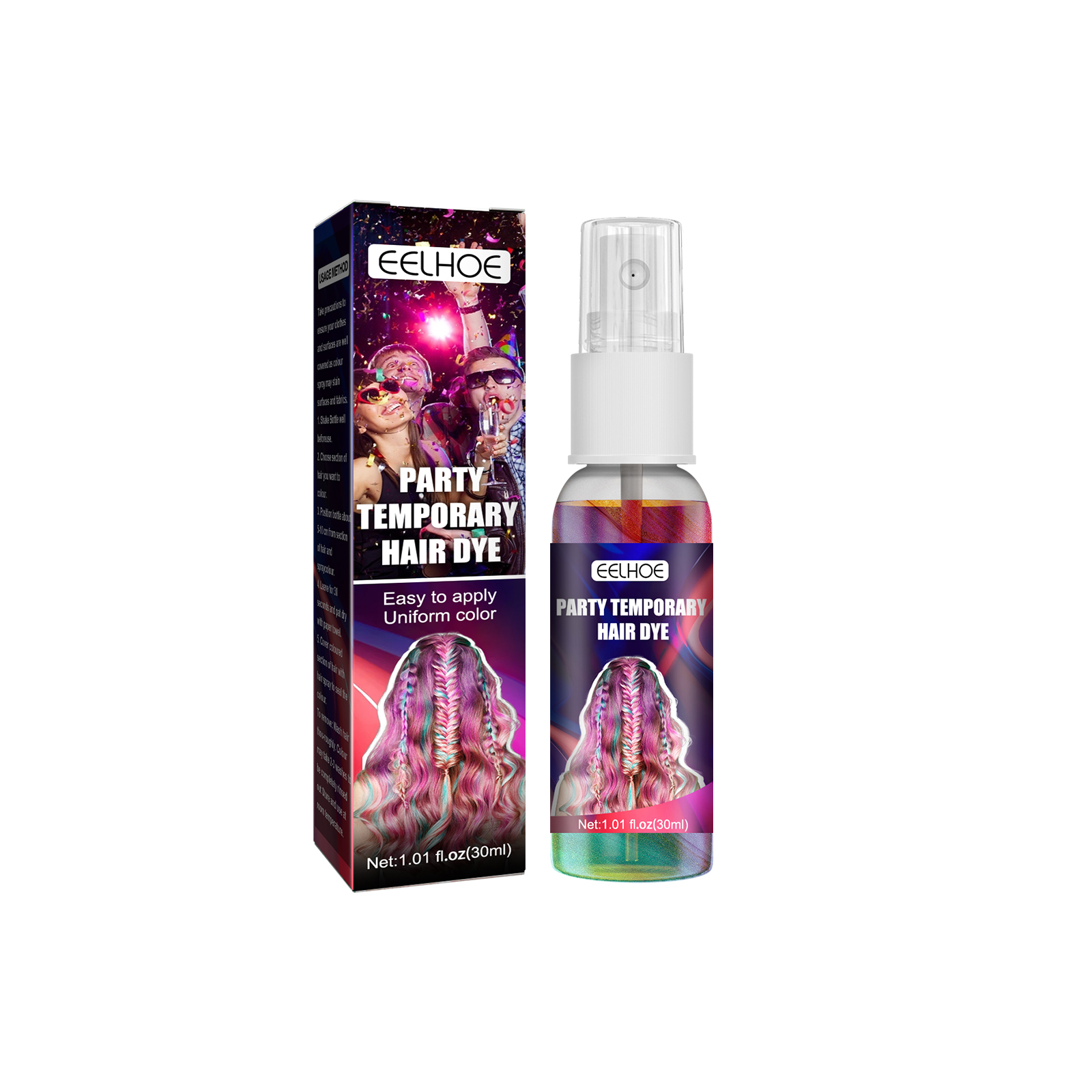 Party Temporary Hair Dye, 30 ml$78.99View details
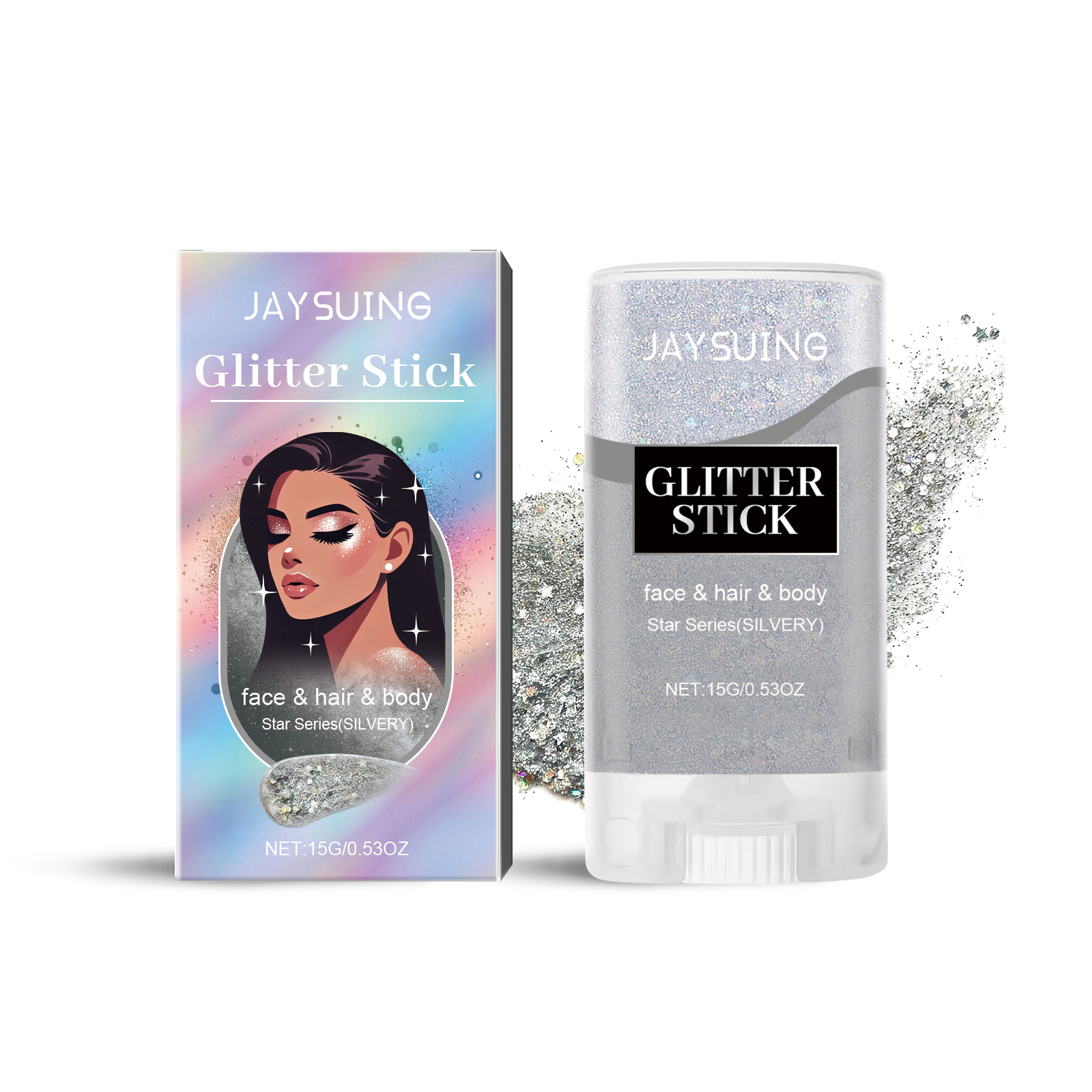 Jaysuing Sequined Glitter Stick, Silver$79.99View details
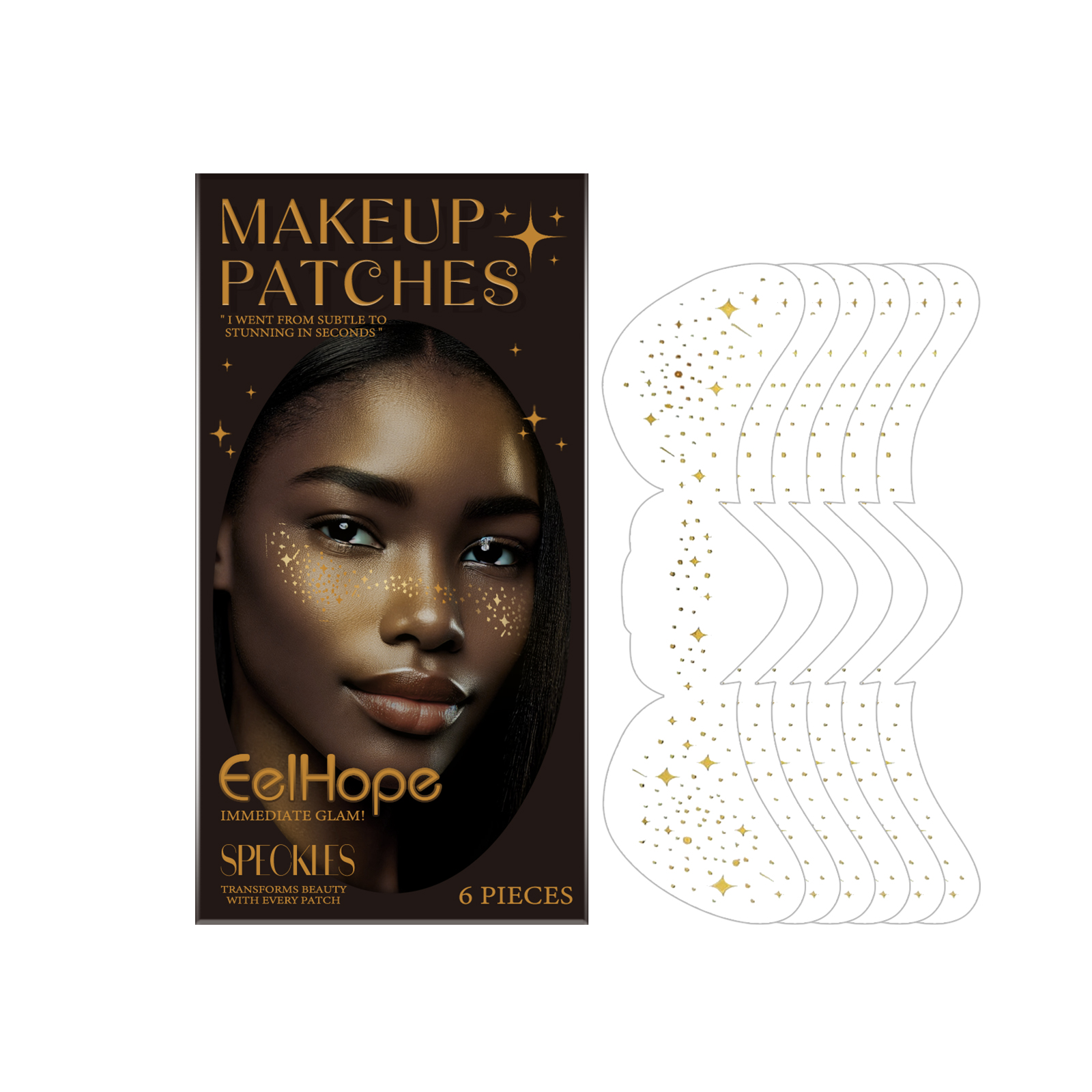 Eelhope Party Freckle Tattoo Stickers$79.99View details
Related reading: how much oil is really in a body mist, in fifteen millilitres of oil; the dose arithmetic behind a 30 g sunscreen tube, in one point two grams; why price per use beats price on the tag, in four cents a cut; more beauty listings in the Beauty category.
The $78.99 price, the 30 ml fill, the 83 g packed weight, the trisiloxane, isobutane and aluminium powder ingredients, the 64 g glitter stick with glycerin, carbomer and mica, and the 47 g sticker sheet are read from our own listings on 2 November 2026. Hair count, hair diameter and length are typical values, not measurements of any one head. The 5.28 m² area, the 5.7 µm and 2.8 µm films, the 0.56 m² aluminium coverage, the 3.8 m² mica coverage and the cost-per-night figures follow from the stated assumptions: 120,000 hairs at 0.07 mm by 200 mm, half the fill lost as propellant, and 5 per cent pigment by weight in both products. Particle sizes are typical ranges for cosmetic aluminium flake and mica, not published specifications of these items.
Compare on Amazon — this category usually has more brands, sizes and price points there.
Check current prices on Amazon →
As an Amazon Associate we earn from qualifying purchases. The price you pay is unchanged. Disclosure