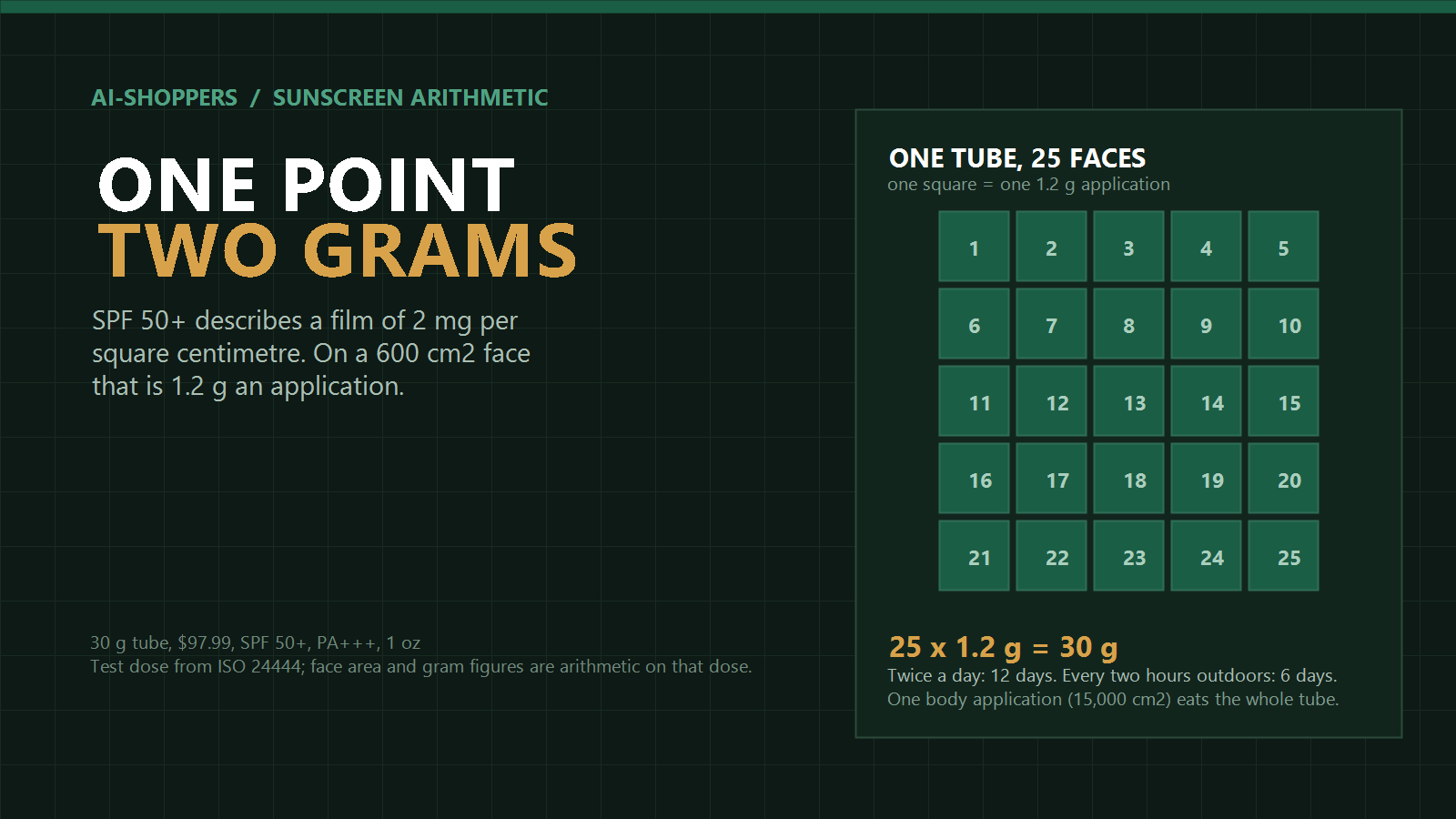
Every sunscreen is sold as a number and used as a smear. The number — 50+, PA+++ — describes a film exactly two milligrams thick on every square centimetre, laid down in a laboratory with a syringe. The smear is whatever your fingertips deliver in seven seconds. Between the two sits a 30 g tube, and one piece of arithmetic almost nobody does before buying: how many faces that tube actually contains.
1. Four lines on the packaging, four different jobs
A sunscreen label carries more information than a shirt label and is read less carefully. The four lines on this one are worth separating, because only one of them tells you how long the money lasts.
SPF 50+ is a band, not a value. In the European labelling scheme the 50+ category is reserved for products measured at 60 or above, so the number on the front is a floor. This matters less than it sounds: a sunscreen measured at 50 lets through 2.00 percent of the burning UVB, and one measured at 60 lets through 1.67 percent. The entire visible difference between the tiers is about a third of one percentage point of transmitted UVB — which is why the jump from 30 to 50 is worth money and the jump from 50 to 60 is not.
PA+++ is the UVA grade. The system runs PA+ to PA++++, mapped to a persistent pigment darkening score: PA+++ covers a PPD of 8 to 16, meaning the tanning dose of UVA is delayed by a factor of eight to sixteen. UVB burns, UVA ages, and the two are tested separately because a filter that is excellent at one can be mediocre at the other.
NET 30G / 1 OZ is the only line that constrains anything. It is the budget. Everything else on the tube describes how the contents perform when spread at a rate the tube will not sustain for long.
“Physical sunscreen” names the filter family, not the strength. A mineral product can be SPF 30 or SPF 70; the phrase tells you the UV is blocked by zinc oxide or titanium dioxide particles rather than by organic absorbers, and that has consequences for white cast and for how evenly the film can be spread — not for how many applications are in the tube.
2. The two milligrams are a protocol, not a habit
SPF is measured under ISO 24444, and the standard is more specific than most people expect. A defined quantity of product, 2.0 ± 0.05 mg per square centimetre, is spread over test sites of 30 to 50 cm² on volunteers’ backs. Each site is then exposed to a lamp calibrated to deliver two minimal erythema doses, and the sites are read 16 to 24 hours later for the first hint of redness. The SPF is the ratio of the dose that reddens protected skin to the dose that reddens bare skin, averaged across 10 to 20 volunteers.
Read that again with the arithmetic in mind. The standard fixes three things: how much product, over how much area, under what lamp. It says nothing about a face, a beach, or a Tuesday morning. A product can pass the test with a film so thick and so even that no hand can reproduce it, which is precisely why the label and the real world diverge.
There is a second, subtler consequence. Because the test fixes the mass per unit area, two products with the same SPF can have wildly different textures — and the runnier one is easier to spread at the required thickness. A thick cream that drags and pills gets used thin, and a thin film is where the label quietly stops applying.
3. The ledger: 600 square centimetres, 1.2 grams
An adult face measures roughly 500 to 650 cm². Take 600 as the working figure. At 2 mg/cm² that is 1,200 mg, or 1.2 g of product per application. In kitchen terms it is a quarter teaspoon: a teaspoon holds about 5 ml, sunscreen runs close to 1 g per ml, and a quarter of that is 1.25 g. The familiar advice to use “a teaspoon for the face and neck” is this same calculation, rounded up for the neck.
Now divide the tube.
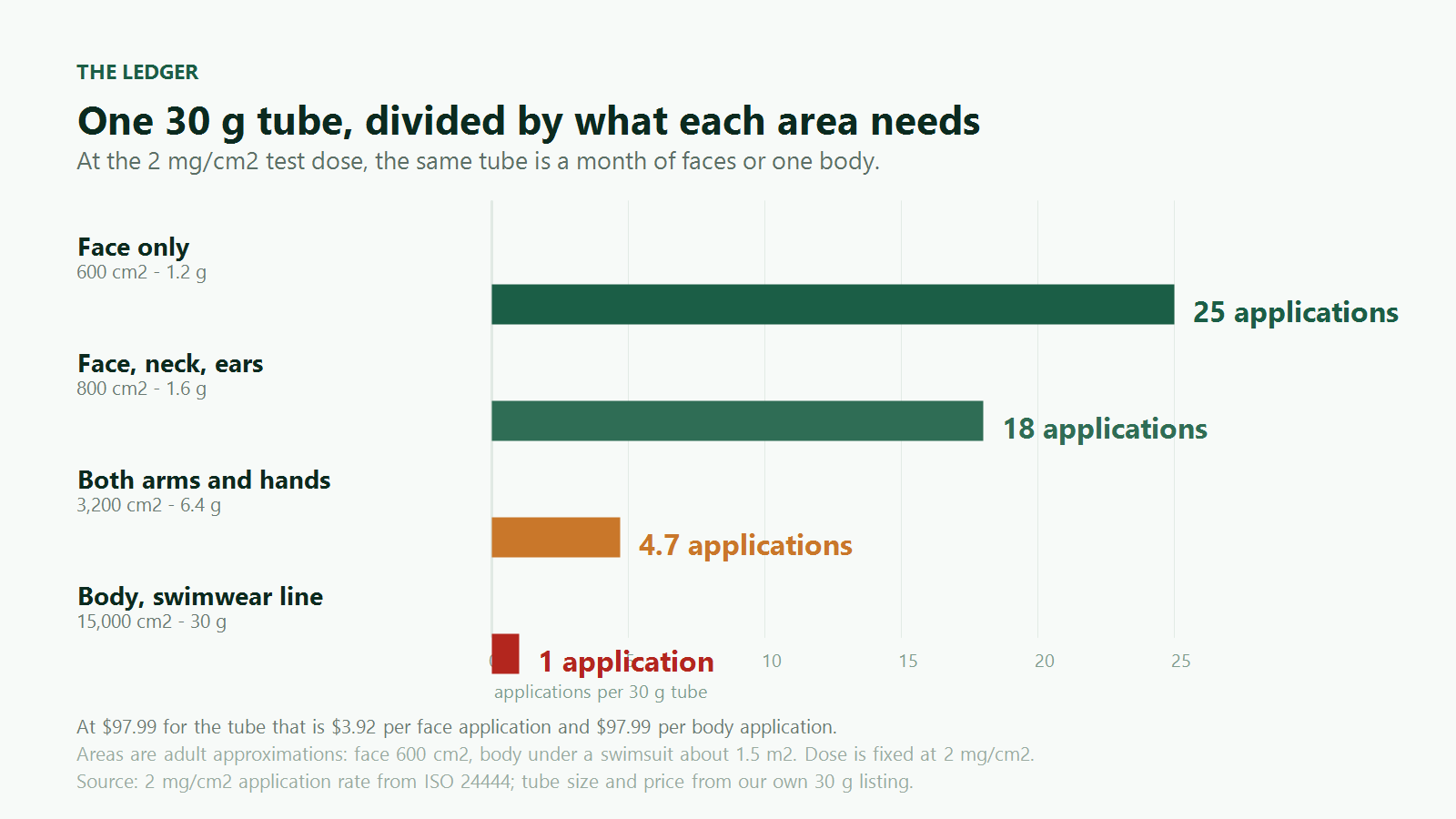
| Area | Surface | Dose at 2 mg/cm² | Applications per 30 g | Cost per application at $97.99 |
|---|---|---|---|---|
| Face only | 600 cm² | 1.2 g | 25 | $3.92 |
| Face, neck and ears | 800 cm² | 1.6 g | 18 | $5.44 |
| Both arms and hands | 3,200 cm² | 6.4 g | 4.7 | $20.85 |
| Body inside a swimsuit line | 15,000 cm² | 30 g | 1 | $97.99 |
Twenty-five face applications. Applied twice a day, that is twelve and a half days of coverage from a tube that most people expect to last a season. Applied every two hours through a long day outdoors — six applications — it is four days. And a single full-body application at the tested dose consumes the entire 30 g, which is the number worth sitting with: protecting one adult at the beach properly costs the whole tube, in one go, for one afternoon.
4. Half a dose is the square root of the label
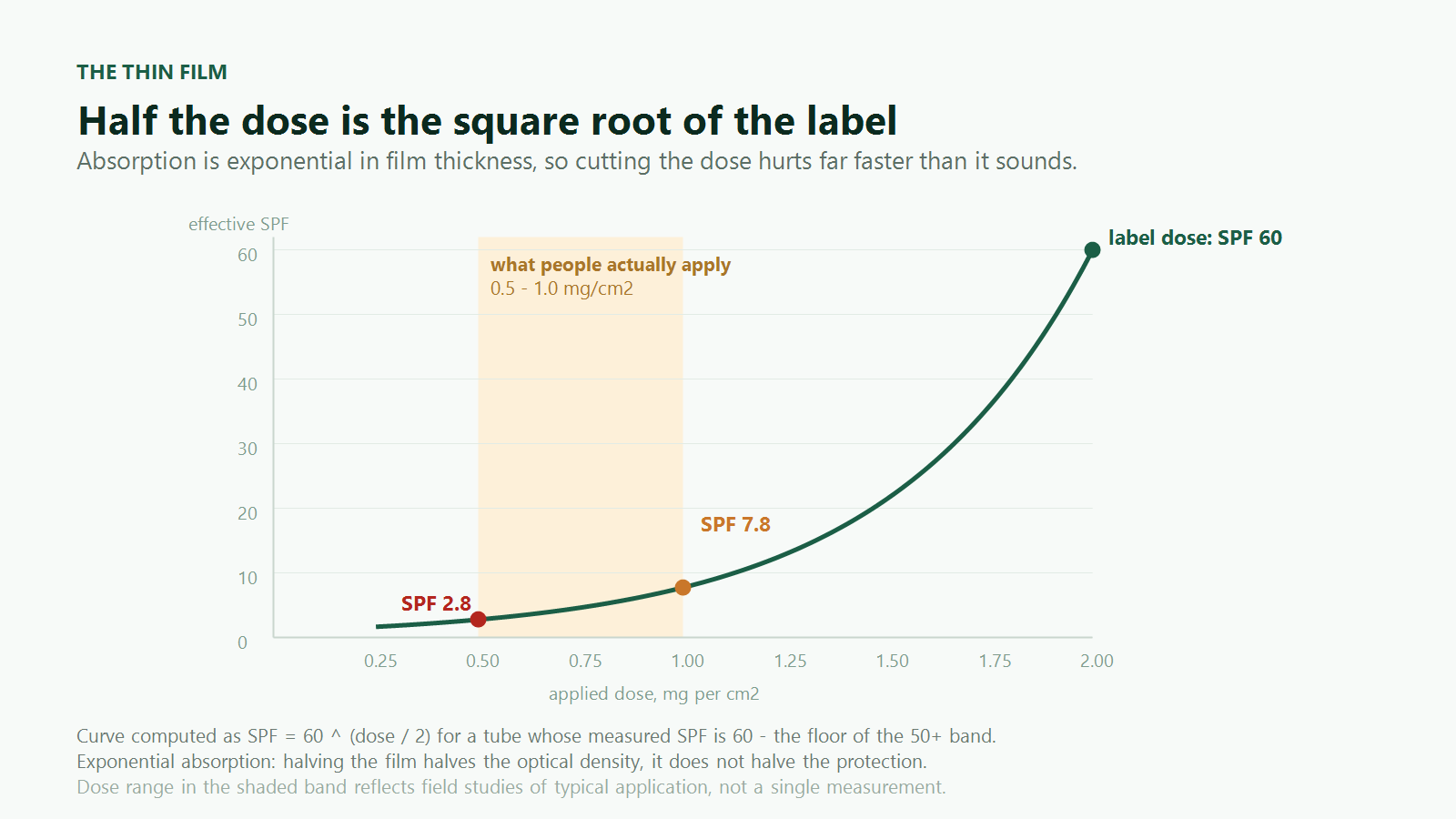
UV absorption follows the Beer–Lambert relationship: absorbance is proportional to the thickness of the film, so transmittance falls exponentially as the film thickens. Doubling the film does not double the protection; it squares it. Which means halving the film does not halve the protection either — it takes the square root.
Work it through for a tube measured at 60. At the tested 2 mg/cm², 1/60 of the UVB gets through: 1.67 percent. At 1 mg/cm², half the optical density, the transmitted fraction is the square root of 1.67 percent — 12.9 percent, an effective SPF of 7.8. At 0.5 mg/cm², a quarter of the test dose, 35.9 percent gets through and the effective SPF is 2.8.
That is not a hypothetical. Field studies of how much sunscreen people actually apply have repeatedly landed between 0.5 and 1 mg/cm² — a quarter to a half of the test dose — which puts the effective protection of a 50+ product somewhere between SPF 3 and SPF 8 for most users. The tube was not lying. The film was thin.
Two practical conclusions follow, and they point in the same direction. First, the highest-leverage change you can make is not a higher number on the tube but a fuller dose from the one you own — doubling a 0.5 mg film buys more protection than any product upgrade. Second, when comparing prices, compare them at equal dose. A cheap tube used at 1 mg/cm² beats an expensive one used at 0.4, every time.
5. What “physical” changes, and what it does not
Mineral filters work by two mechanisms at once. Zinc oxide and titanium dioxide absorb UV photons across the UVB band and into the near UVA, and they also scatter light. Absorption depends on the semiconductor’s band gap, which for these two oxides sits at the edge of the visible — roughly 370 to 400 nm — so the cut-off lands inside UVA rather than beyond it.
Scattering is the more interesting half. Scattering efficiency rises steeply as wavelength falls — roughly as the inverse fourth power for particles much smaller than the wavelength, and more gently for larger ones — so a given film of mineral particles blocks short-wave UVB more efficiently than long-wave UVA. This is the physical reason a mineral product can post a high SPF and a mid-range PA: the same film is simply less good at the long end. The PA grade on the box is doing real work here, and on a mineral product it deserves more attention than the SPF.
The white cast is the same phenomenon viewed in the visible band. Mineral particles scatter visible light too, which is why a thick, even, properly dosed film of a mineral sunscreen looks like a mask. You cannot separate the protection from the whitening; they are one optical effect. Tinted versions — like the three-colour concealer cream compared below — exist precisely to put pigment back over the scatter.
6. Two tubes, two answers on price per gram
The other product in this comparison is a 40 g tinted cream, also printed SPF 50+ and PA+++, also mineral, sold as a three-colour concealer that doubles as sun protection. On the shelf it looks like the cheaper way to buy protection. Whether it is depends entirely on whether you can wear the dose.
| Physical sunscreen, 30 g | Tinted three-colour cream, 40 g | |
|---|---|---|
| Price (31 October 2026) | $97.99 | $79.99 |
| Price per gram | $3.27 | $2.00 |
| Face applications at 1.2 g | 25 | 33 |
| Cost per face application | $3.92 | $2.42 |
| Cost per two hours of cover | $1.96 | $1.21 |
| Dose most people will actually apply | 0.5–1.0 mg/cm² | 0.3–0.6 mg/cm² (tint sets the limit) |
Per gram the tinted cream is 39 percent cheaper, and at equal dose it is the better buy on every line of that table. The catch is the last row. A three-colour concealer is designed to be worked thin and blended; at 1.2 g the coverage becomes a full mask, and most wearers will stop at half that. At 0.6 mg/cm² the effective SPF of a 60-measured product is about 4.4 — not nothing, but not what the front of the tube implies.
So the rule is not “buy the cheaper gram”. It is: choose the format whose full dose you will actually apply, then compare price per protected hour. If you wear tint daily and will spread it properly, the 40 g wins on cost and on compliance. If you want an untinted film you can lay on thick without looking made-up, the 30 g is the one you will use correctly.
7. Four days of beach, not four months of summer
Planning a trip is where the arithmetic stops being abstract. Twelve hours outdoors with reapplication every two hours is six applications, 7.2 g, so a 30 g tube is gone in just over four days — for one person, on the face alone. Two adults for a week need roughly 100 g, which is four 30 g tubes at $392, or three 40 g tubes at $239.97.
Both sizes pass the carry-on rule: liquids must be in containers of 100 ml or less, and 30 g and 40 g are well inside it. The limit that catches people is the aggregate — everything in one quart-sized bag — so a family of four packing eight tubes is fine on volume per container and tight on bag space.
Heat is the other travel variable. A closed car in sun reaches temperatures that soften and can split an emulsion, and the same interior heat that ruins a car organizer will do the same to a tube left on a dashboard for an afternoon. Keep it in the bag, not the glovebox, and shake before use: separation is reversible, a cooked emulsion is not.
On the water-resistance claim printed on the tinted cream: the two standard tiers are 40 minutes and 80 minutes of immersion, tested after a defined soak. Neither means “all day”. Reapply after swimming, and treat towelling off as removal, because it is.
8. What this arithmetic cannot tell you
Three honest limits. First, our own listing carries no measured SPF, no batch number and no period-after-opening symbol, so the 50+ and PA+++ here are the manufacturer’s printed claims, not a result we verified. Second, the face areas used above are population approximations; a narrow face is nearer 500 cm² and a broad one nearer 650, which moves the dose by 20 percent either way. Third, none of this is medical advice — if you burn easily, take medication that photosensitises, or have a skin condition, the person to ask is a dermatologist, not a tube.
What the arithmetic does establish is the scale of the problem. A 30 g tube at the tested dose is 25 face applications, or four days outdoors, or a single body application. Once you know that, the questions worth asking at the shelf change: not “is 50 better than 30”, but “will I apply this at the dose where 50 means anything”. That is the same question a price tag hides in every other category — the one our piece on cost per use and the numbers price tags hide takes apart for kitchen tools, and the one what fragrance concentration actually decides raises about the gap between a bottle’s label and its contents.
Frequently asked questions
How much sunscreen should I use on my face?
About 1.2 g, which is roughly a quarter teaspoon, for a face of 600 cm². Add another 0.4 g for the neck and ears. That is the 2 mg/cm² rate the SPF test uses; below it the label number no longer describes what is on your skin.
Does SPF 50+ mean I can stay out 50 times longer?
No. SPF is a ratio of the doses that redden protected and unprotected skin, measured at 2 mg/cm². At half that dose the protection is about the square root of the label — around SPF 7.8 for a product measured at 60 — and no sunscreen replaces shade, clothing or time out of the sun.
How long does a 30 g tube actually last?
Twenty-five face applications at the tested dose: twelve and a half days at twice a day, or four days at six applications a day outdoors. A single full-body application at 2 mg/cm² uses the whole 30 g.
Is a physical sunscreen better than a chemical one?
They are different, not better or worse. Mineral filters absorb and scatter, and the scattering is stronger at short wavelengths, which is why a mineral product can pair a high SPF with a mid-range PA grade — read the PA. Both types need the same 2 mg/cm² film to deliver the number on the tube.
Can a tinted cream with SPF replace a separate sunscreen?
Only if you apply the tinted cream at 1.2 g, which is more than most people will wear. At 0.6 mg/cm² a product measured at 60 delivers roughly SPF 4.4. If you wear it thick, it counts; if you blend it thin, it is make-up with a bonus.
Gear referenced in this guide
Both tubes are from our own listings, priced on 31 October 2026. Nothing in this guide requires buying either: a teaspoon and the millilitre figure on any tube you already own will reproduce the whole ledger.
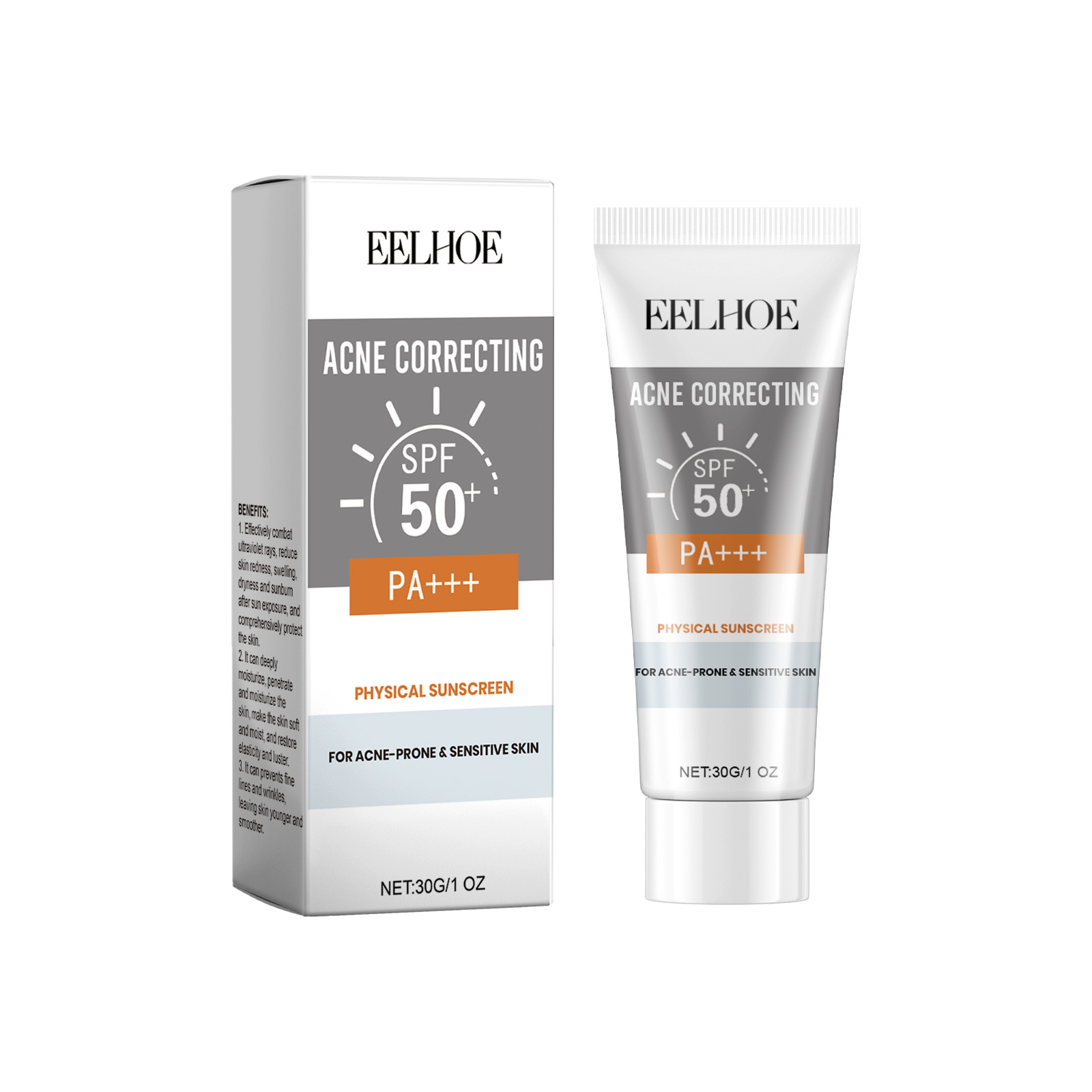 EELHOE Physical Sunscreen, 30 g$97.99View details
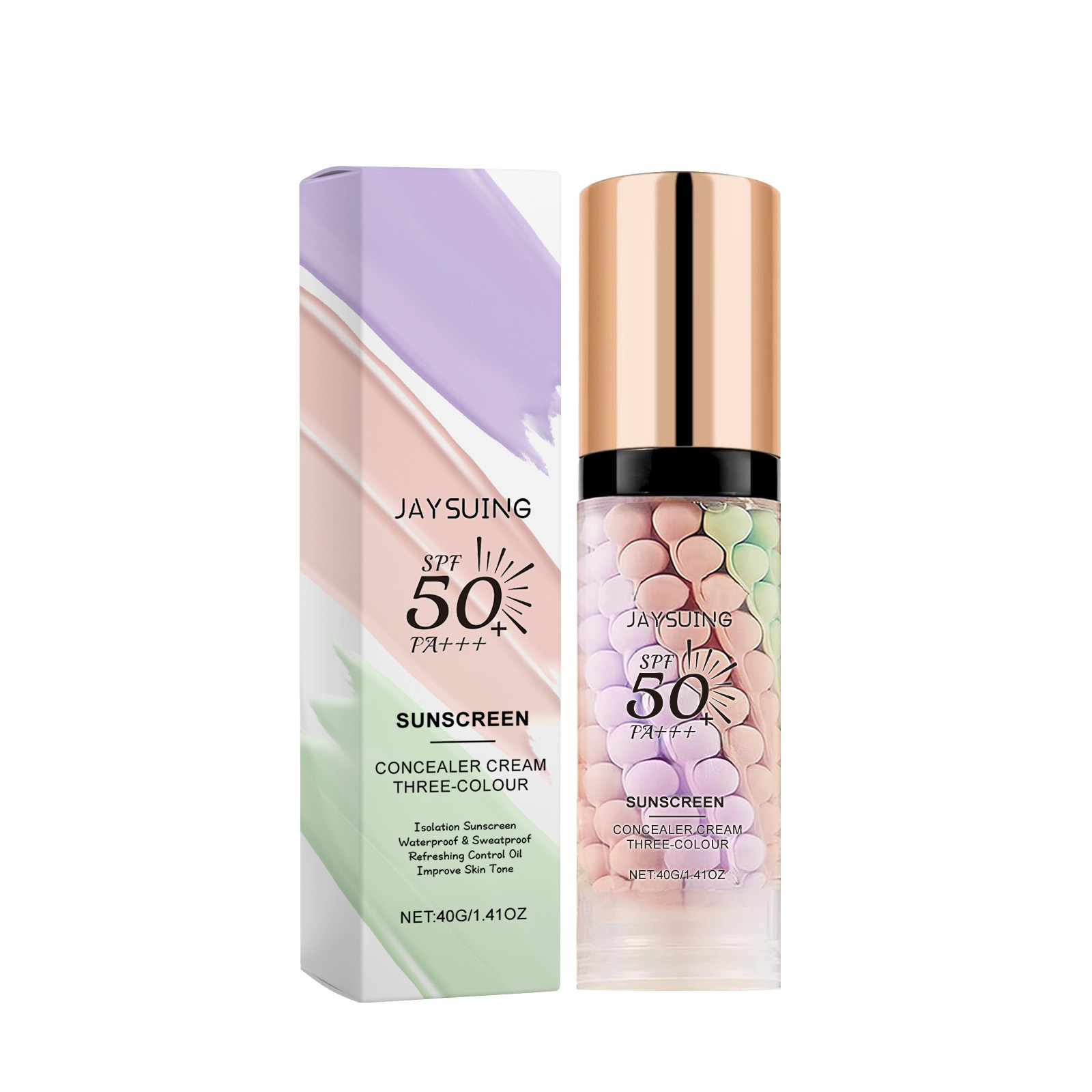 Jaysuing Three-Colour Cream, 40 g$79.99View details
The two figures taken from our listings are the sizes and prices printed on the packaging and the product pages: 30 g / 1 oz at $97.99, and 40 g / 1.41 oz at $79.99, both read on 31 October 2026. Everything else is arithmetic or standard published data: the 2.0 ± 0.05 mg/cm² application rate, the 30–50 cm² test sites, the 2 MED exposure and the 16–24 hour reading come from ISO 24444; the 50+ = 60-or-above rule is the EU labelling convention; the PA scale of 2–4, 4–8, 8–16 and 16-plus PPD is the Japanese grading; the 40 and 80 minute water-resistance tiers are the standard two-level claim. Face and body areas are adult approximations and will shift every gram figure by up to a fifth. The SPF values on the curve are computed, not measured, and the sunscreens’ own SPF and PA claims are the manufacturers’ printed figures, which we have not independently tested.
Compare on Amazon — this category usually has more brands, sizes and price points there.
Check current prices on Amazon →
As an Amazon Associate we earn from qualifying purchases. The price you pay is unchanged. Disclosure