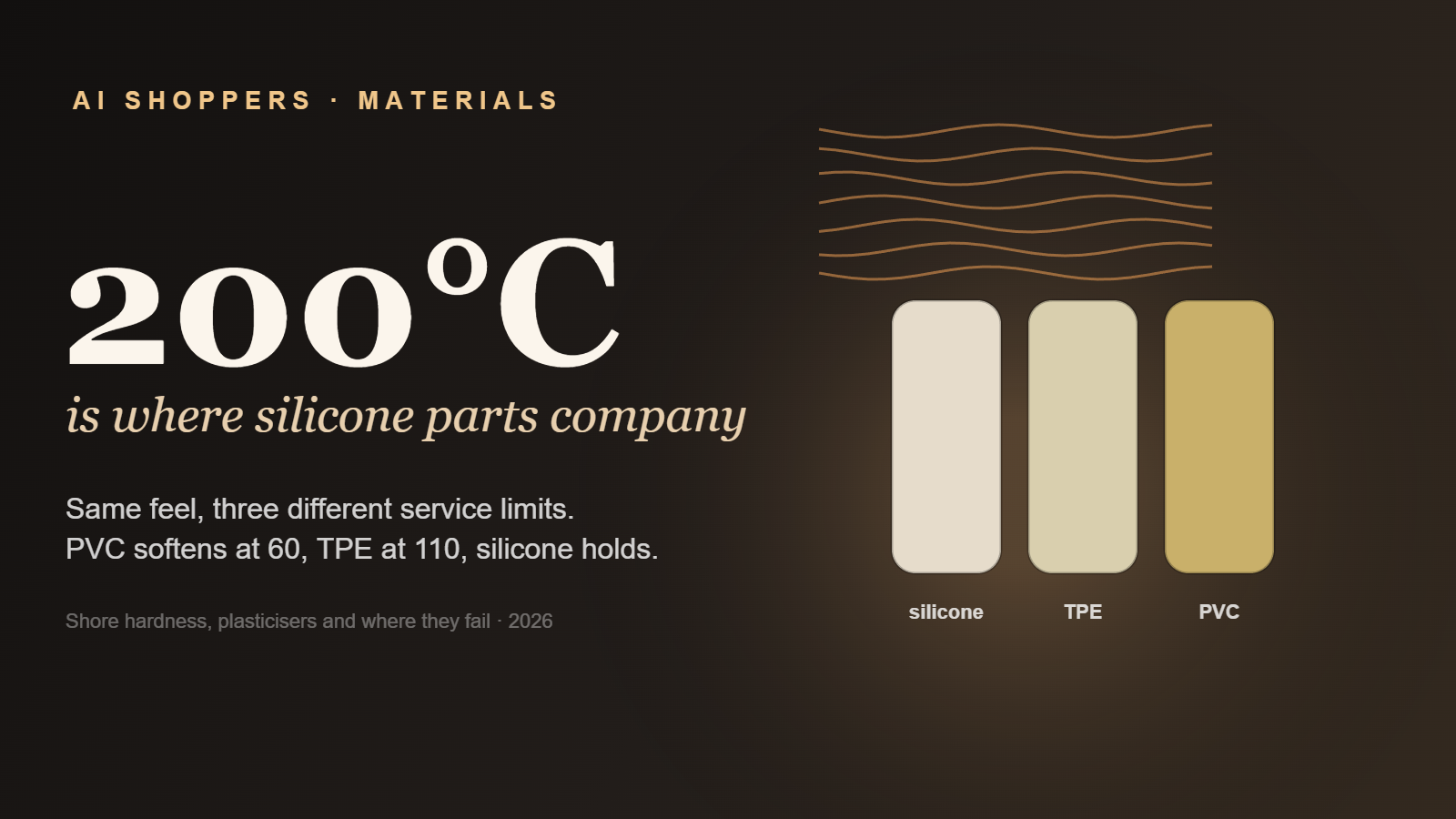
Silicone, TPE and plasticised PVC feel almost identical in the hand: soft, slightly grippy, matte. They are sold under nearly identical words — “silicone-like”, “soft-touch”, “premium rubber”. And they diverge by a factor of three in the one property that decides whether a mat, a spatula or a phone case survives daily use: continuous service temperature.
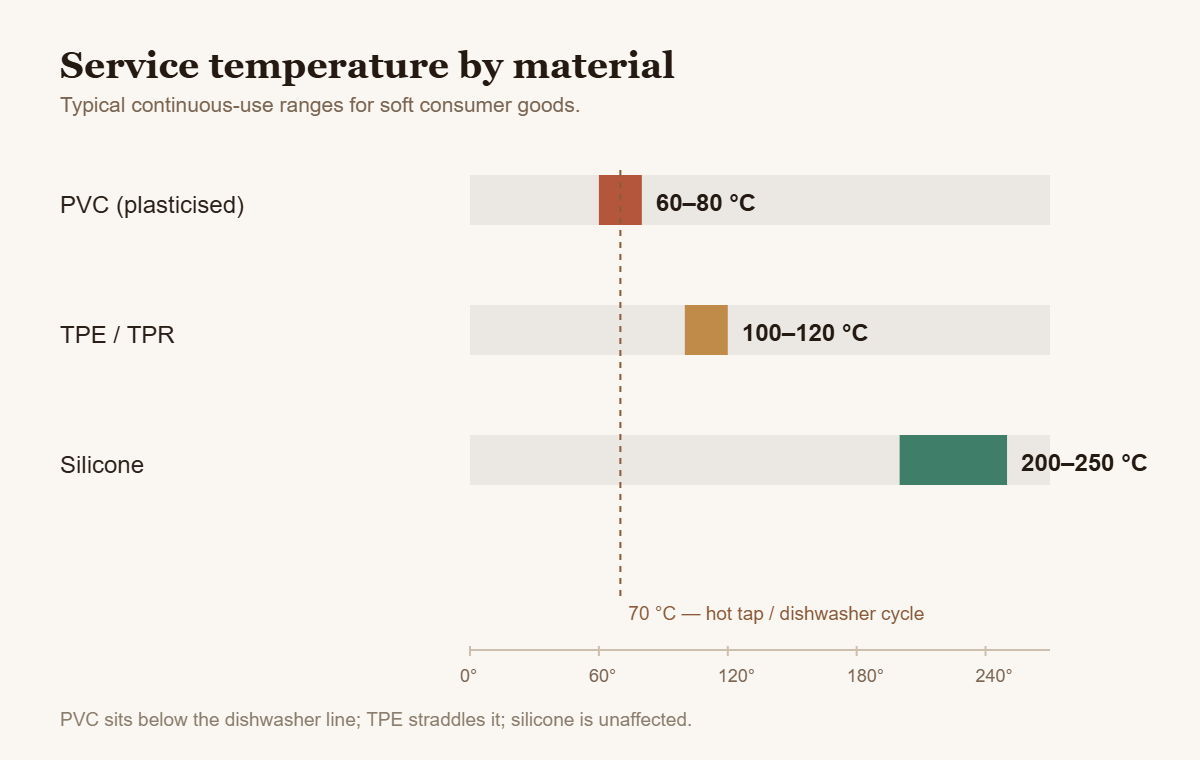
The numbers are unglamorous but decisive. Plasticised PVC softens somewhere between 60 and 80 °C. TPE holds to roughly 100–120 °C. Silicone keeps its properties past 200 °C. A dishwasher runs at 60–70 °C — which is why the same “soft mat” can come out of the machine intact, warped, or smelling of plasticiser.
1. Three words for “soft”
Silicone is a cross-linked polysiloxane: an inorganic backbone (silicon–oxygen) with organic side groups. That backbone is why it does not need plasticiser to be soft, and why heat does not make it flow. TPE — thermoplastic elastomer — is a block copolymer that behaves like rubber but melts like plastic, which is what allows it to be injection moulded and recycled. Plasticised PVC is polyvinyl chloride with 20–35 percent by weight of plasticiser oil worked into it; the oil is what makes rigid PVC soft, and the oil is what migrates out over time.
All three can be food-contact compliant. The difference is what has to be controlled: silicone needs a platinum-cure and post-curing step, TPE needs a compliant grade, PVC needs food-grade plasticisers and a migration test. The label “food grade” tells you the test passed; it does not tell you which of the three you are holding.
2. Temperature decides the use case
Service temperature is where the three separate cleanly. PVC below the dishwasher line means a PVC sink mat or bath mat will soften in hot water, take a set, and slowly release plasticiser — the surface goes tacky, then chalky. TPE straddles the line: fine for a 60 °C wash, marginal at 70 °C, and prone to deformation if left against a hot surface. Silicone is unaffected across the whole domestic range, including oven use up to about 220–230 °C for short periods.
3. Hardness is not the same as softness under load
All three are quoted in Shore A, typically 20–60 for silicone, 30–70 for TPE and 50–80 for plasticised PVC. Shore A measures indentation resistance at a fixed time, not compression set — how much a material stays squashed after a load is removed. Silicone has excellent compression set, which is why silicone seals keep sealing; TPE creeps more and takes a permanent dent where a heavy pot sits; PVC deforms and stays deformed once the plasticiser has migrated.
Practical translation: a silicone mat under a sink caddy returns to shape; a TPE mat may keep the footprint of the caddy; a PVC mat eventually keeps everything.
4. The table
| Property | Silicone | TPE / TPR | Plasticised PVC |
|---|---|---|---|
| Service temperature | 200–250 °C | 100–120 °C | 60–80 °C |
| Shore A range | 20–60 | 30–70 | 50–80 |
| Density | 1.1–1.2 g/cm³ | 0.9–1.2 g/cm³ | 1.2–1.4 g/cm³ |
| Plasticiser needed | No | No | Yes, 20–35% |
| Typical failure | Tearing at thin edges | Creep, oil bleed | Migration, tackiness, hardening |
Read the density row carefully: PVC is the heaviest of the three, and that weight is mostly filler and plasticiser. A “silicone” mat that feels unusually heavy for its size is worth checking — either it is PVC, or it has a heavy filler.
5. Food, pets and the migration question
For anything that touches food or a pet’s tongue, migration is the property that matters. Silicone is chemically inert once cured: nothing to migrate. TPE can bleed mineral oil at the surface, which is why cheap TPE mats sometimes leave a film. PVC releases plasticiser continuously, faster with heat, fat and sunlight — the reason old PVC items smell sweet and go sticky.
None of this means PVC is unsafe in every application. It means the material has a shorter window in hot, fatty or sunlit conditions, and the buyer should know which one they are paying for.
6. Five checks before buying
One: does the listing name the material, or only describe the feel? Two: is a temperature range given, not just “heat resistant”? Three: is the weight plausible for the size? Four: for food contact, is there a standard reference (FDA, LFGB) rather than a badge graphic? Five: for mats, does the underside have a texture or a solid sheet — solid sheets trap water and accelerate plasticiser loss.
Two of those five can be answered from the product page; the rest need one message to the seller. That message is the difference between a three-year mat and a three-month one.
7. Why the price gap is real
Raw material cost explains most of the retail difference. Food-grade silicone typically runs several times the price of plasticised PVC per kilogram, and TPE sits in between. On a 300 g mat, that spread is a few dollars of material — but it also predicts the tooling: silicone needs compression or liquid-injection moulding with post-curing, TPE runs on standard injection machines, and PVC is the cheapest to form of the three.
So a $12 “silicone” mat and a $40 one are rarely the same material with a different margin. More often the cheap one is TPE or PVC, described in silicone’s vocabulary. The test is simple: squeeze a corner and release it. Silicone returns instantly and does not hold a fingernail mark; TPE recovers more slowly, and PVC keeps a faint dent for a second or two — and permanently if it has been hot.
End-of-life follows the same line: silicone is inert and can be burned or landfilled without leaching, TPE is recyclable in some streams, and PVC is the most difficult of the three to recycle because of additives. None of that changes your kitchen tomorrow, but it explains why the material name is worth asking for.
Frequently asked questions
Is “silicone-like” the same as silicone?
No. It usually means TPE or plasticised PVC with a soft-touch surface. If the listing will not say “100% silicone” or “food-grade silicone”, assume one of the others.
Can TPE go in the dishwasher?
Often yes at 60 °C, marginal at 70 °C. Repeated hot cycles accelerate creep and oil bleed, so hand-washing extends life even when the label allows the machine.
Why did my PVC mat go sticky?
Plasticiser migration. Heat, detergent and sunlight pull the oil to the surface; it then evaporates or washes away, leaving a tacky then brittle material.
Does silicone tear more easily?
At thin edges, yes — silicone has lower tear strength than TPE. That is why good silicone mats have rolled or thickened rims rather than knife-edge borders.
Which is best for a bathroom mat?
Look at the backing first, then the face. Silicone or TPE with a perforated or dotted backing dries fastest; a solid PVC sheet traps water regardless of the pile above it.
Honest disclosure: the ranges above are typical published values for these material classes, not lab tests of the products shown. Grades vary by supplier; ask for the datasheet if a product will be used near heat or with food.
Gear referenced in this guide
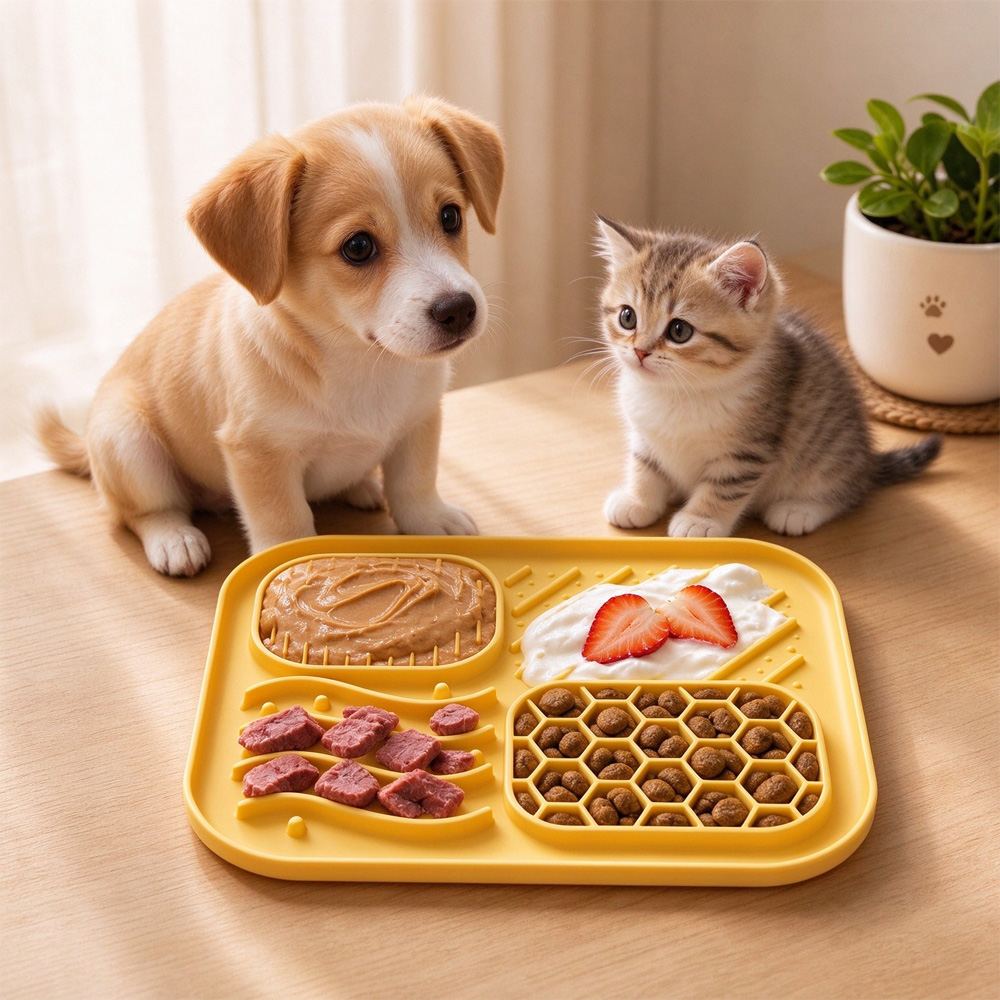
Silicone Pet Licking Mat, 4-Zone Slow Feeder
Food-grade silicone with suction cups — the material that tolerates hot washing and freezing.
$68.99
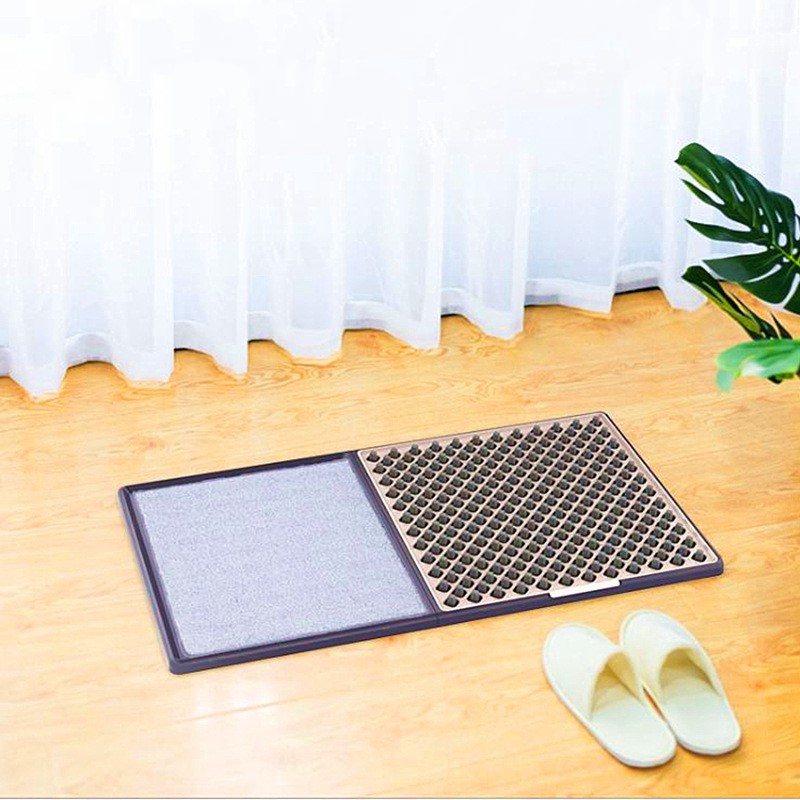
Non-Slip Bathroom Mat, Quick-Dry Absorbent Floor Mat
Where backing choice decides drying: the soft face matters less than what is underneath.
$84.99
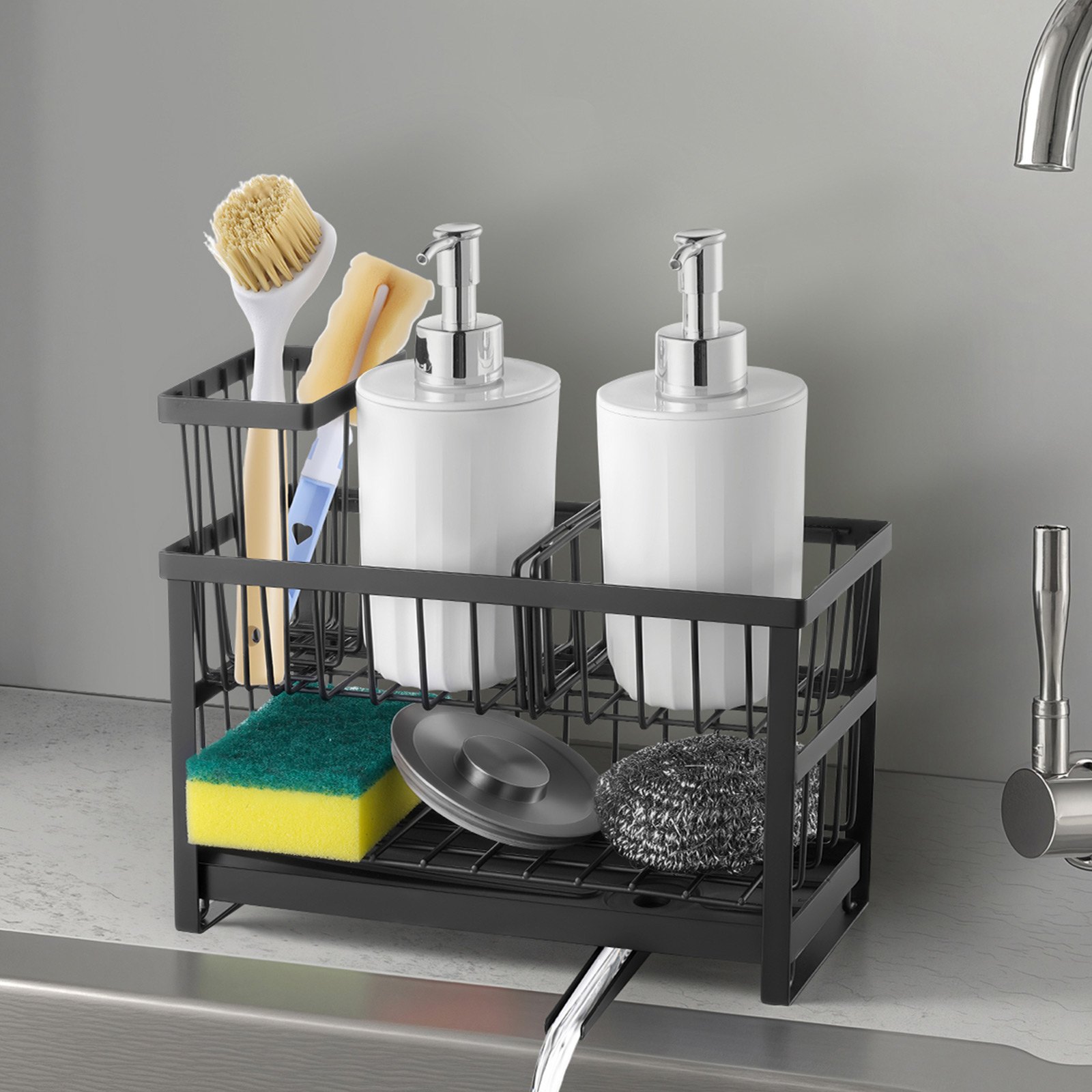
Kitchen Sink Caddy Organizer, Sponge and Brush Holder
Keeps sponges off the surface — ventilation again, the cheapest fix in a wet zone.
$65.99
Compare on Amazon — this category usually has more brands, sizes and price points there.
Check current prices on Amazon →
As an Amazon Associate we earn from qualifying purchases. The price you pay is unchanged. Disclosure
[…] how silicone, TPE and PVC differ in service temperature, and what a bath mat holds and how long it takes to […]