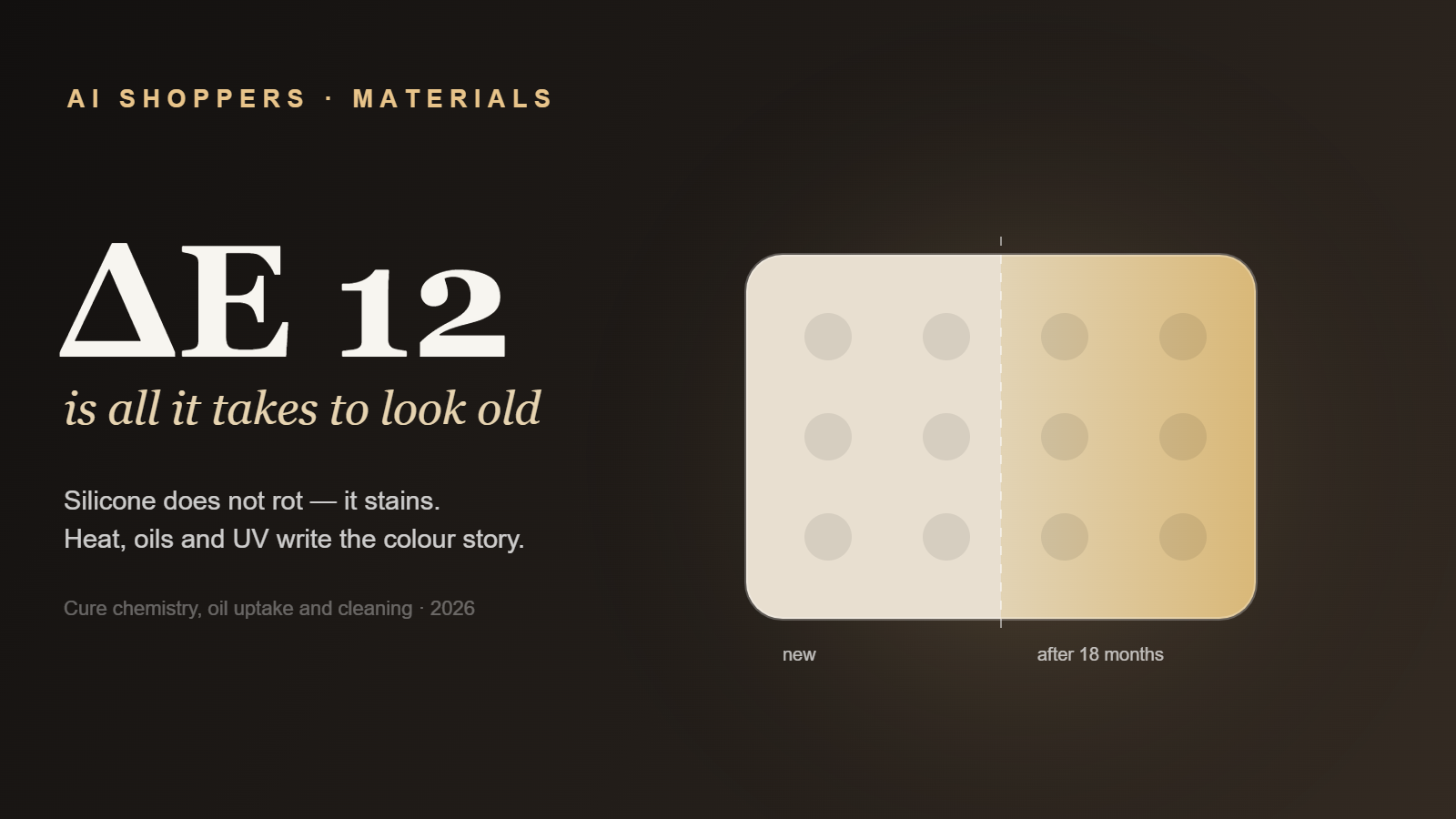
A white silicone mat is not supposed to go yellow. It does anyway — usually within eighteen months, usually at the edges and around the thickest sections, and almost always while the material itself is still perfectly functional. The yellowing is a cosmetic change caused by chemistry the buyer never sees: how the silicone was cured, what it absorbed, and how much ultraviolet light it met.
That distinction matters for money. If yellowing meant failure, every discoloured mat would be landfill. It does not: a mat at ΔE 12 — visibly aged — typically has the same hardness, the same tear strength and the same food-contact safety as the day it was bought. Knowing which changes are cosmetic and which are real saves a replacement every year.
1. Two cure systems, two yellowing rates
Silicone rubber is made by cross-linking polymer chains. The two industrial routes are platinum-catalysed addition cure and peroxide cure. Platinum cure leaves almost no residues, which is why it is used for food contact and medical parts; it also yellows slowly. Peroxide cure is cheaper and faster, but it leaves organic residues in the matrix that oxidise with heat and light — the classical cause of a yellow halo around thick sections.
You cannot see the cure system on a product page. What you can see is the price and the claim: “100% food-grade silicone” usually implies platinum cure, because peroxide-cured stock is harder to certify for repeated food contact.
2. Service temperature is not the problem
Silicone holds its properties from about −40 °C to 200–250 °C, which is far beyond any kitchen. A dishwasher at 60–70 °C is a mild environment by comparison. So heat alone rarely destroys silicone; heat plus oxygen plus oils is what ages it, and the visible result is colour, not structure.
3. Oil uptake: the part nobody mentions
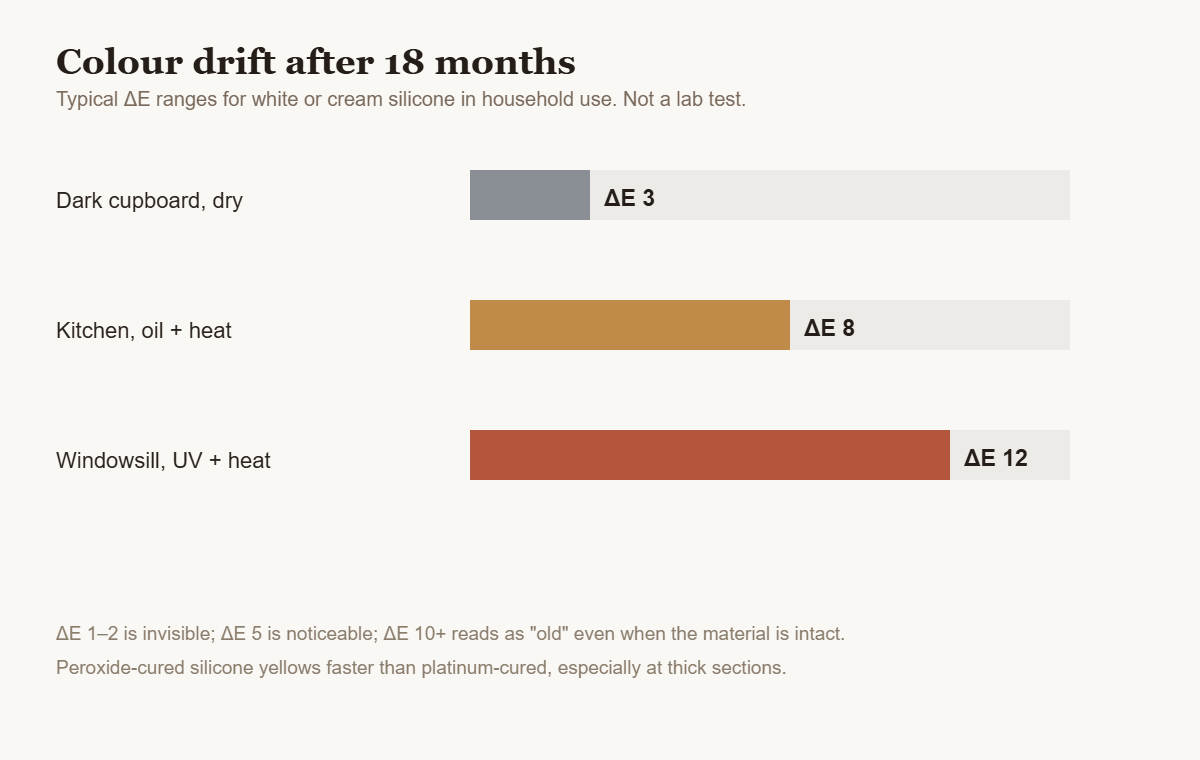
Silicone is not oil-proof. Non-polar oils — cooking oil, butter, pet-food fats — diffuse into the matrix and swell it by roughly 5–15 percent. The oil itself oxidises over months and turns amber, and the silicone keeps it. This is why a mat used for roasting or pet food yellows along the contact areas first, while the outer rim stays pale.
The practical consequence: wash silicone with hot water and dish soap immediately after fatty contact, not the next morning. Once the oil has diffused, surface cleaning removes very little of it.
4. UV and the windowsill effect
Ultraviolet light accelerates oxidation of any residual organics and can also attack the polymer backbone at the surface. A mat left on a sunny sill for a year will usually show a stronger colour shift on the exposed face than the underside — a clean diagnostic. If the two faces differ noticeably, the cause is light, not the material.
5. What the change actually means
| Symptom | Cause | Function affected? | Fix or replace |
|---|---|---|---|
| Even yellowing | Peroxide residues, heat | No | Clean, keep |
| Yellow along contact areas | Oil uptake | No, until it smells | Degrease; replace if tacky |
| Chalky white surface | UV oxidation | Slightly — surface is weaker | Replace if it cracks |
| Tacky or sticky | Oil + heat, degraded surface | Yes | Replace |
| Tears at thin edges | Mechanical wear | Yes | Replace |
Read the table by row, not by colour. Yellow is the least informative symptom on the list; tackiness and tearing are the ones that mean the part is done.
6. Cleaning that works, and one thing that does not
A paste of bicarbonate of soda and water, left for ten minutes and rinsed, lifts surface oils and light staining. A soak in 3 percent hydrogen peroxide followed by a day in sunlight will visibly reduce yellowing on platinum-cured silicone; it works because the peroxide oxidises the chromophores that heat and oil created. Dilute vinegar helps with mineral film but does nothing for yellow. Bleach is the one to avoid: it can attack the surface and leaves chloride behind.
7. Buying so it does not happen
Three checks: does the listing say “platinum-cured” or at least “food-grade silicone”; is the part a solid moulding rather than a thin coating over another material; and is the colour white or cream — because pigmented silicone hides yellowing but also hides wear. Dark grey and black silicone yellow invisibly, which is either a feature or a way to miss the moment it goes tacky.
Honest disclosure: the ΔE figures and oil-uptake ranges are typical values from silicone processing literature and household observation, not measurements of the products shown. Cure chemistry varies by supplier and is rarely disclosed.
8. Where yellow is a warning, not a stain
On a flat mat, colour is cosmetic. On a working part it is not. Suction cups, sealing lips and O-rings rely on elastic recovery: the cup must spring back after each press, the lip must stay in contact. Once those thin sections take up oil and oxidise, recovery drops — a cup that held overnight starts falling off in an hour. Yellow on a thin sealing edge is usually the first visible sign that the part is at the end of its useful life.
The test is simple and takes ten seconds: press the cup flat against a clean surface, release, and watch. If the rim comes back with a sharp edge, it is fine. If it stays slightly flattened, replace it — no cleaning will restore the shape.
9. Storage and the three-year rule
Stored in a dark, dry drawer, silicone is effectively stable for a decade. Stored in a hot car or on a windowsill, expect visible ΔE 10 or more within two summers. A practical rule for kitchen silicone that sees heat and oil: expect three years of good appearance and five to eight years of function, and buy on that basis rather than on the colour.
Frequently asked questions
Is yellowed silicone safe to use with food?
Usually yes, if the surface is intact and not tacky. Yellowing is a colour change, not a chemical breakdown; the risk comes from cracks and stickiness, which harbour residue.
Can I reverse the yellowing completely?
No. Peroxide and sunlight reduce it, sometimes by half, but the underlying chromophores and any oil already diffused stay in the matrix.
Why did my black mat turn grey-brown?
Surface oxidation plus oil film. Clean with bicarbonate; if the colour change is uniform and the surface is not sticky, it is cosmetic.
Does dishwasher use accelerate it?
A little. The temperature is mild for silicone, but repeated detergent exposure and long drying cycles add up. Hand washing extends appearance, not function.
Which silicone items are worth replacing?
Anything that touches food and has developed cuts, a tacky surface, or a sour smell. Mats used under appliances can stay in service far longer.
Further reading
Related: how silicone, TPE and PVC differ in service temperature, and what a bath mat holds and how long it takes to dry.
Gear referenced in this guide
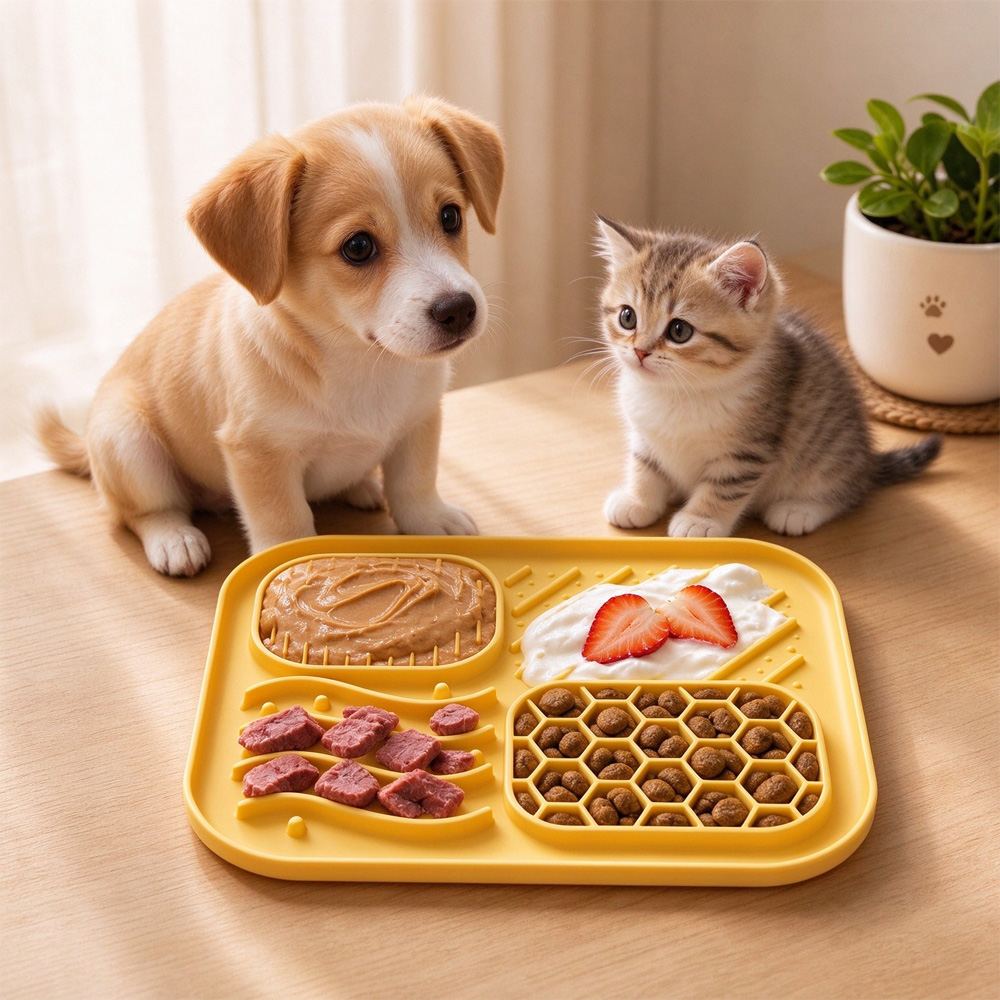
Silicone Pet Licking Mat, 4-Zone Slow Feeder
Food-grade silicone: the grade where yellowing stays cosmetic for years.
$68.99
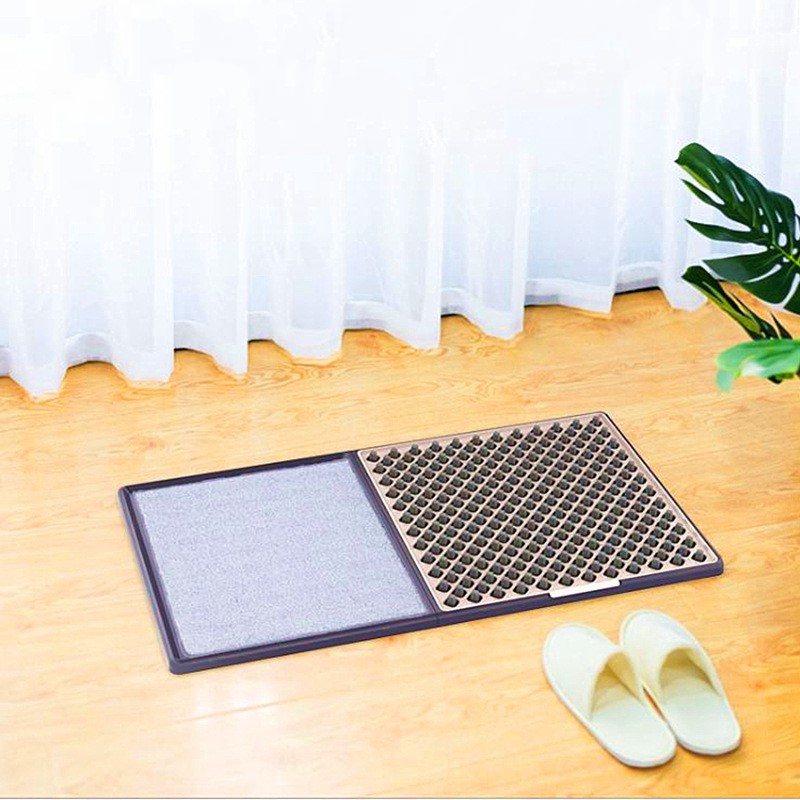
Non-Slip Bathroom Mat, Quick-Dry Absorbent Floor Mat
A different construction entirely — pile and backing, where failure is structural rather than cosmetic.
$84.99
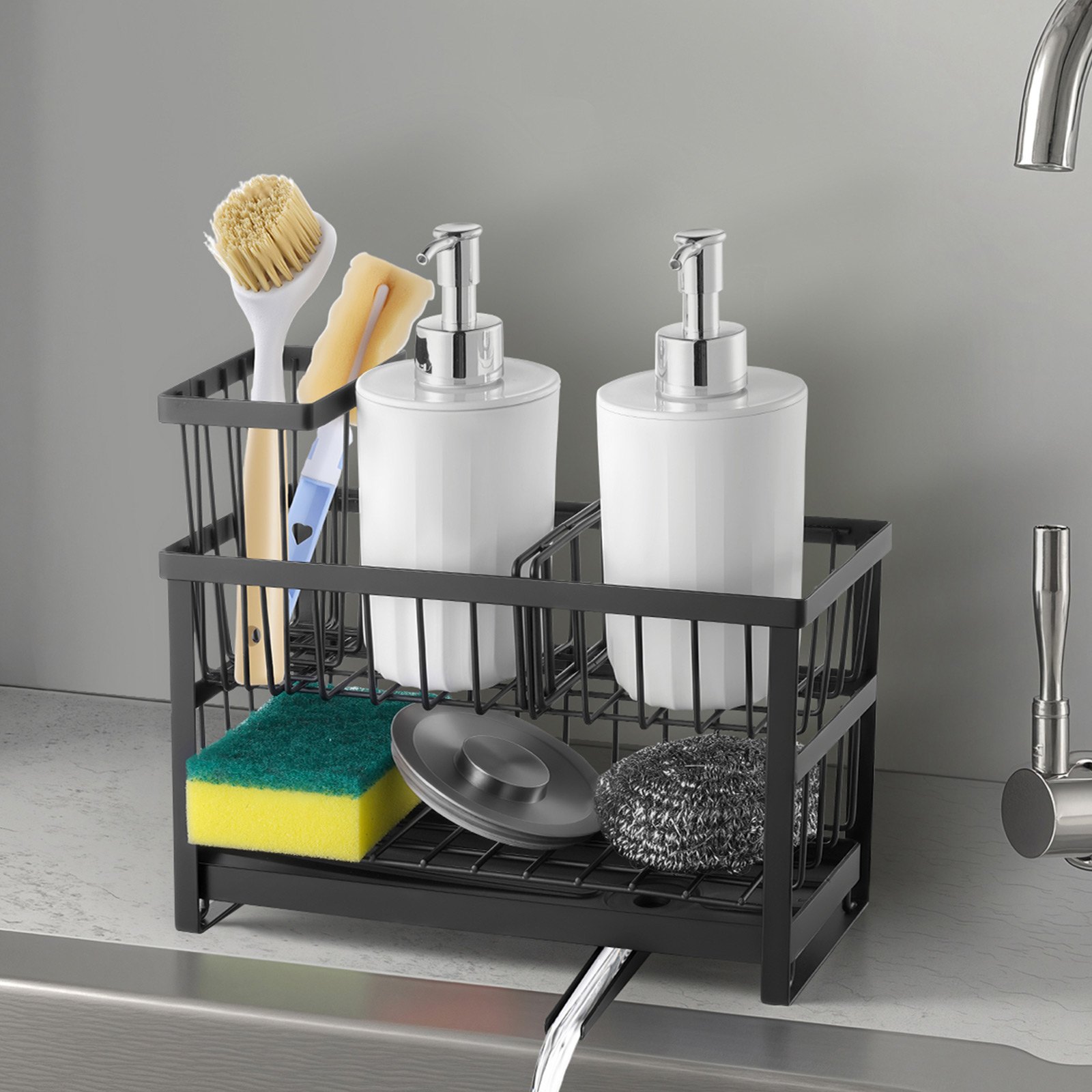
Kitchen Sink Caddy Organizer, Sponge and Brush Holder
Keeps silicone sponges and brushes out of standing water — the cheapest way to slow oil uptake.
$65.99
Compare on Amazon — this category usually has more brands, sizes and price points there.
Check current prices on Amazon →
As an Amazon Associate we earn from qualifying purchases. The price you pay is unchanged. Disclosure