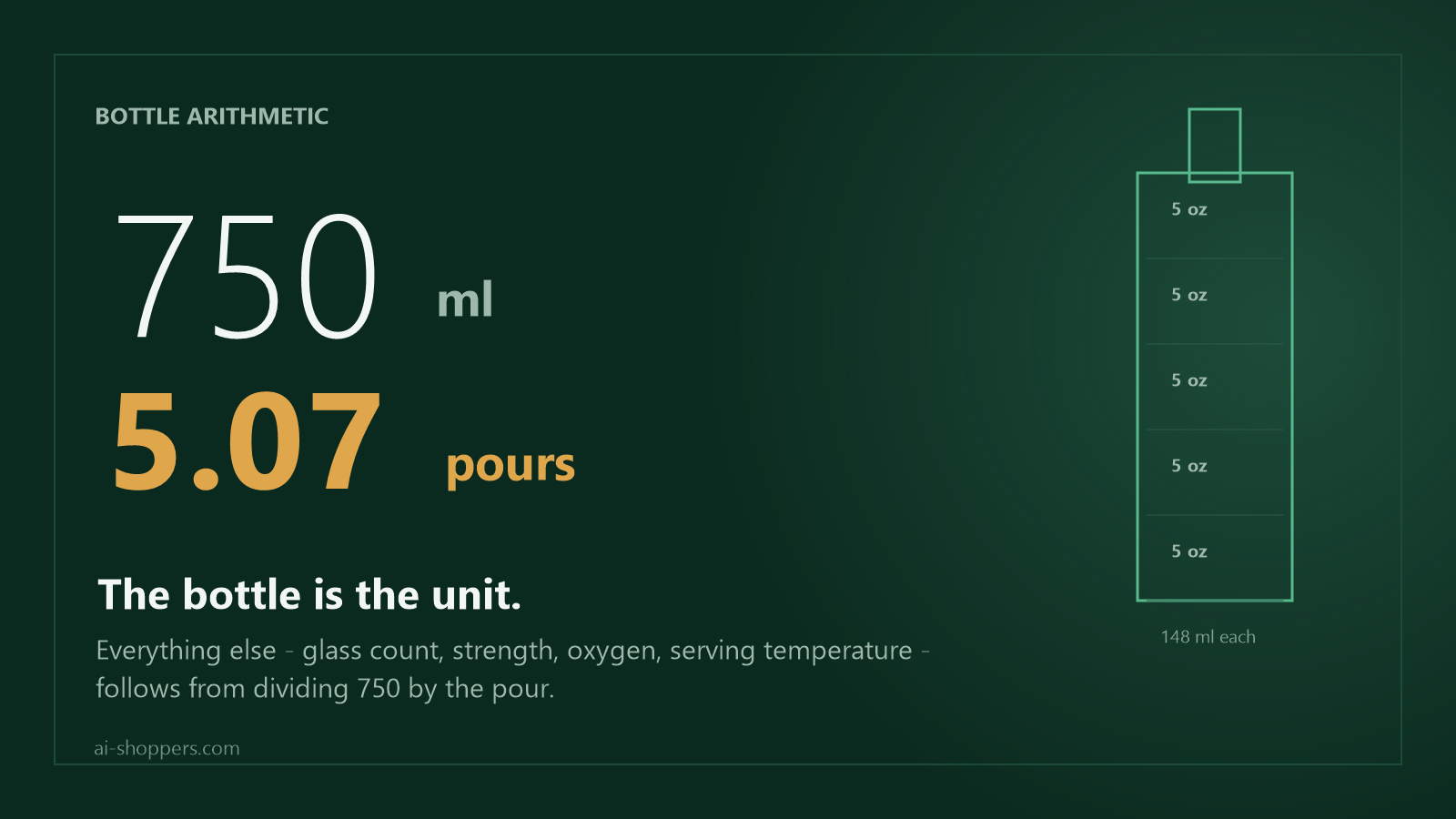
A bottle of wine is 750 millilitres, and almost every other number in the shop is built on top of that one figure without anyone dividing by it. Do the division and three things fall out at once: how many glasses are actually in the bottle, how much alcohol is on the table, and why the last glass tastes different from the first. None of those answers depends on which wine you buy. They depend on the pour, the glass and the air above the wine — all measurable, all free to fix.
1. Divide 750 by the pour
Start with the unit. A US fluid ounce is 29.5735 millilitres, so a standard bottle holds 25.4 fluid ounces. The pour most US restaurants use is five ounces, which is 148 ml. Divide one by the other and the answer is 5.07 — five glasses, and a mouthful left in the bottle.
That single number is where most wine arithmetic goes wrong, because almost nobody pours five ounces at home. A generous hand pours six, which is 177 ml, and the bottle drops to 4.2 pours. A seven-ounce pour — the one that fills a big glass to a comfortable-looking level — gives you 3.6 pours from a bottle that still says 750 on the label. The label is a volume; the pour is a decision.
| Pour | Millilitres | Pours per 750 ml bottle | Fill in a 400 ml glass |
|---|---|---|---|
| 2 oz tasting pour | 59 ml | 12.7 | 15% |
| 5 oz restaurant pour | 148 ml | 5.07 | 37% |
| 6 oz home pour | 177 ml | 4.2 | 44% |
| 7 oz generous pour | 207 ml | 3.6 | 52% |
Two practical consequences. If you are buying for a dinner, the number of bottles is not the number of guests; it is the number of pours divided by 5.07, which is usually more bottles than the mental estimate. And if you want the wine to taste the way the winemaker intended, the pour matters as much as the bottle — a 7 oz pour in a wide bowl is being asked to do something different from a 5 oz pour in the same glass.
2. The glass sets the pour before you do
People do not pour in millilitres; they pour to a height that looks right. That is why glass size changes the count. In a 400 ml glass, five ounces fills 37 percent of the bowl — a normal-looking restaurant pour. In a 700 ml Burgundy bowl, the same 148 ml fills 21 percent, which reads as a splash, and the hand corrects upward to seven ounces without anyone deciding to.
This is not a trick of the eye but a real cost: at 7 oz a bottle gives 3.6 pours, so a table of four sharing one bottle gets less than one glass each, and the second bottle gets opened earlier than planned. Measure once with a kitchen jug into your own glass, note the height, and the pour stops drifting. The mark is the cheapest wine accessory there is, and it does not need to be visible to guests.
3. Five pours is five and a half drinks
Alcohol is the other division the label invites and nobody performs. A 750 ml bottle at 13 percent alcohol by volume contains 97.5 ml of ethanol. Ethanol weighs 0.789 grams per millilitre, so that is 76.9 grams. A US standard drink is 14 grams, which puts the bottle at 5.5 standard drinks — not five, because five pours of 5.07 oz each are slightly larger than 14 g of alcohol.
The arithmetic scales cleanly. Two people sharing a bottle are each at 2.75 standard drinks; three people are at 1.8 each; four people are under one and a half, which is why a bottle for four is a reasonable plan and a bottle for two is a decision about the evening. At 14.5 percent — common for warmer-climate reds — the bottle is 6.1 standard drinks, and the same five pours are 22 percent stronger than a 12 percent bottle. The pour count did not change; the content did.
The one number to remember: a standard 750 ml bottle is five pours and five and a half standard drinks. Both figures come from the same 750, and neither is printed on the label.
4. The 112 milligrams that finish the bottle
Air is 20.9 percent oxygen by volume and oxygen weighs 1.43 grams per litre, so the headspace above the wine is a measurable dose. A full bottle has almost none. Pull one five-ounce glass and 148 ml of air enters; that air holds about 44 milligrams of oxygen. Drink half the bottle and the ullage is 375 ml, holding 112 milligrams.
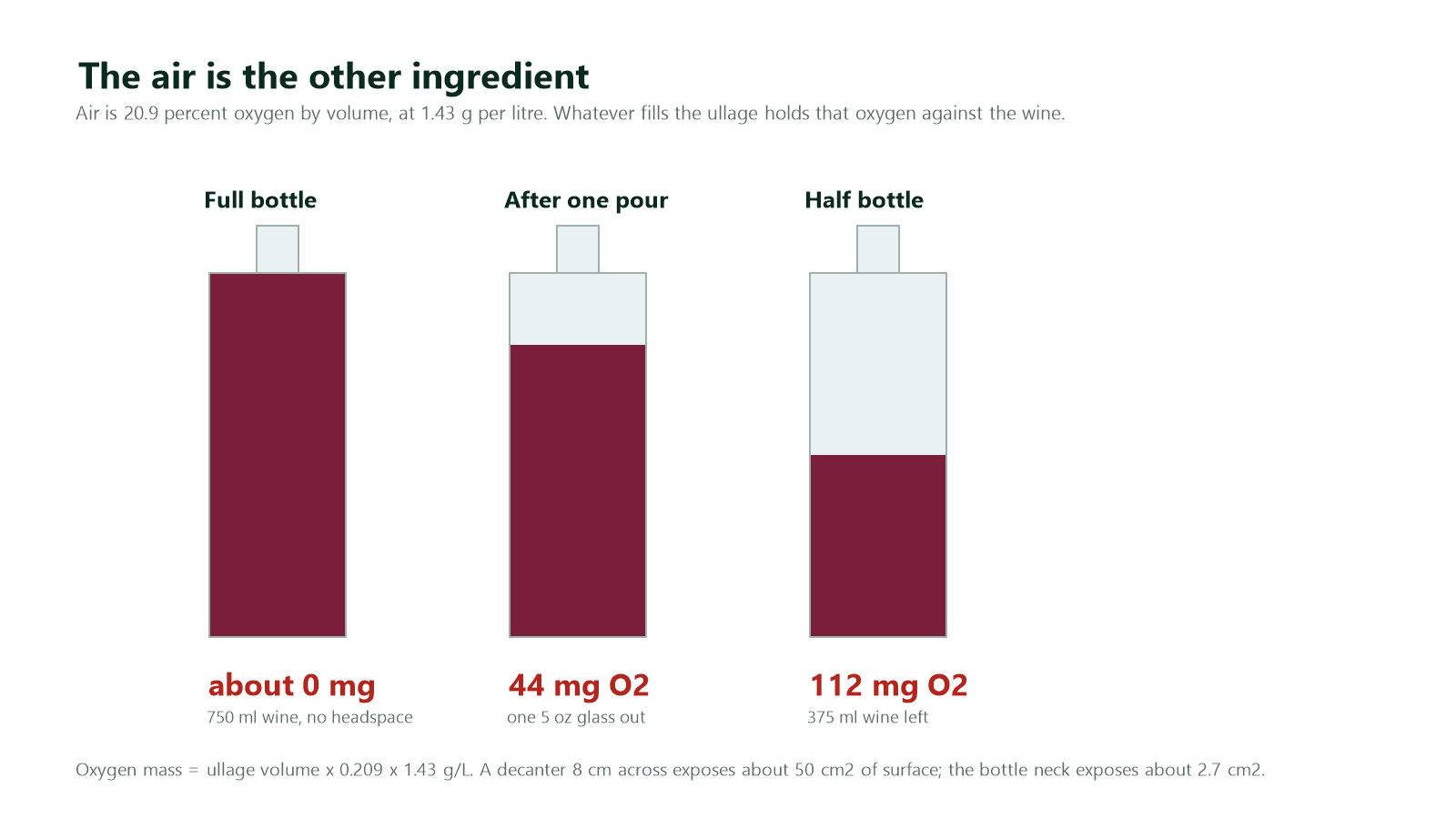
One hundred and twelve milligrams does not sound like much against 750 grams of wine, and that is exactly the point: wine is a fragile system held in balance by sulfur dioxide, and oxygen attacks the aromatics long before it changes the colour. The US limit for total sulfur dioxide in wine is 350 parts per million (27 CFR 4.22), and above 10 ppm the label must say the wine contains sulfites. That allowance exists to absorb oxygen, which is why a robust young red survives three days open and a delicate white from a cold vintage does not.
Surface area decides how fast those milligrams do their work. An 8 cm decanter bowl exposes about 50 square centimetres of wine to air; the neck of a bottle exposes about 2.7. That is roughly nineteen times the exposure, which is why twenty minutes in a decanter softens a young red more than a day in a half-empty bottle — and why that same decanter will flatten a fragile white in an hour.
5. Temperature: 4 °C is storage, 8–10 is service
White wine is usually served too cold and red too warm, and both errors come from treating a room or a fridge as a serving condition. A domestic fridge runs at about 4 °C; a heated room at about 21 °C. Common service guidance puts dry whites at 8–10 °C and reds at 16–18 °C. The gap is not fussiness — cold suppresses aroma, heat exaggerates alcohol.
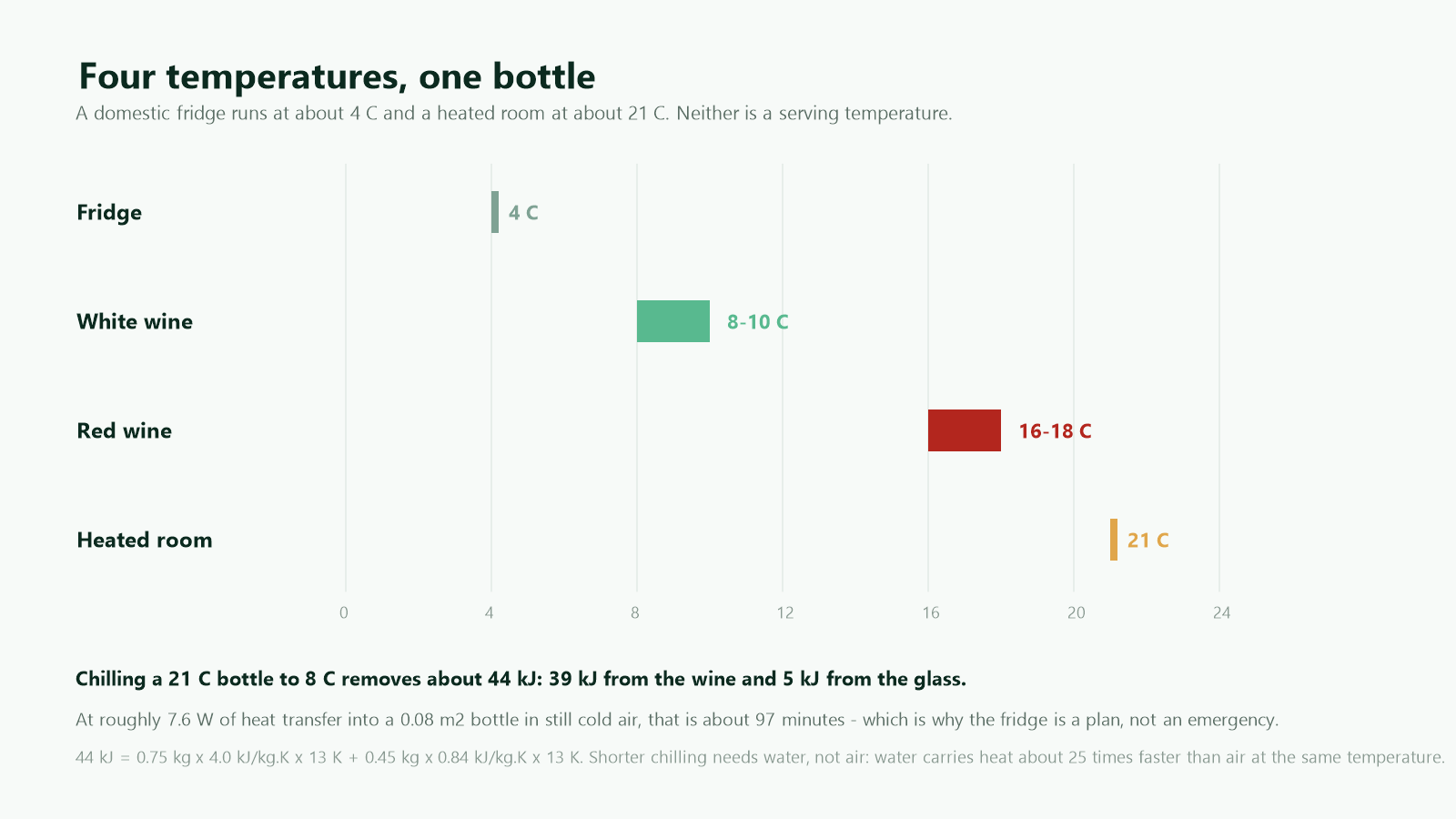
The chilling time is arithmetic. Taking a 750 ml bottle from 21 °C to 8 °C removes about 44 kilojoules: 0.75 kg of wine at 4.0 kJ/kg·K over 13 K is 39 kJ, plus 0.45 kg of glass at 0.84 kJ/kg·K is another 5 kJ. A bottle in still cold air transfers heat at roughly 7.6 W across its 0.08 m² surface, so the job takes about 97 minutes. That is why a bottle put in the fridge when guests arrive is still warm at the first pour, and why an ice-water bath — water moves heat about 25 times faster than air — does the same work in a fraction of the time.
The reverse correction is shorter and more useful. A red standing in a 21 °C room needs to lose about 13 kJ to reach 17 °C, which is roughly 30 minutes in the fridge door. Most reds that taste “hot” or “flat” at a dinner table are simply being served four degrees too warm.
6. What keeps a bottle, and what only feels like it
Nothing stops oxidation in an open bottle; the methods below only change how fast the 112 milligrams get to work. If a cork does break on the way out, the recovery sequence is a separate set of decisions. What they do differ in is what they remove.
| Method | What it removes | What it cannot do | Realistic window |
|---|---|---|---|
| Recork and refrigerate | New air ingress, and slows the reaction by cooling | Remove the oxygen already in the headspace | 2–3 days for a young red, shorter for a delicate white |
| Vacuum pump stopper | Part of the headspace air | Pull oxygen back out of the wine, where much of it already is | Adds hours rather than days |
| Inert gas blanket | Replaces the headspace with argon or nitrogen | Undo oxygen already dissolved | The longest of the three, if the gas is used properly |
| Decanter | Nothing — it does the opposite | Preserve anything | A serving vessel, not a storage vessel |
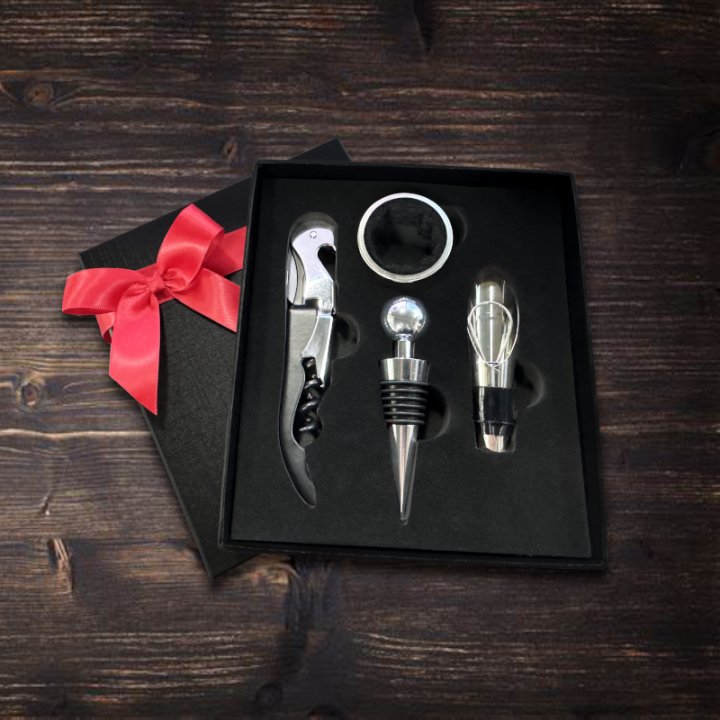
The stopper in a gift set is the first of these: a ribbed cone that seals the neck and keeps new air out. That is worth having because it costs nothing to use, but it should not be sold as preservation. Cool the bottle, stopper it, and accept that day three is a different wine from day one — often a perfectly good one, rarely the same one.
7. Buying for a table of six
Six people, two pours each, is twelve pours. At 5.07 pours per bottle that is 2.4 bottles, so you buy three and expect half a bottle left over — which is the correct outcome, because running out at the table is the one error that cannot be fixed politely. If the group is drinking spritzers or the food is heavy, two bottles covers it; if there is a toast and a long dessert, four is not excessive.
Cost per pour is the honest way to compare a $12 bottle with a $60 one — the same cost-per-use arithmetic used for anything with a service life. Divide the price by 5.07 pours, or by 5.5 standard drinks, and the numbers separate quickly: $2.37 and $2.18 for the $12 bottle, $4.93 and $4.55 at $25, $11.83 and $10.91 at $60. The premium is real at every level, and it is being paid per glass, not per bottle — which is the number that matters when one bottle has to serve a table.
8. The opener: four parts and one measurement
The tool is the only piece of equipment in this arithmetic, and it has one job that can be measured. A standard still-wine cork is 24 mm across and 44 mm long, seated in a neck bored to about 18.5 mm. The helix has to enter the cork far enough to pull all 44 mm without tearing the top third, which is why a short worm on a cheap corkscrew breaks corks and a long one does not.
Our own listing is a four-piece stainless set at $79.99: a waiter’s corkscrew with a foil blade, a foil cutter ring, a stopper and a pourer, in a gift box. Two of those four will be used weekly and two will be used when someone brings a bottle with a wax cap. That is a fair description of most wine gift sets, and it is worth saying plainly rather than pretending the box changes how the wine tastes.
What actually matters when you buy one: the worm should be at least 40 mm long and slightly tapered, the lever should sit on the rim rather than the glass, and the foil cutter should be a ring you can turn rather than a blade you have to aim. Beyond that, an $8 waiter’s friend and a $79.99 box open the same bottle.
9. The five-minute version
Measure your pour once and write down the height. Assume five pours per bottle, not six. Treat a bottle as 5.5 standard drinks when you plan the evening. Chill whites 97 minutes from room temperature or use water and do it in a fraction of that; take reds out of a 21 °C room for 30 minutes. Stopper and refrigerate what is left, and expect day three to be a different wine. Buy one more bottle than the guest count suggests. Everything else about wine is preference; these are arithmetic, and they are the part you can get right before you spend anything.
Frequently asked questions
How many glasses of wine are in a 750 ml bottle?
Five, at the five-ounce pour most US restaurants use: 750 ml is 25.4 fl oz, and 25.4 divided by 5 is 5.07. At a six-ounce home pour it is 4.2 glasses, and at seven ounces it is 3.6. The bottle is fixed; the pour is what changes the count.
How much alcohol is in a bottle of wine?
Multiply the volume by the strength: 750 ml at 13 percent is 97.5 ml of ethanol, which weighs 76.9 grams, or 5.5 US standard drinks of 14 grams each. At 14.5 percent the same bottle is 6.1 standard drinks. The glass count stays the same, which is why strength is the number people underestimate.
How long does an open bottle last?
Two to three days for a young red, less for a delicate white, with the bottle stoppered and refrigerated. The limit is not the air that gets in — it is the 44 mg of oxygen that entered with the first pour plus what was already dissolved. A vacuum stopper slows the next few hours; it does not remove what is already there.
Should red wine go in the fridge?
For about 30 minutes before serving, yes, if the room is 21 °C. Dropping a bottle from 21 to 17 °C takes roughly 13 kJ, which is what a 7.6 W heat path through the bottle delivers in half an hour. Serve it at 16–18 °C, not at fridge temperature, which would mute it.
Does a decanter improve the wine or just the look?
Both, and the mechanism is surface area: an 8 cm decanter bowl exposes about 50 cm² of wine to air against about 2.7 cm² at a bottle neck. That is roughly nineteen times the exposure, so twenty minutes in a decanter can do what a day in a half-empty bottle does. The same maths means a decanter is the worst place to store wine you are not going to finish.
Gear referenced in this guide
One item from our own listing, priced on 1 November 2026. None of the arithmetic above needs it: a jug, a fridge and a stopper already in the drawer will get you most of the way. The numbers are written so you can decide whether the rest is worth buying.
The $79.99 price, the four-piece contents, the US warehouse, the 1–2 day dispatch, the 2–6 day delivery and the 30-day return window are read from our own listing on 1 November 2026. The 29.5735 ml fluid ounce, the 750 ml bottle, the 14 g US standard drink and the 0.789 g/ml density of ethanol are standard definitions; the 5.07 pours, 97.5 ml of ethanol, 76.9 g, 5.5 standard drinks and every cost-per-pour figure are arithmetic on those definitions. The 44 mg and 112 mg oxygen figures assume air at 20.9 percent oxygen and 1.43 g per litre, and change with the size of the headspace. The 44 kJ, 7.6 W and 97 minutes assume 0.75 kg of wine, 0.45 kg of glass, a 0.08 m² bottle surface and still cold air; a moving-air fridge will be faster. The 350 ppm sulfur dioxide limit is 27 CFR 4.22. Serving temperatures of 8–10 °C for whites and 16–18 °C for reds are the ranges commonly given by wine educators, not a legal standard. Open-bottle windows are typical guidance, not a guarantee.
Compare on Amazon — this category usually has more brands, sizes and price points there.
Check current prices on Amazon →
As an Amazon Associate we earn from qualifying purchases. The price you pay is unchanged. Disclosure