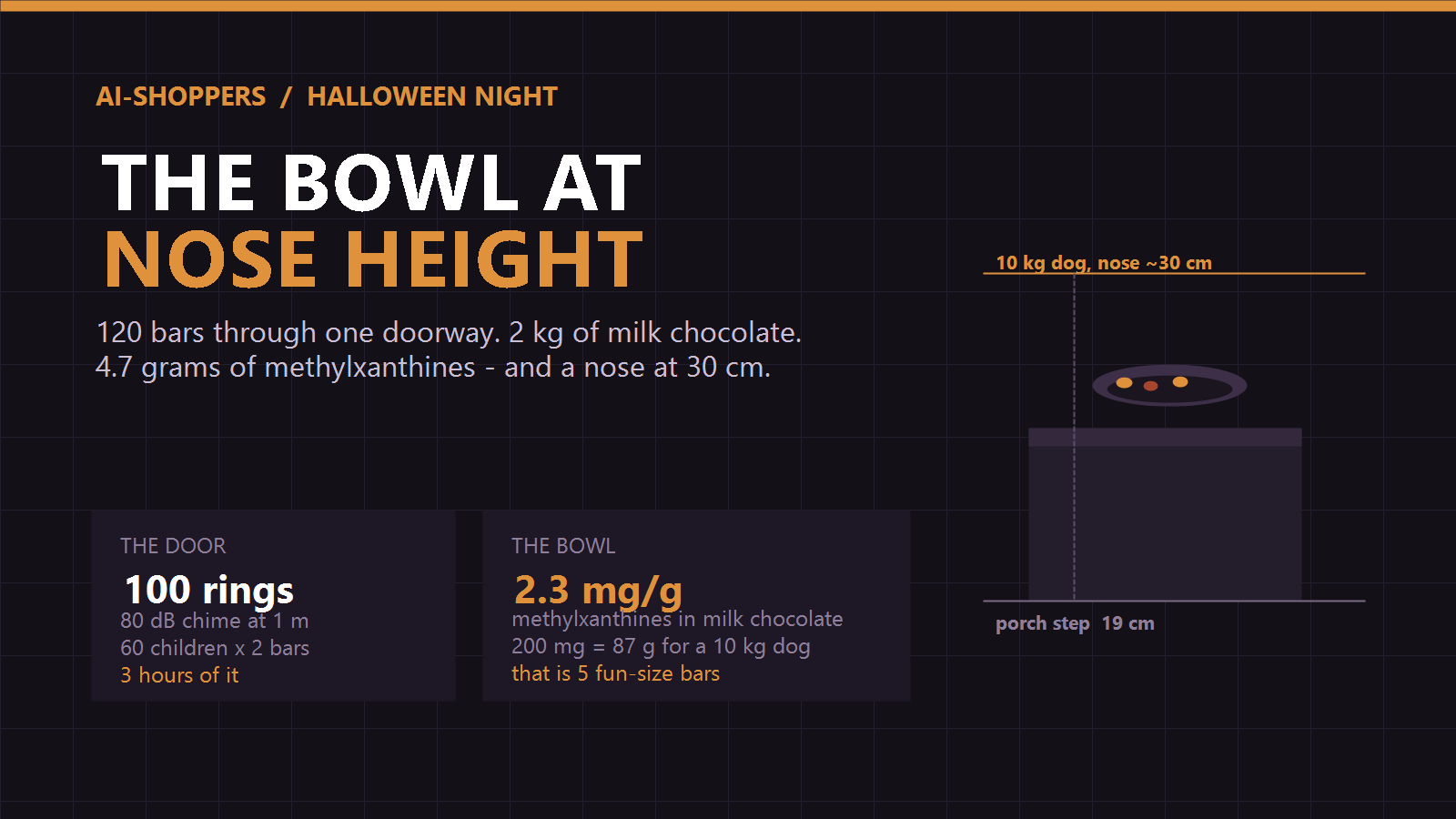
On the last night of October a front door stops being a boundary and becomes a machine. In the United States, 61 percent of people mark Halloween by handing out candy, according to the National Retail Federation’s 2026 survey — 7,889 consumers, fielded 1 to 9 September, margin of error 1.1 points — and total spending is forecast at $13.5 billion, or $115.14 per person. Work that down to a single porch: sixty children, two bars each, and about 2 kilograms of milk chocolate passes through one doorway in three hours. Inside that doorway is a dog who has been told, by every rule of its own biology, that the perimeter is being breached a hundred times, and that a bowl of food has been placed at the height of its nose. The candy is the story everyone tells. The geometry is the story that actually decides what happens.
1. A hundred and twenty bars through one doorway
The retail numbers are the easy part, and they are worth stating plainly because they set the scale of the evening. Seventy-four percent of consumers plan to celebrate Halloween this year; 49 percent began shopping in September or earlier, which is why the porch decorations were up before the leaves were. The average person expects to spend $115.14, and the total — $13.5 billion — is larger than the annual revenue of most of the companies whose chocolate is in the bowl.
None of that reaches a dog as money. It reaches a dog as mass and as frequency. A fun-size bar weighs 15 to 20 grams; take 17 as the working figure. Sixty children taking two bars each is 120 bars, which is 2.04 kilograms of chocolate, and at 2.3 milligrams of methylxanthines per gram of milk chocolate that is roughly 4.7 grams of active compound crossing the threshold of a house in one evening. Two things follow, and they pull in opposite directions: the amount is trivial for a human adult, and it is several times the dose at which a 10-kilogram dog is expected to start showing clinical signs.
2. The porch light is a contract
Halloween works because of a signal that nobody wrote down: a lit porch means the house is participating, a dark one means it is not. That convention is what allows strangers to walk up a driveway after dark and knock, and it is the reason the evening has a rhythm rather than a queue — houses opt in or out, and children read the street accordingly.
The version of the tradition that causes trouble is the one that has grown alongside it: the bowl left outside. Sometimes it is on the step with a hand-written note, sometimes on a folding table at the end of the path, sometimes on the hall table just inside an open door. It solves a real problem — nobody wants to answer the bell two hundred times — and it creates a specific physical situation. A bowl on the bottom step sits about 19 centimetres above the ground. That is not a shelf. That is the height at which a small dog eats.
Our own seasonal piece, a printed log slice about 30 cm across, is the decorative half of the same convention: something by the door that says this house is in. It is a sign, not a barrier. Nothing about a wooden disc on a hook changes what a nose can reach, which is why the useful decisions on Halloween night are all made about height and closure rather than about decoration.
3. What the door sounds like from the inside
A mechanical door chime is usually quoted at around 80 decibels at one metre. That is roughly the level of a vacuum cleaner, and for a human it is a notification. For a dog it is a notification with a job attached: something is at the perimeter, and the perimeter is the thing a dog has spent its whole life monitoring. Dogs hear into the high forties in kilohertz — a ceiling near 45 kHz against a human limit around 20 — and they localise and identify sounds in a band where a chime’s harmonics live. The bell is not background noise to them. It is the most informative sound in the house.
Now multiply. A busy suburban porch might see sixty to a hundred and twenty visits between six and nine in the evening; at the peak, that is a ring every ninety seconds for an hour. One hundred rings is not one hundred startles — a dog habituates to repetition — but it is one hundred confirmations that the door is not a boundary tonight. Add the rest of the sensory file: strangers whose coats carry other households’ smells, masks that remove the face a dog reads for intent, and a stream of high-pitched voices at the exact frequency band of distress. A dog barking at all of it is not being dramatic. It is doing the job it believes it was given.
4. Nose height, measured
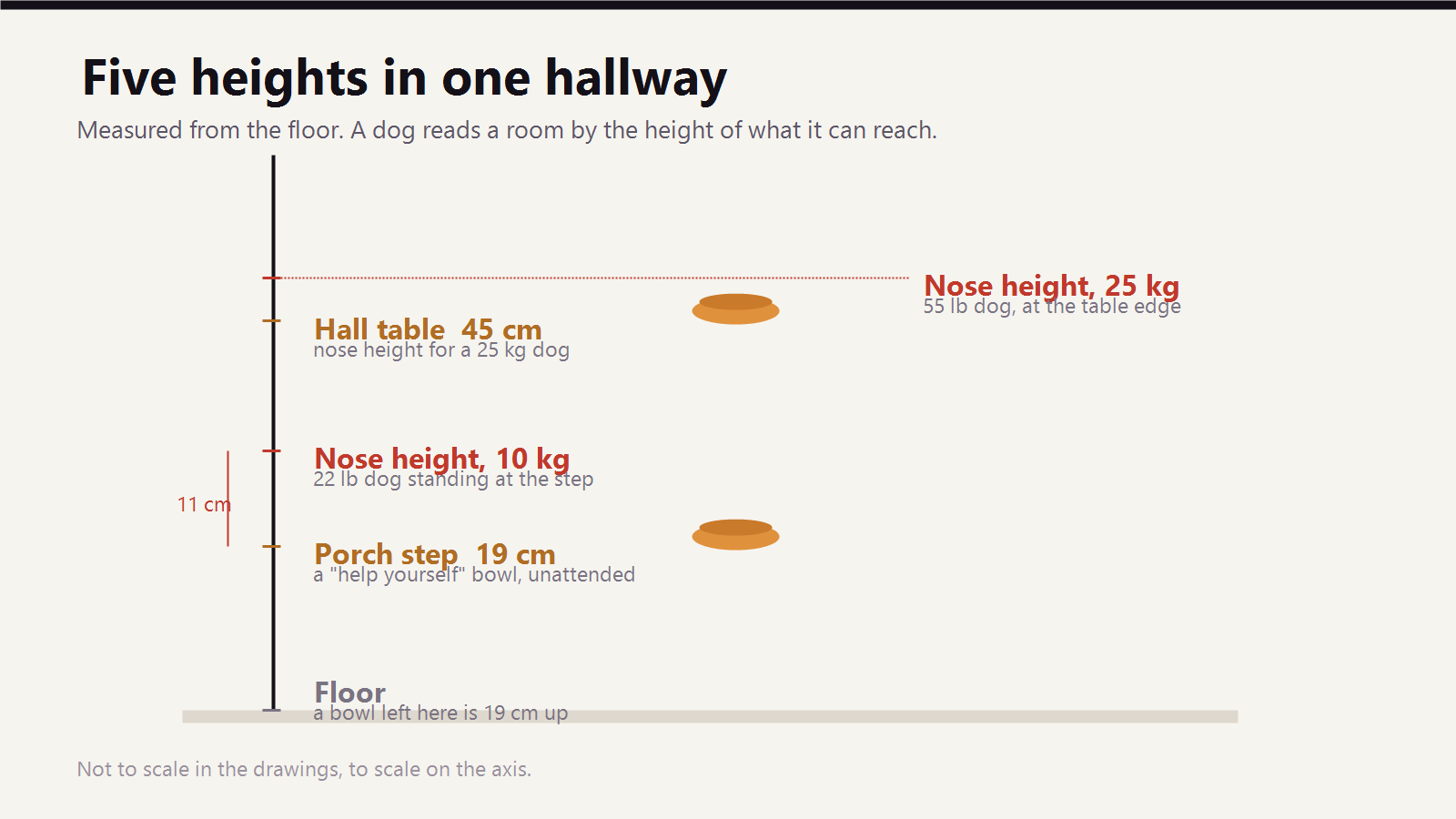
The candy problem is usually described as a temptation problem. It is better described as a reach problem, and reach is a number. A dog of about 10 kilograms — a beagle, a cocker, a sturdy terrier — carries its nose at roughly 30 centimetres when standing and considerably lower when sniffing, which is most of the time. A 25-kilogram dog, the size of a labrador, is at about 50 centimetres. A hall table is 45. A kitchen counter is 90. A porch step is 19.
Put those together and the “help yourself” bowl is not near the dog’s nose. It is at it. Add the fact that chocolate’s aroma is volatile at room temperature and that a dog’s olfactory epithelium is many times the area of ours, and the bowl is not merely reachable — it is loudly announcing itself from the other side of a door that keeps opening.
The second reach problem is smaller and more common: the dropped bar. A child’s bag splits on the step, a bar rolls under the bench, one piece lands in the shrubbery. Nobody notices, because nobody is looking at the ground. The dog finds it in the morning, or an hour after the last visitor, and by then the wrapper is the only evidence and the wrapper is under the sofa.
5. Five fun-size bars: the arithmetic
Chocolate toxicity is a methylxanthine problem — theobromine and caffeine — and the concentration varies by more than a factor of seven hundred across the products in a typical Halloween bag. The Merck Veterinary Manual’s table is the standard reference and it is short enough to memorise the shape of: cocoa powder at 28.5 mg/g, unsweetened baking chocolate at 15.5, dark and semisweet at 5.3 to 5.6, milk at 2.3, and white chocolate at 0.04.
The clinical thresholds, also from Merck, are 20 mg/kg for mild signs (vomiting, diarrhoea, thirst), 40 to 50 mg/kg for cardiotoxic effects, and around 60 mg/kg for seizures. Those are per kilogram of dog, so the arithmetic is short division and the results are more surprising than people expect.
| What is in the bowl | Methylxanthines | 10 kg dog reaches 20 mg/kg at | 25 kg dog at | In Halloween terms |
|---|---|---|---|---|
| Milk chocolate | 2.3 mg/g (64 mg/oz) | 87 g | 217 g | 5 fun-size bars / 13 |
| Dark or semisweet | 5.3–5.6 mg/g (150–160 mg/oz) | 37 g | 92 g | 2 bars / 5 |
| Unsweetened (baker’s) | 15.5 mg/g (440 mg/oz) | 13 g | 32 g | half a 28 g square / one |
| Cocoa powder | 28.5 mg/g (807 mg/oz) | 7 g | 18 g | one level tablespoon / 2.5 |
| White chocolate | 0.04 mg/g (1.1 mg/oz) | 5,000 g | 12,500 g | a fat problem, not this one |
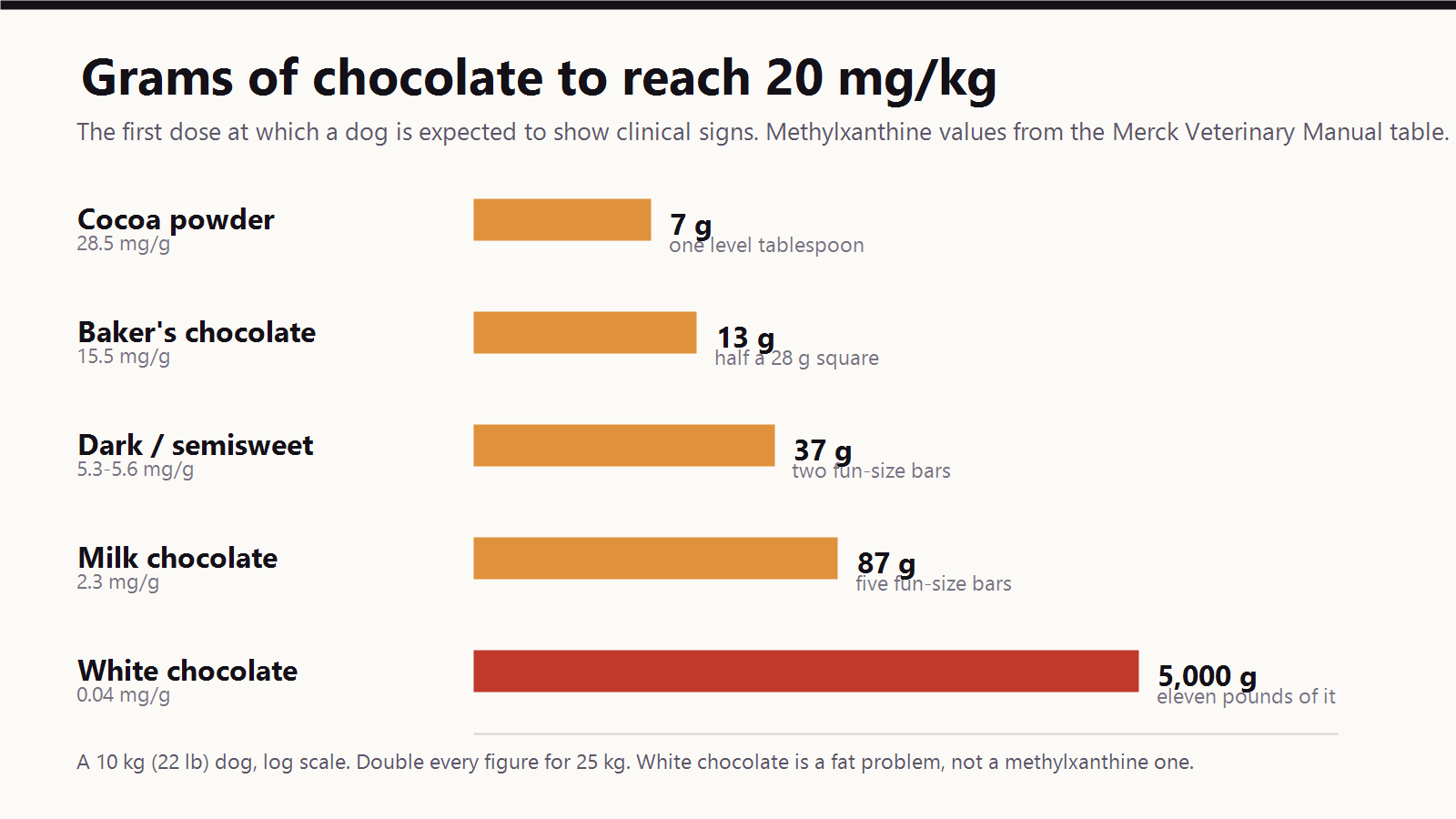
Two derived numbers are worth carrying into the evening. A single 28-gram square of baker’s chocolate delivers 434 mg of methylxanthines — 43 mg/kg for a 10 kg dog, squarely inside the cardiotoxic band. And a 100-piece bag of fun-size milk chocolate bars, the kind sold for handing out, holds about 1.7 kg of chocolate and therefore about 3.9 grams of methylxanthines: six and a half times the seizure threshold for a 10 kg dog, and two and a half times for a 25 kg one. The bag does not need to be eaten. It needs to be opened, and to be lower than a nose.
What the numbers do not tell you: they are population thresholds, not guarantees. Individual dogs vary, a dog with a heart condition or a small body mass has less room, and the theobromine figures are averages across products that differ by brand and by cacao percentage. If a dog has eaten chocolate and you are unsure of the amount, the useful move is a phone call with three facts — the dog’s weight, the product and the wrapper, and the time — rather than a guess at the arithmetic.
6. The three things in the bowl that are not chocolate
Xylitol. Sugar-free gum and mints are the item in the bag where the arithmetic stops being reassuring, because the mechanism is different: xylitol triggers insulin release in dogs, and blood sugar can collapse inside half an hour. The ASPCA lists vomiting, lethargy and loss of coordination progressing to seizures, with liver damage possible within 12 to 24 hours. A single piece of gum can carry anywhere from a fifth of a gram to a gram depending on the brand, which for a small dog is already the range vets treat as an emergency. It is also in sugar-free candy, some peanut butters, chewable vitamins and toothpaste — and “no sugar added” on a label is not a warning, it is a clue.
Raisins. Chocolate-covered raisins combine two problems in one piece, and the raisin half is the stranger one: the suspected toxin is tartaric acid, the effect is kidney damage, and there is no dose at which raisins are considered safe for a dog. Some animals react to a handful; the published guidance treats any exposure as worth a call. Grapes in a fruit bowl are the same hazard in a less seasonal form.
Wrappers. Foil and cellophane are not toxic, which is why they get discounted, and they are the item most likely to cause a surgical problem: a dog that eats chocolate in a hurry eats the wrapper in a hurry, and twisted foil does not pass. The wrapper is also the only record of what was eaten, which makes it worth more intact than in the bin.
7. Twenty minutes of tongue
Every behaviour plan for a night like this fails for the same reason: it is a plan to stop a dog doing something, and stopping is not a behaviour. The workable version gives the dog something that competes with the door — something that occupies the mouth, takes time, and pays out slowly enough that the dog chooses it over the hallway.
A licking mat does exactly one thing well. The four-zone surface holds a smear of peanut butter, yoghurt or wet food in ridges that a tongue cannot clear in a single pass, and the session runs about twenty minutes for a medium dog — long enough to cover the peak of the evening, short enough that it ends before the dog loses interest. The suction cups matter more than they look: pressed onto a tiled bathroom wall or the side of a bath, the mat holds at nose height in a room with a closed door, which is the configuration that actually removes the dog from the doorway. Ours is about 7.9 × 5.9 in (20 × 15 cm) and 180 g, food-grade silicone, $68.99 — small enough to freeze flat, which is the version that buys the most time, because frozen takes longer than room temperature by a wide margin.
Two practical notes from using one. First, the suction cups need a smooth, non-porous surface; on grout lines or a textured tile they let go, and a mat that slides is a toy rather than a station. Second, this is a management tool, not a tranquilliser: a dog that is already over threshold at the first ring will ignore food, which is why the mat goes down before the first visitor, not after the fifth.
The same principle covers the rest of the evening. A long walk in the late afternoon, a meal given early, and a room at the back of the house with a radio on will do more than any device. If the dog is due a trim before guests arrive, do it in the morning and do it calmly — the mechanics of a home trim are their own subject, and a nervous dog with sharp shears is a second problem on a night that already has one.
8. The two minutes after the last child
The last visitor leaves, the porch light goes off, and the street goes quiet in the particular way it does on 31 October. That is the moment to walk the route with a torch: the step, the path, under the bench, the edge of the planting. Not to tidy up — to find what a nose will find first. A dropped bar in the dark is invisible at eye level and obvious at 30 centimetres.
If something is missing and a dog is showing any of the signs the ASPCA lists — vomiting, restlessness, panting, a racing heart, tremors — the call is worth making before the symptoms sort themselves out. The ASPCA Animal Poison Control Center is on (888) 426-4435 and the Pet Poison Helpline on (855) 764-7661, both around the clock; a consultation fee may apply, and both will want the dog’s weight, the product and the time. A phone call at nine in the evening is cheaper and kinder than a wait-and-see that ends at two in the morning.
None of this is a reason to skip Halloween, and the article is not veterinary advice. It is a reason to move one bowl from a step to a shelf, close one door, and put twenty minutes of frozen peanut butter in front of a dog before the first ring. The chocolate is going to come through the doorway either way. The only variable is whether it comes through at nose height.
Frequently asked questions
How much chocolate is actually dangerous for a dog?
Roughly 20 mg of methylxanthines per kilogram of body weight is where mild signs begin, 40 to 50 mg/kg is the cardiotoxic band, and about 60 mg/kg is where seizures are expected. Because milk chocolate carries 2.3 mg per gram, a 10 kg dog reaches the first threshold at 87 grams — about five fun-size bars. The same dog reaches it with 37 grams of dark chocolate, 13 grams of baker’s chocolate, or 7 grams of cocoa powder.
Is white chocolate safe then?
It is nearly free of methylxanthines — 0.04 mg/g, against 2.3 for milk — so it will not cause theobromine poisoning in any realistic quantity. It is still a large dose of fat and sugar, which for some dogs means vomiting, diarrhoea and a pancreatitis risk. “Not toxic in the way chocolate is toxic” is not the same as “fine”.
Why does my dog bark more on Halloween than on any other night?
Because the door is being approached by strangers a hundred times in three hours, and each approach is announced by a chime at around 80 decibels. Dogs hear well into the high forties in kilohertz, so the bell carries more information for them than for us, and masks remove the faces they normally read for intent. The barking is territorial behaviour meeting an unusual frequency of intrusions, not a reaction to the decorations.
Should I leave a bowl outside so I do not have to answer the door?
It is a reasonable trade for the household and a bad one for a dog, because the usual resting place — the bottom step — is about 19 cm off the ground, which is eating height for anything under 15 kg. If the bowl has to be outside, put it on a table at 70 cm or more, keep the dog behind a closed inner door, and check the step and path with a torch afterwards for dropped bars and torn wrappers.
Do licking mats really calm a dog, or is that marketing?
They do not sedate anything. What they do is give a dog a competing behaviour with a long duration: a ridged mat with frozen food takes about twenty minutes to clear, and during those twenty minutes the dog is not patrolling the hallway. That is the same logic as giving a child something to do in a waiting room. It works best started before the trigger, and it works poorly on a dog that is already panicking — for that, talk to a vet about the behaviour, not a product page.
Gear referenced in this guide
Three items from our own listings, priced on 31 October 2026. None of them is required: a towel on the floor and a closed door get a household most of the way through the evening, and the arithmetic above is written so you can decide for yourself whether the rest is worth buying.
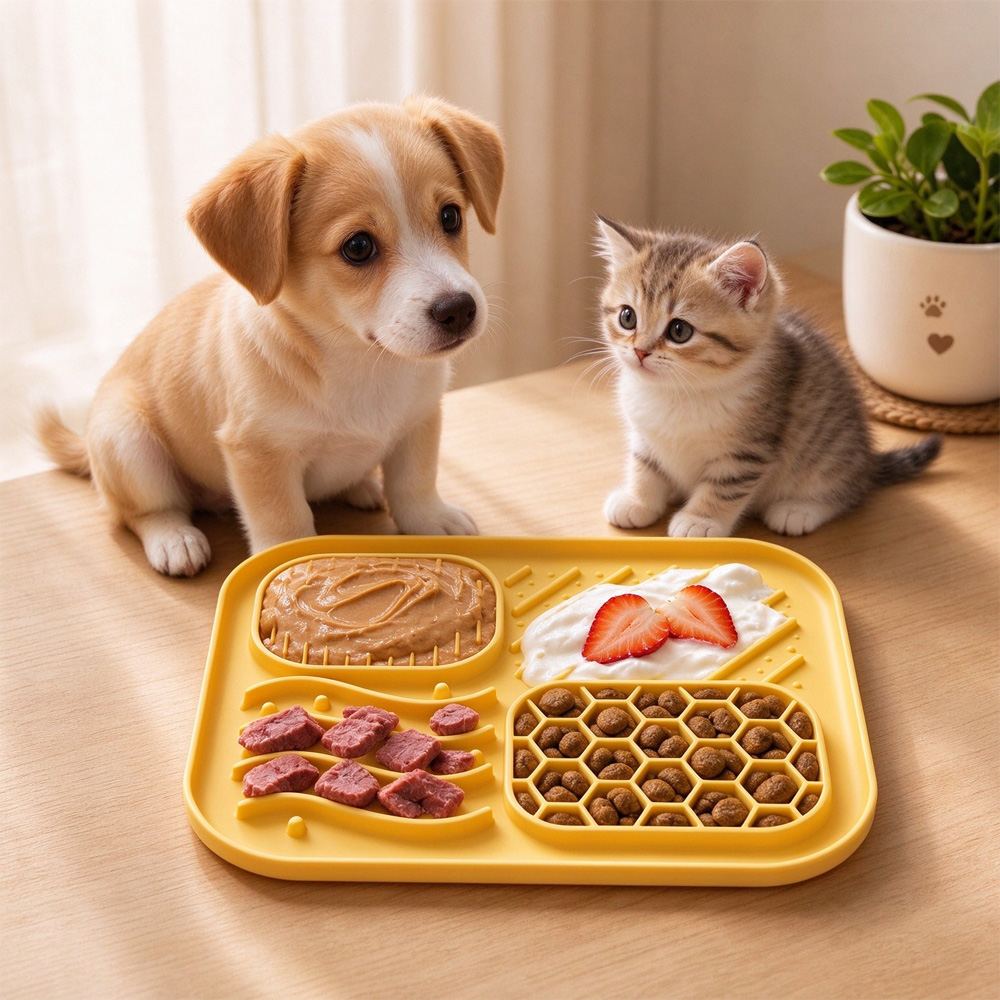 Silicone Licking Mat, 4-Zone$68.99View details
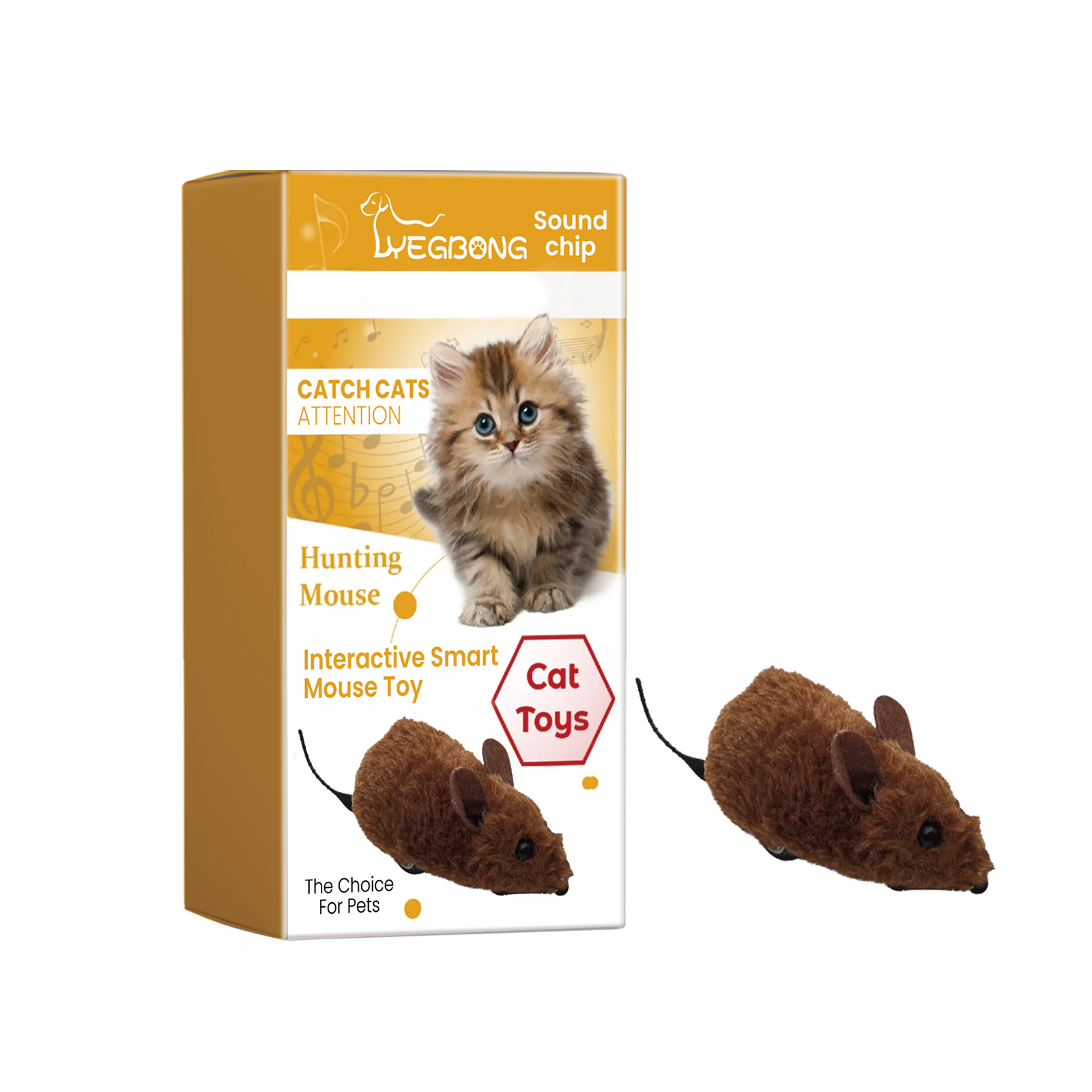 Interactive Smart Mouse Toy$77.99View details
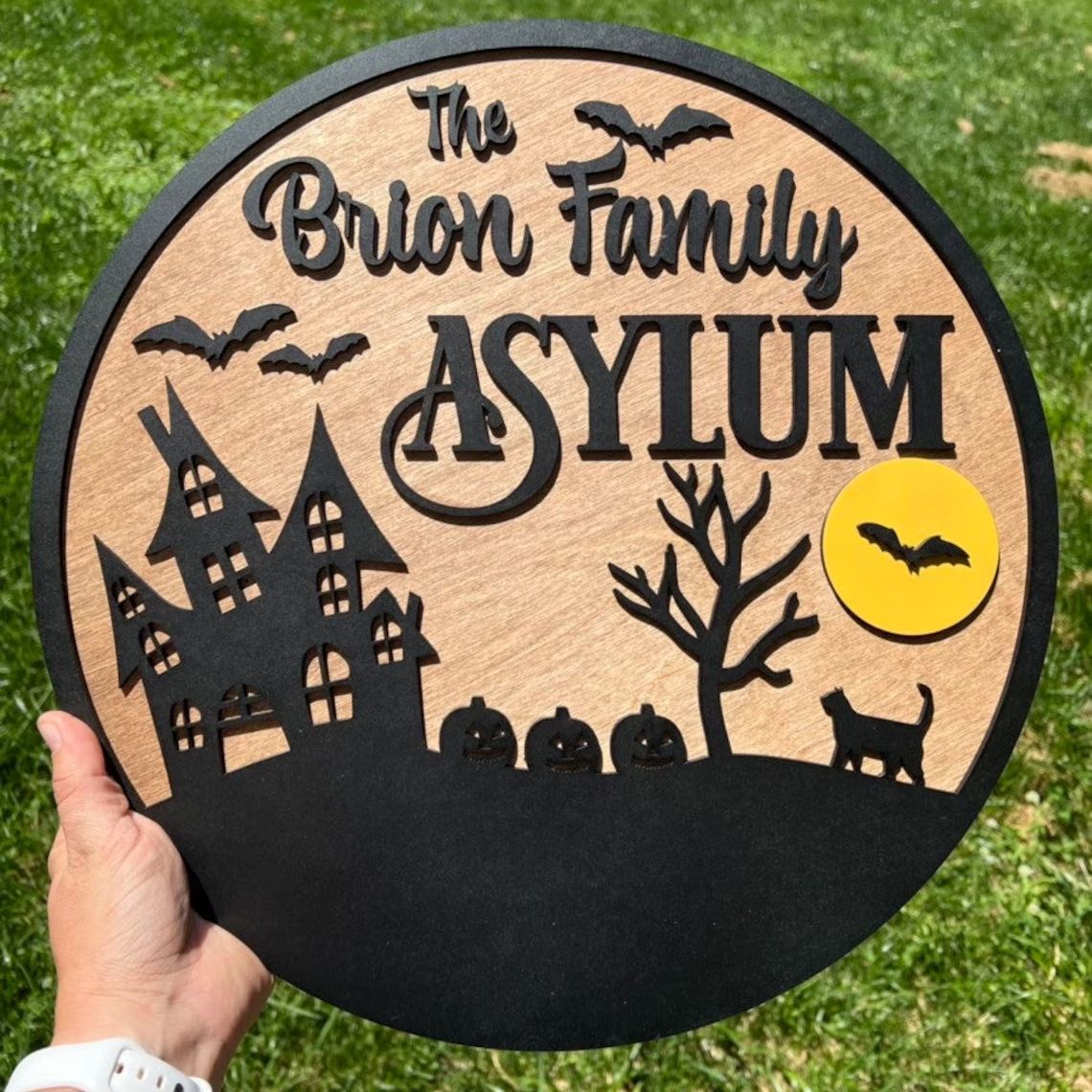 Halloween Log Slice Sign$69.99View details
Prices, the 7.9 × 5.9 in mat size and 180 g weight, and the 30 cm sign diameter are read from our own listings on 31 October 2026; the mouse toy is listed at $77.99 on the same date. Methylxanthine concentrations (cocoa powder 28.5 mg/g, unsweetened 15.5, semisweet 5.3–5.6, milk 2.3, white 0.04) and the 20 / 40–50 / 60 mg/kg clinical thresholds come from the Merck Veterinary Manual’s chocolate toxicosis table. Spending, participation and per-person figures are the National Retail Federation’s 2026 Halloween survey (7,889 respondents, fielded 1–9 September, margin of error ±1.1 points). Xylitol and raisin effects are described from the ASPCA’s people-foods guidance. The 17 g fun-size bar, the 100-piece bag, the 19 cm step, the 30 cm and 50 cm nose heights and every gram figure derived from them are arithmetic on those inputs — re-run them with your own dog’s weight and your own bowl before Halloween.
Compare on Amazon — this category usually has more brands, sizes and price points there.
Check current prices on Amazon →
As an Amazon Associate we earn from qualifying purchases. The price you pay is unchanged. Disclosure