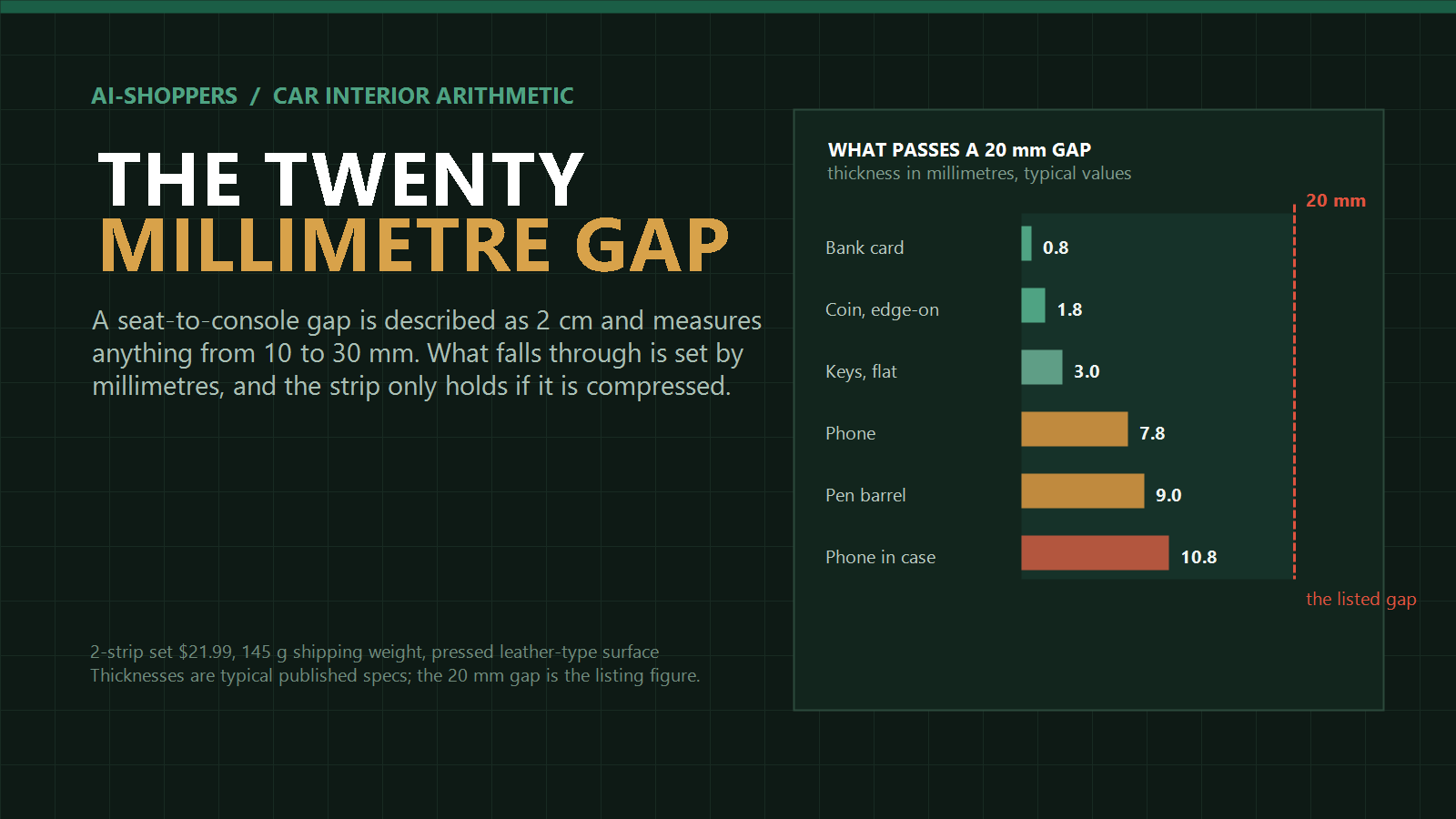
The listing calls it a 2 cm gap. Your car does not have a 2 cm gap. It has a gap that changes with the seat position, runs from about 10 mm at the back of the console to 30 mm at the front in some vehicles, and is the exact width of whatever you were holding when it slid off your lap. A strip that fills it is a simple object. Whether it works is decided by four numbers, only one of which appears on the product page.
1. The gap is a tolerance, not a dimension
A seat gap is the space left over between two parts that were never designed to touch: the seat frame with its foam and trim on one side, the console moulding on the other. Both are built to a tolerance, the seat slides fore and aft, and the console narrows towards the front. The result is a slot that is wider at one end than the other and wider again when the seat is pushed back.
That is why a single figure in a listing is close to useless as a fitment claim. Before buying anything, measure your own car in the position you actually drive in. Three measurements are enough: at the front of the gap, at the middle, and at the back where the seat meets the console nearest the buckle. Write down the smallest of the three, because the smallest is where the strip has the least material to press against.
If you do not own a ruler that fits in the gap, a stack of coins works as a gauge. A US quarter is 1.75 mm thick, so ten of them are 17.5 mm and eleven are 19.25 mm; a euro 50-cent coin is 2.38 mm. Slide the stack in edge-on and add or remove coins until it is a firm fit. This is not a precision instrument, but the decision in front of you only needs about 2 mm of resolution.
Measure in your driving position. Moving a power seat through its full travel can change the gap at the console by 5 mm or more, because the seat back pivots and the cushion tilts as it moves. A strip that looked tight at the front of the rail can be loose at the back, and a loose strip is the one that gets dragged.
2. What actually falls through
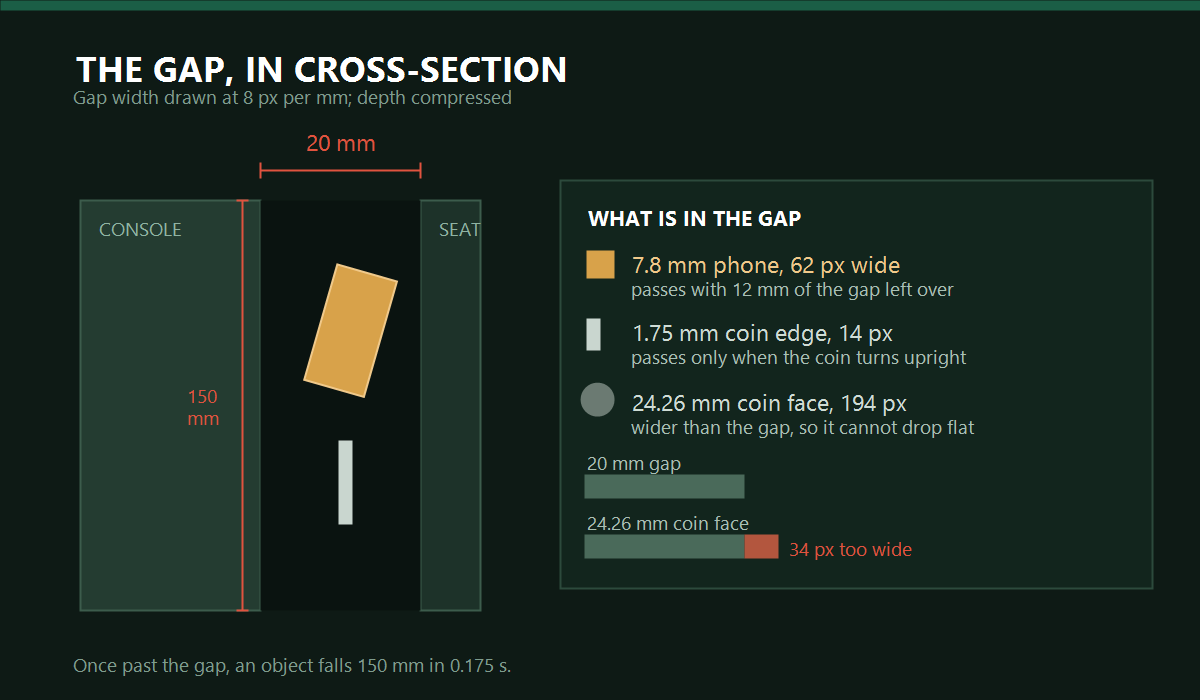
Passing through a slot requires two things at once: the object’s smallest dimension must be less than the gap, and the object must be oriented so that the small dimension faces the slot. In practice, gravity and a curved seat base do the orienting for you. Here is what the common objects measure.
| Object | Typical thickness | Through a 20 mm gap | What decides it |
|---|---|---|---|
| Bank card (ISO/IEC 7810 ID-1) | 0.76 mm | Always | Slides like a blade; no orientation needed |
| US quarter, edge-on | 1.75 mm | Yes, on edge | The 24.26 mm face will not fit flat |
| House key, flat | about 3 mm | Yes | Bow and teeth catch only if the slot is under 3 mm |
| Phone, current flagship | 7.8 mm | Yes | 11.9 mm of clearance left over |
| Phone in a 1.5 mm case, both sides | 10.8 mm | Yes | Still 9.2 mm of clearance |
| Pen barrel | about 9 mm | Yes | Length makes it bridge the gap only when square |
| Key fob | 12–15 mm | Usually | Depends on the fob and how the seat is adjusted |
Two things follow. First, a gap filler is not protecting you from a rare event. A 7.8 mm phone in a 20 mm slot has more than a centimetre of room on each side; it goes through without touching either wall. Second, the coin is the interesting case: the same object passes or does not pass depending on how it is lying. It is 1.75 mm thick and 24.26 mm across, so a 20 mm gap catches it flat and swallows it edge-on. That is why people find coins wedged under the seat rail rather than at the bottom of the well.
3. Two-tenths of a second, then a blind reach
Once an object is past the edge, it is gone before your hand has moved. A typical seat cushion and rail assembly gives the object about 150 mm of fall before it reaches the rail or the floor pan. From rest, that takes 0.175 seconds — square root of two times 0.15 metres over 9.81 — and it arrives at about 1.72 m/s. There is no version of this where a driver catches a phone.
Retrieval is the part that costs time. The average adult hand is about 85 mm across at the knuckles, four times the width of the slot, so the object cannot be reached from above. It has to come out from behind the seat, from the rear footwell, or from under the seat by feel. All three routes are blind, and under the seat is where the rail, the seat motor, the wiring loom and, in many cars, the side airbag connector live.
That is the real argument for a strip that costs $21.99: it does not save the phone, it removes an entire category of blind reaching in traffic. If the phone does go under the seat, stop somewhere safe and move the seat fully forward to get at it. Do not do it at a red light.
4. The distance you cover while looking down
Reaching for something under the seat takes longer than people think, because the hand has to find the object and then find a way out. A one-and-a-half-second glance down at 60 km/h covers 25 metres. Two seconds at 100 km/h covers 56 metres. The US National Highway Traffic Safety Administration puts a text message at five seconds; at 88 km/h, that is 122 metres — longer than a football field, travelled without seeing the road.
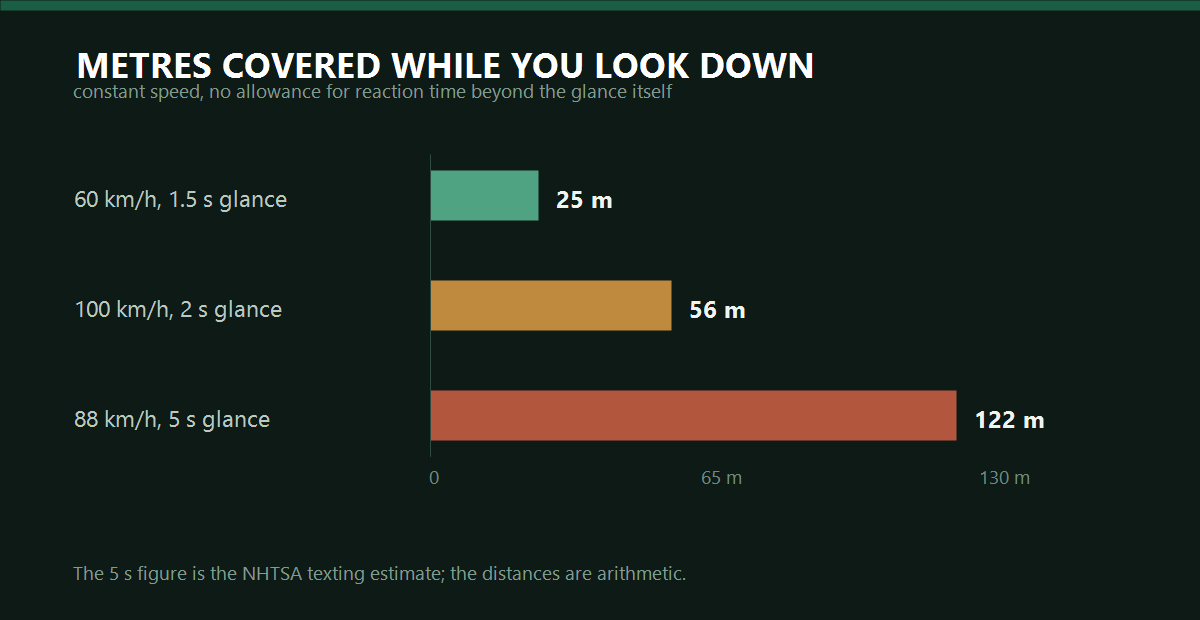
A gap filler does not make this safe; it makes it unnecessary. That is a different and better claim than “keeps your phone safe”, which no flexible strip can honestly make. The phone is not secured by the strip. It is prevented from entering the slot at all, which means it stays on the seat where you can pick it up at the next stop.
5. How a friction fit actually holds
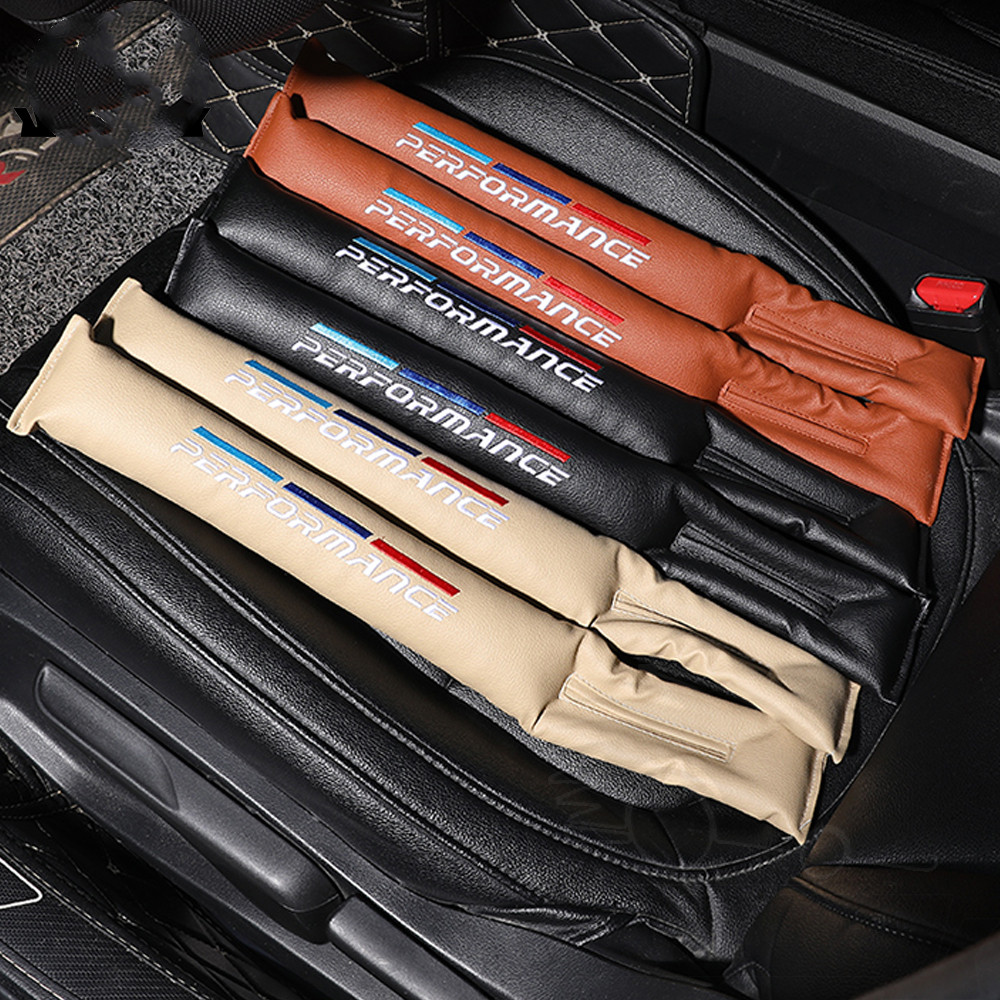
The strip has no adhesive, no clips and no screws. It holds because it is squeezed. Push a soft, leather-covered core into a slot narrower than its resting width and the material presses outwards on both walls; the resulting normal force, multiplied by the friction coefficient of the surfaces, is what resists being pulled down or dragged sideways.
Put approximate numbers on it. A strip running 400 mm along the slot with about 30 mm of contact depth on each wall gives roughly 0.024 square metres of contact. If the compressed material presses at about 2 kPa — a gentle figure for soft foam under trim — the normal force is about 48 newtons. With a friction coefficient of 0.4 between leather-type material and plastic trim, the strip resists roughly 19 newtons, or about 1.9 kg, before it slides.
Against that, a 200 g phone needs 1.96 N to hold it at rest and about 1.6 N under 0.8 g of braking. The margin is wide, which is why the product works at all. But the same arithmetic explains its failure mode: if the gap is 30 mm and the strip only touches lightly, the contact pressure collapses, and with it the normal force, the friction and the holding capacity. A strip that feels loose is not “almost fitted”. It is not fitted.
Check it in ten seconds. Fit the strip, then pinch it between thumb and forefinger and pull straight up. It should resist with a noticeable force and spring back into place. If it lifts out easily, the gap is too wide for one strip — the listing itself says very wide gaps in large trucks may need two strips per side.
6. Where the strip cannot help
Gaps over about 30 mm. Beyond that a single strip has nothing to press against at the base and will sit in the slot rather than fill it. Two strips side by side, or a purpose-made wider filler, is the answer.
Seats that travel over the strip. If the seat’s forward travel brings the cushion trim across the strip’s path, the strip will be pushed sideways or pulled out. The listing’s own advice is to check after moving the seat fully forward or back. Do that check once, deliberately, rather than discovering it on a motorway.
Anything in the airbag or belt path. The strip belongs in the gap beside the console, not across the seat belt buckle, not over the buckle stalk, and not wedged against the side airbag connector under the seat. If your car has a seat-mounted side airbag, the bolster is designed to split along a seam; nothing should be packed against it.
Heat and cheap trim. A closed car in summer sun gets hot enough to soften thin leather-type material. Because the fit depends on stiffness, a strip that goes soft holds less. It will not melt into the trim — there is no adhesive — but it can deform into the shape of the gap and lose the spring that made it stay. The listing’s care instruction is a damp cloth and no solvents, which is also the right advice for the plastic it presses against.
Storage. This is a gap filler, not a gap organizer. It has no pocket, no lip and no place to put the phone. If the goal is somewhere to put things, a rigid console-side organizer is the right product and this one is the wrong one.
7. Filler, organizer, or nothing
| Flexible gap filler | Rigid gap organizer | Foam or rolled cloth | |
|---|---|---|---|
| Closes the slot | Yes, by compression | Partly; it sits in the slot | Yes, until it shifts |
| Adds storage | No | Yes | No |
| Follows the console curve | Yes | No; straight edges leave gaps | Yes |
| Needs fixing hardware | No | Usually wedged or clipped | No |
| Survives seat travel | Check after moving the seat | Can be pushed out | Often dragged out |
| Cleaning | Damp cloth | Wipe or vacuum | Replace |
| Best for | Stopping drops | Holding a phone or coins | A temporary fix |
The 2-pack is priced at $21.99, which is $11.00 per strip and covers both front seats in most cars — the figure that matters is cost per use, not cost per strip. That is the honest comparison: not against a $200 console accessory, but against the ten minutes you spend on your knees in a car park with a torch. If the gap measures under 30 mm and the seat does not travel across it, this is the cheapest fix that solves the actual problem, which is the drop, not the phone.
8. Fitting, in four steps
Measure first, in the driving position, at three points, and keep the smallest number. Press the strip in until it sits just below the seat edge; the listing’s own fitting note is that it should look like part of the interior rather than a bulge on top of it. Move the seat fully forward and fully back, then look at the strip: if it has been pulled sideways, reseat it and check again. Trim the end with scissors if the run is longer than the gap; the material cuts cleanly and there is no core to seal.
Clean with a damp cloth and avoid solvents, which will take the finish off a pressed leather-type surface. The listing calls the material leather-type rather than full-grain, and at $21.99 for two strips that is the expected trade: a soft, shape-holding surface rather than a hide that will patina.
Shipping runs at 1–3 business days processing and a 3–7 day estimate to the US, with tracking. The return window is 30 days: damaged or wrong items are refunded or replaced, with a photo enough to start it. Given that fitment is the one thing a listing cannot confirm for your car, buy with that window in mind and test the fit before the month is out.
Frequently asked questions
Will it fit my car?
It is a universal flexible strip, not a vehicle-specific part, so fitment is a measurement rather than a model lookup. Measure the slot in your driving position at the front, middle and back. Under 30 mm at the narrowest point is the working range for one strip; wider gaps in large trucks may need two strips per side, which the listing itself notes.
Does it stop coins as well as phones?
Yes, if the gap is genuinely closed. A quarter is 1.75 mm thick and 24.26 mm across, so it drops through a 20 mm slot only when it turns on edge. A strip that fills the slot stops that rotation from mattering, because there is no opening left for the coin to enter.
Will it interfere with the seat belt or the seat moving?
Not if it is fitted in the gap beside the console. The belt path runs over the cushion and the buckle stalk, not through the console gap. The one thing to check is seat travel: move the seat fully forward and back once after fitting and confirm the strip has not been dragged sideways.
Is it real leather?
The listing describes a pressed leather-type material with a soft finish, chosen because it holds its shape in the gap and does not rattle. It is not sold as full-grain leather, and the price reflects that.
Can I cut it to length?
Yes. The strip is flexible with no rigid core, so scissors will trim the end cleanly. Cut slightly long and press the end down, rather than cutting to an exact measurement and finding the run is short at the curve.
Gear referenced in this guide
One item from our own listing, priced on 2 November 2026. The measurements above do not depend on buying it: any compressible strip that is thicker than your slot will close the same gap, and a strip that is too thin will not.
Related reading: what heat does to a back-seat organizer in a closed car, in the 68 °C cabin test; how often listings omit the numbers that decide a purchase, in the 84-listing spec audit; more car interior fittings in the Car & Auto category.
The $21.99 price, the 2-strip contents, the 145 g shipping weight, the 300 × 150 × 60 mm package, the pressed leather-type material, the 1–3 day processing, the 3–7 day US delivery estimate and the 30-day return window are read from our own listing on 2 November 2026. The 0.024 square metre contact area, the 48 newton normal force, the 19 newton friction limit and the 0.175 second fall time follow from the stated assumptions: 400 mm of strip length, 30 mm of contact depth per wall, 2 kPa of compression, a friction coefficient of 0.4 and a 150 mm drop. Object thicknesses are published format specifications and typical values, not measurements of your belongings. Gap widths of 10 to 30 mm are typical ranges for passenger cars and are not a fitment guarantee for any specific vehicle; measure your own.
Compare on Amazon — this category usually has more brands, sizes and price points there.
Check current prices on Amazon →
As an Amazon Associate we earn from qualifying purchases. The price you pay is unchanged. Disclosure