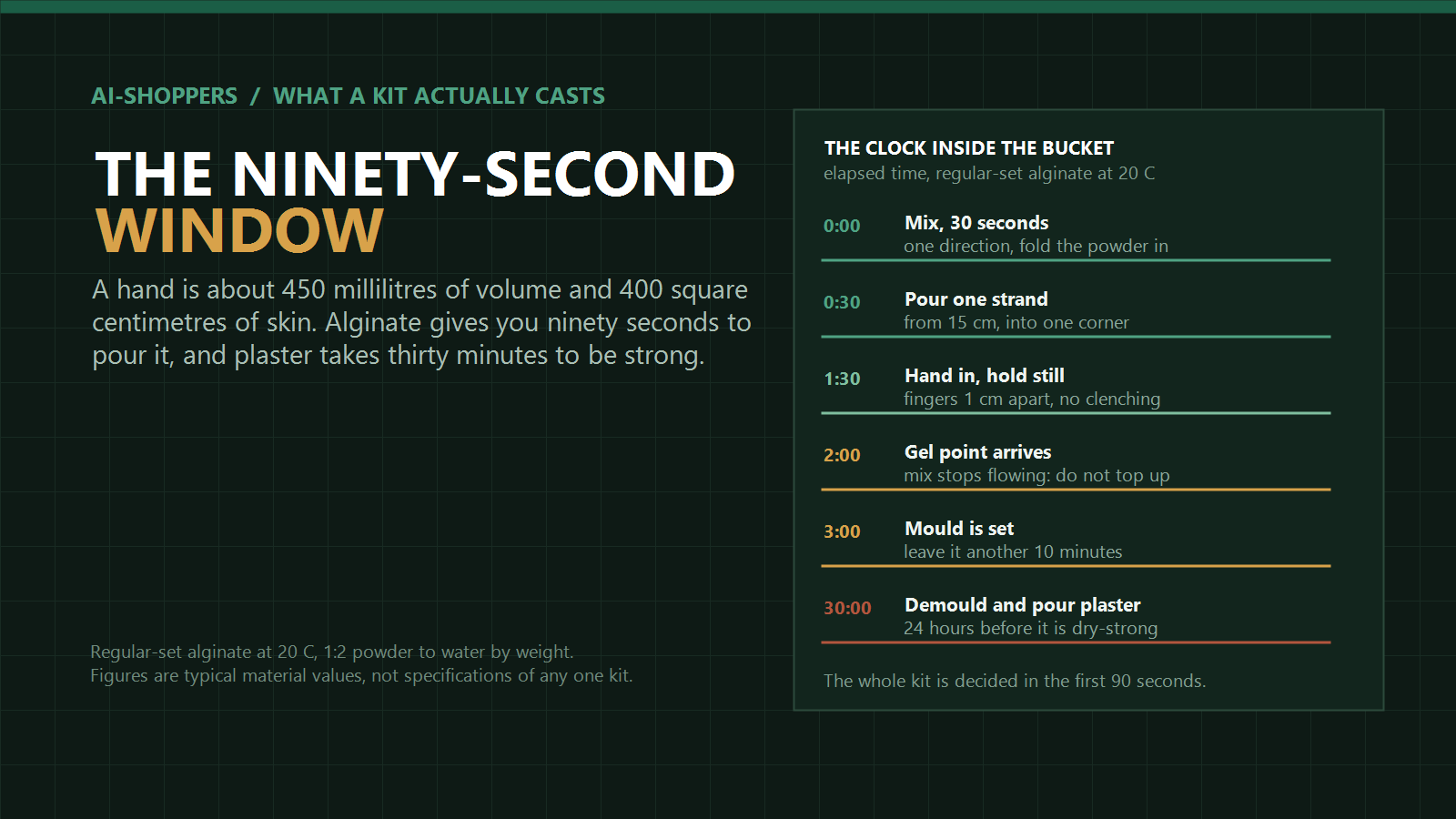
A hand-casting kit is sold as a keepsake: two hands, a bucket, half an hour, a statue. What it actually is, is a race between two materials that set on their own schedule, inside a container whose volume was decided before you opened the box. The alginate gives you about ninety seconds. The plaster asks for six hundred grams and takes a day to dry. Everything that goes wrong goes wrong in that gap.
One hand is about 450 millilitres
Start with the volume, because volume is what the bucket has to hold and what the plaster has to fill. An adult hand, wrist to fingertips, displaces roughly 400 to 500 millilitres; use 450 ml. Its skin surface is a separate number, about 400 cm², because a hand is mostly fingers and fingers have a lot of surface for very little volume.
Now the container. A typical kit bucket is 20 cm across and holds 2 litres. Put a hand in it and the alginate has to fill the difference: 2,000 ml minus 450 ml of hand leaves 1,550 ml of mix. That is the number that decides whether the kit works.
Alginate is mixed at about one part powder to two parts water by weight. A 500 g bag therefore makes 500 g of powder plus 1,000 g of water — 1,500 g of mix, and at a mixed density near 1.15 g/ml, about 1,300 ml. That is 250 ml short of what the bucket needs. The hand goes in, touches the bottom, and the cast comes out with a flat palm and no fingertips. Nothing was done wrong; the bag was simply too small for the bucket.
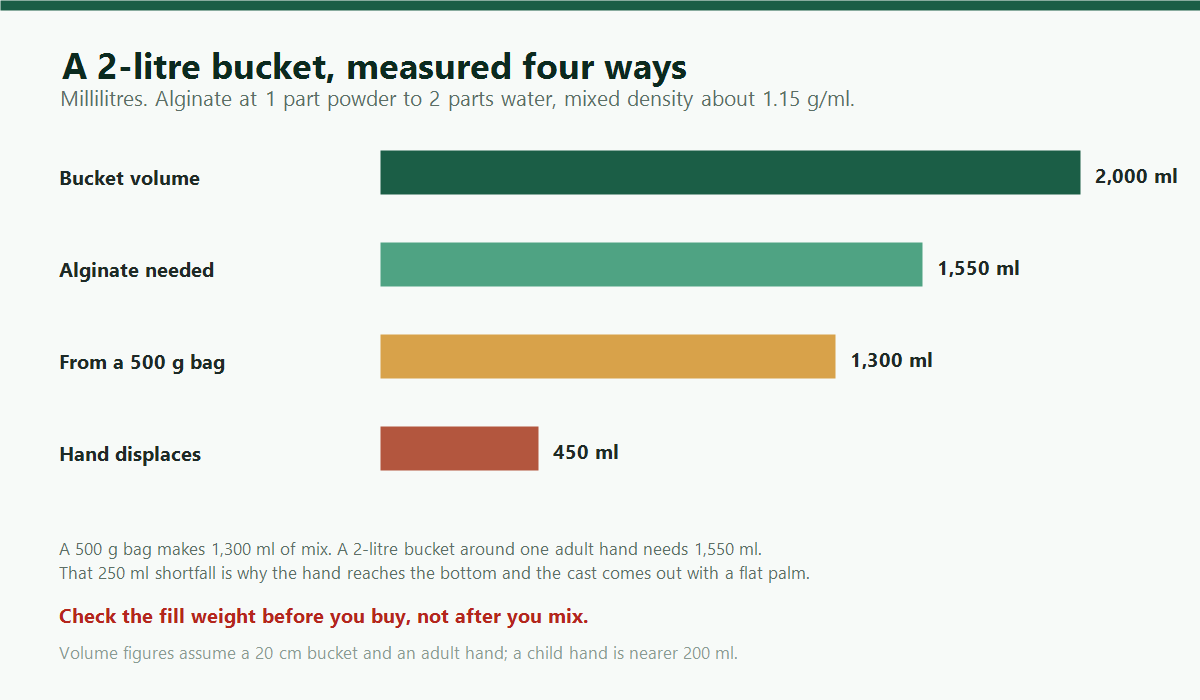
Two consequences follow. First, a kit that ships 500 g of alginate is a child’s-hand kit or a two-hands-in-a-narrow-bucket kit, whatever the box photograph shows. Second, you can shrink the requirement by shrinking the bucket: a 1.5-litre container around one hand needs 1,050 ml, which a 500 g bag covers with room to spare. The bucket diameter has to clear the widest part of the hand by at least 2 cm on each side, or the alginate wall is too thin to hold its shape when you lift the mould.
Ninety seconds, then it is out of your hands
Alginate sets by a chemical reaction, not by drying. Sodium alginate reacts with calcium ions from calcium sulfate to form an insoluble calcium alginate gel. A phosphate salt is added as a retarder: it consumes calcium ions first, and only when it runs out does the gel start to form. That is why the clock is predictable, and why it is short.
Mixing takes 30 seconds. Pouring takes another 30 to 60. By the time the mix has been in the bucket for 90 seconds, it is thickening against the wall, and at 2 to 3 minutes it has gelled. After that the hand cannot move, and nothing can be added: new mix will not bond to set alginate, it will sit on top as a lump.
| Elapsed | What has to be true | What ruins it |
|---|---|---|
| 0:00 | Water measured, powder weighed, hand washed and dry | Estimating the water by eye; a wet hand dilutes the mix |
| 0:30 | Powder fully wetted, no dry pockets | Whisking air in; lumps that set hard |
| 1:00 | Mix poured in one strand from 15 cm | Pouring from height in a thin stream, trapping bubbles |
| 1:30 | Hand in, fingers 1 cm apart, wrist below the surface | Clenching; fingers touching; moving after the gel point |
| 2:00–3:00 | Gel point: the surface stops flowing | Topping up with fresh mix; lifting the hand to check |
| 30:00 | Mould firm enough to demould | Pulling early, tearing the finger channels |
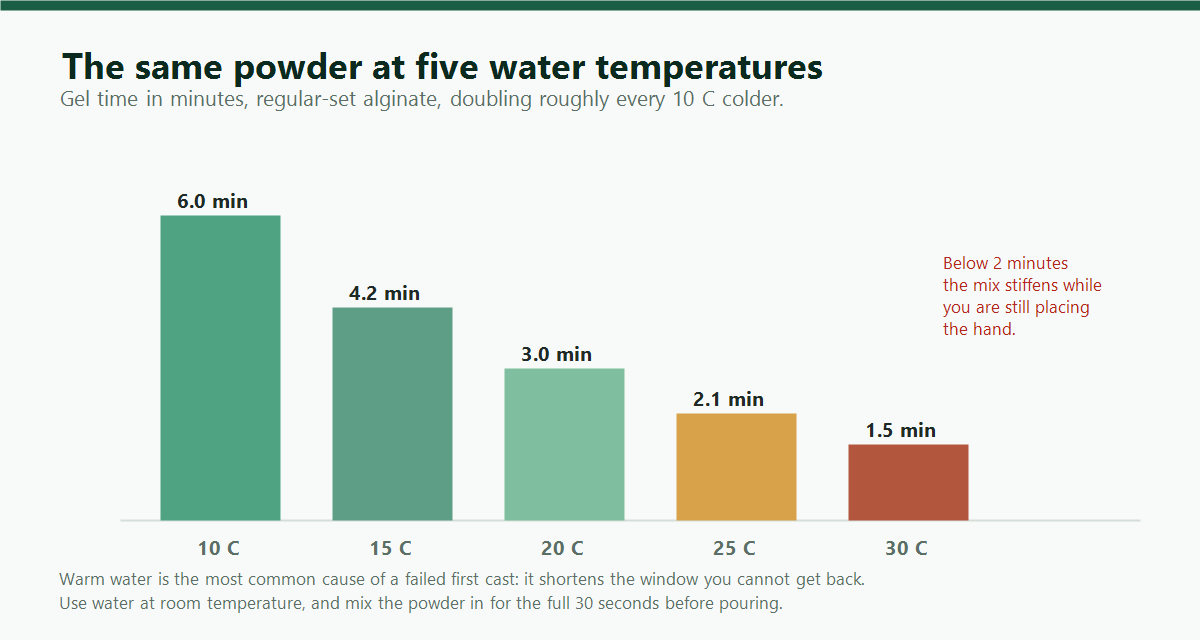
Temperature moves the whole schedule. Reaction rates roughly double for every 10 °C, so the same powder that gels in 3 minutes at 20 °C gels in about 6 minutes at 10 °C and about 1.5 minutes at 30 °C. Cold tap water in November buys you time; warm water takes it away, and the failure is silent — the mix looks fine right up to the moment it stops moving.
Alginate is irreversible, and that is the cost structure
You cannot melt an alginate mould and reuse it. The gel is held together by calcium cross-links; once formed, they do not come apart with heat the way a thermoplastic does. A torn finger channel cannot be glued. Every attempt costs a full mix, which is why the cost per keepsake is the kit price, $28.99 to $35.99 in our own listings, and a second attempt doubles it.
There is a second clock after demoulding. Alginate is mostly water, and it loses that water to the air. The mould shrinks and the surface dries, and both distort the cavity. Pour the plaster within 15 to 30 minutes of taking the hand out; an hour on the kitchen table is enough to lose the crisp edge around a fingernail.
The powder has a shelf life too. Sealed, alginate keeps about 12 months; opened, it takes on humidity, and the retarder is the part that suffers first. A kit bought last winter and opened in a damp cupboard may gel early and set weak, with no visible sign in the bag. Keep it sealed with a silica sachet and treat an opened bag as a one-month material.
Plaster needs 0.8 cubic centimetres per gram
Plaster of Paris is calcium sulfate hemihydrate. Add water and it re-forms gypsum crystals, taking water into the crystal structure as it hardens. The chemistry needs only 18.6 g of water per 100 g of powder, but that mix is unworkable, so the practical ratio is 60 to 70 ml per 100 g. The extra water is there for flow, and it leaves as porosity once the cast dries.
That ratio gives a useful conversion for buying: 100 g of powder plus 65 g of water makes about 80 cm³ of set plaster. So one gram of powder fills 0.8 cm³. A 450 ml hand cavity therefore needs 560 g of powder, and with the base and mixing loss, 600 g is the honest number for one adult hand. A 450 ml cast weighs about 900 g when set.
Two more numbers matter. Plaster expands as it sets, by about 0.3 per cent linearly: over a 20 cm cast that is 0.6 mm, harmless on a keepsake and significant if you plan to fit the cast into a frame or a recess. And the reaction is exothermic, releasing about 117 J per gram of powder. Six hundred grams in a one-litre mix is roughly 70 kJ, enough to raise the bucket by close to 29 °C if none of it escaped. The bucket will feel distinctly warm; that is normal, and it is also why you do not demould into a cold room and expect the same result.
The strength you are waiting for. Set plaster reaches handling strength in about 30 minutes, but its dry compressive strength — roughly 8 to 15 MPa for plaster of Paris — arrives after the excess water has evaporated, which takes 24 to 48 hours at room temperature. Sanding or drilling at hour two is how corners get chipped.
The three ways a first cast fails
Movement. A hand that shifts 2 mm after the gel point leaves a stepped cavity, and the cast reproduces the step exactly. Fingers must be separated by about 1 cm so the alginate can flow between them; a closed fist casts as a single mass with no finger definition at all.
Water ratio. Ten per cent too much water lengthens the gel time and lowers the strength; ten per cent too little makes a mix that cannot fill the fingers. Weigh the water if the kit includes a scale, and use the marked line on the bucket if it does not, at eye level rather than looking down into it.
Air. Mix by folding the powder into the water in one direction, not by whisking. A 1 mm bubble trapped against the skin becomes a 1 mm nodule on the finished hand, and there is no way to fill it afterwards. Pouring in one strand from about 15 cm, into the corner of the bucket rather than onto the hand, lets the mix rise around the fingers instead of folding air into itself.
What to check before you buy
Four numbers on the listing decide whether the kit can do the job, and only one of them is usually printed:
- Alginate fill weight. 600 g or more for a 2-litre bucket and an adult hand; 500 g only if the bucket is 1.5 litres or the hand is a child’s.
- Plaster fill weight. 600 g for one adult hand. Two hands need roughly 1.1 kg, because two clasped hands displace more than twice one hand.
- Bucket diameter. At least the hand’s width plus 4 cm, so there is 2 cm of alginate on each side.
- Setting type. Fast-set alginate at 1 to 2 minutes is harder to use than regular-set at 2 to 3, and it is the usual reason a first attempt fails.
Everything else — the gift box, the mixing sticks, the sandpaper — is packaging. A kit that prints its fill weights and its set time is telling you it was designed by someone who has run the arithmetic.
What it will not do
It will not give you fingerprints. Alginate reproduces detail down to roughly 25 micrometres, and a fingerprint ridge is 300 to 500 micrometres wide, so the ridges are within reach in theory. In practice a hand held still in a kitchen bucket moves, and the plaster has to be poured within half an hour, so the print is soft at best. Treat it as a shape, not a forensic record.
It will not survive outdoors or a freezer. Gypsum is porous and water-soluble at the surface; rain erodes it and frost spalls it. Keep the cast indoors, and seal it with a coat of acrylic or clear lacquer if it will be handled often.
It will not fix a bad mix. There is no rescue step for alginate that gelled before the hand went in, and no way to add plaster to a cavity that has already been half filled and set. The material is cheap; the attempt is what costs money.
It is not a toy for unsupervised children. The plaster dust is a respiratory irritant, the mix gets to about 50 °C, and a set block of plaster is heavy enough to hurt a foot. Mix outdoors or in a ventilated room, and keep the bucket away from anyone who might drink from it.
Frequently asked questions
How long does a hand casting kit take from start to finish?
About 45 minutes of active work: 30 seconds of mixing, 90 seconds to place the hand, 2 to 3 minutes for the alginate to gel, 20 to 30 minutes for the mould to firm, then 10 minutes to pour the plaster. The cast is handleable an hour later but only reaches dry strength after 24 to 48 hours, so plan the whole thing as a two-day project if you intend to sand or seal it.
Why did my cast come out with a flat palm?
Almost always because the alginate ran out before the bucket was full. A 2-litre bucket around an adult hand needs about 1,550 ml of mix, and a 500 g bag makes about 1,300 ml. The hand settles to the bottom, the palm sits against the plastic, and the cast reproduces a flat plane instead of a palm.
Can I reuse the alginate mould for a second cast?
No. The gel is cross-linked by calcium ions and does not soften with heat, so it cannot be reset or patched. Some kits include enough powder for two mixes, but that is two moulds, not one mould used twice. Budget one mix per cast, and one spare if the first attempt matters.
How much plaster do I need for two hands?
About 1.1 kg of powder. Two clasped hands displace more than twice one hand, because the space between them counts, and the cavity is deeper than a single hand. Mix in two batches rather than one: a single 1.1 kg batch in a small bucket sets before you can pour it all, and the second half is wasted.
Does water temperature really change the setting time?
Yes, by roughly a factor of two for every 10 °C. Regular-set alginate that gels in 3 minutes at 20 °C gels in about 6 minutes at 10 °C and about 1.5 minutes at 30 °C. Cold water gives you a longer working window; warm water is the most common reason a first cast fails, because the mix stiffens while the hand is still being positioned.
Gear referenced in this guide
Three casting kits from our own listings, priced on 2 November 2026. The arithmetic above does not depend on buying any of them: any alginate-and-plaster kit behaves the same way, and the fill weights are the part that varies.
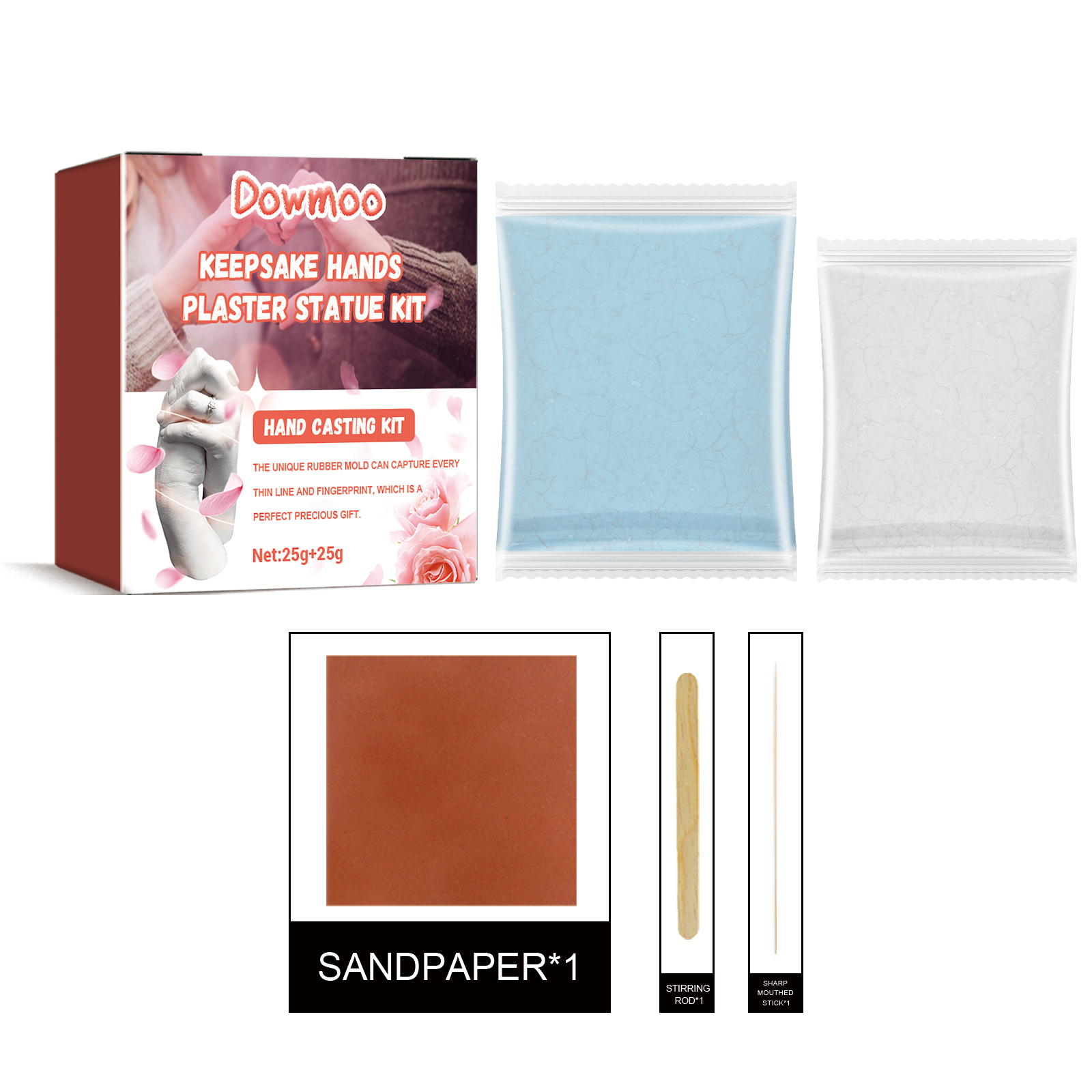 Hand Casting Kit, Plaster Hand Model$28.99View details
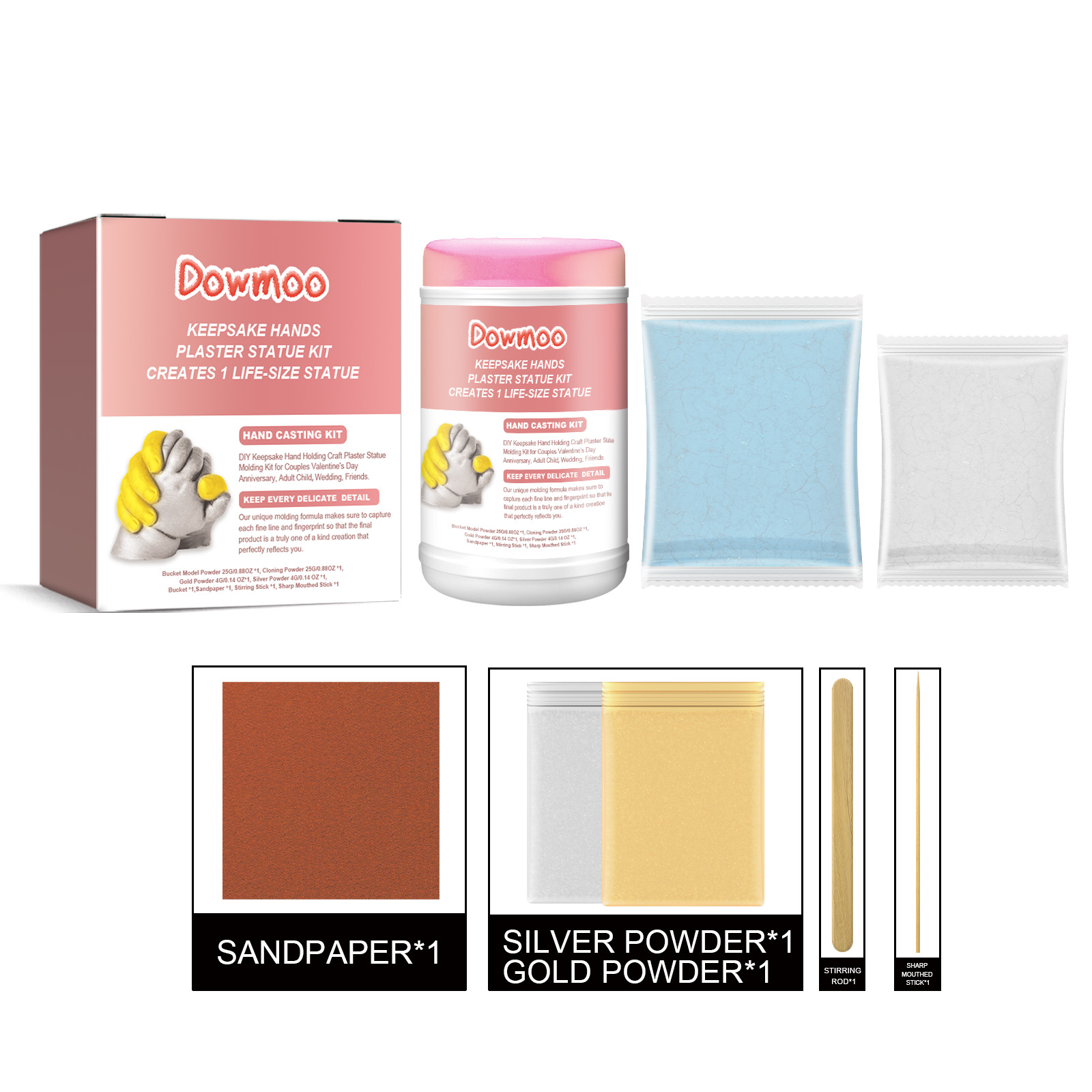 Keepsake Hands Plaster Statue Kit$30.99View details
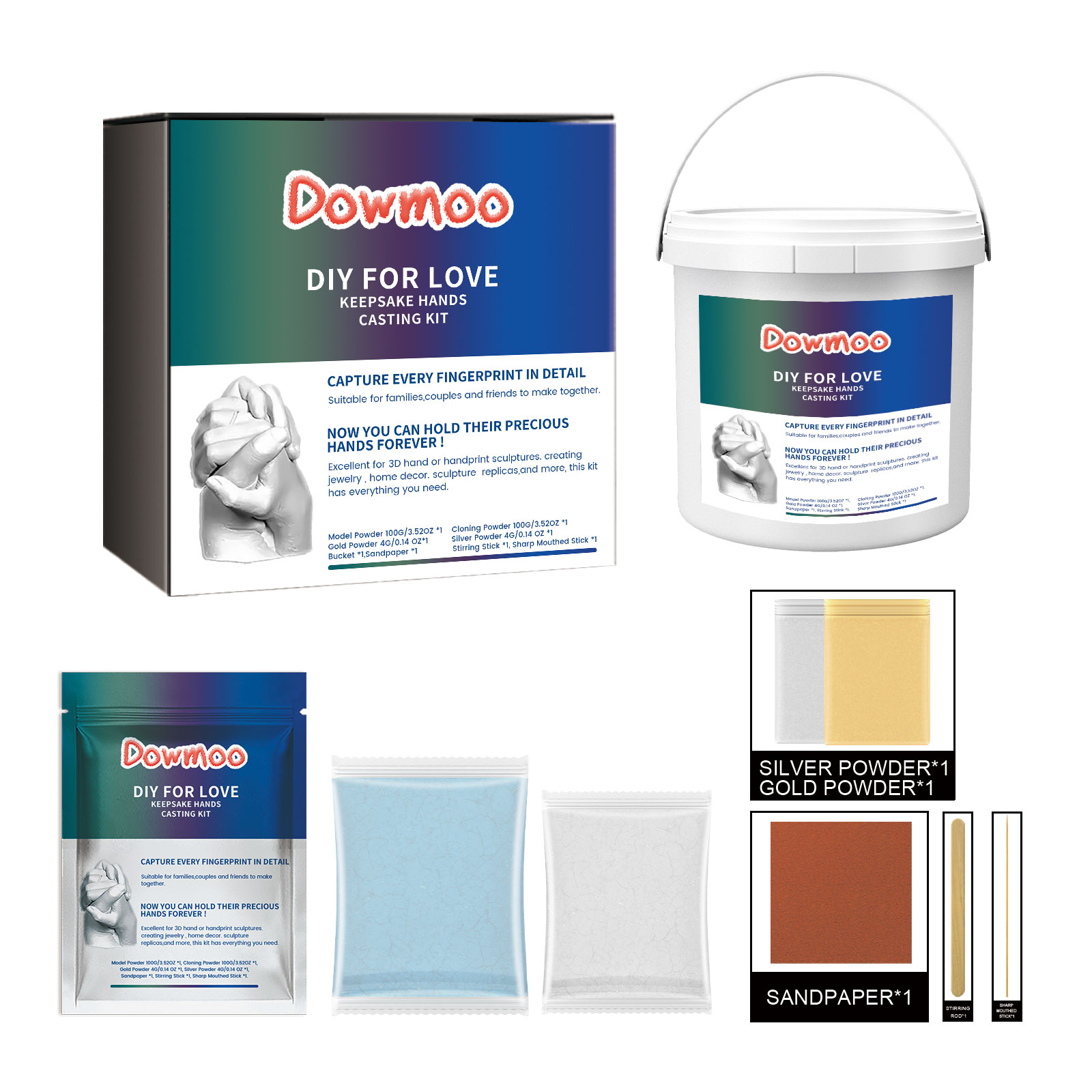 DOWMOO DIY Keepsake Hands Kit$35.99View details
Related reading: why a container’s inside dimensions beat its stated size, in two millimetres of slack; how volume per dollar exposes a bad buy, in $35 a litre or $5.23; why one attempt at a craft kit is the real unit of cost, in four cents a cut; more gift and craft listings in the Kids & Gifts category.
The $28.99, $30.99 and $35.99 prices are read from our own listings on 2 November 2026; the listings do not publish fill weights, which is why the checklist above tells you to read them off the box. Material values are typical for regular-set alginate and plaster of Paris, not specifications of these kits: 1:2 powder-to-water alginate at a mixed density near 1.15 g/ml, gel time 2 to 3 minutes at 20 °C with a Q10 near 2, plaster at 60 to 70 ml water per 100 g, 0.3 per cent linear setting expansion, 117 J per gram of hydration heat, and 8 to 15 MPa dry compressive strength. The 450 ml hand volume, 400 cm² hand area, 1,550 ml bucket requirement, 560 to 600 g plaster requirement and 29 °C temperature rise follow from those figures and from a 20 cm, 2-litre bucket.
Compare on Amazon — this category usually has more brands, sizes and price points there.
Check current prices on Amazon →
As an Amazon Associate we earn from qualifying purchases. The price you pay is unchanged. Disclosure