Every January, someone’s bamboo cutting board splits down the middle, or a bamboo drawer insert opens a hairline crack along a glued seam. The rattan basket in the same kitchen does not. It is not luck and it is not quality: it is the difference between a hollow tube of aligned fibres and a solid vine, measured in a few percent of shrinkage.
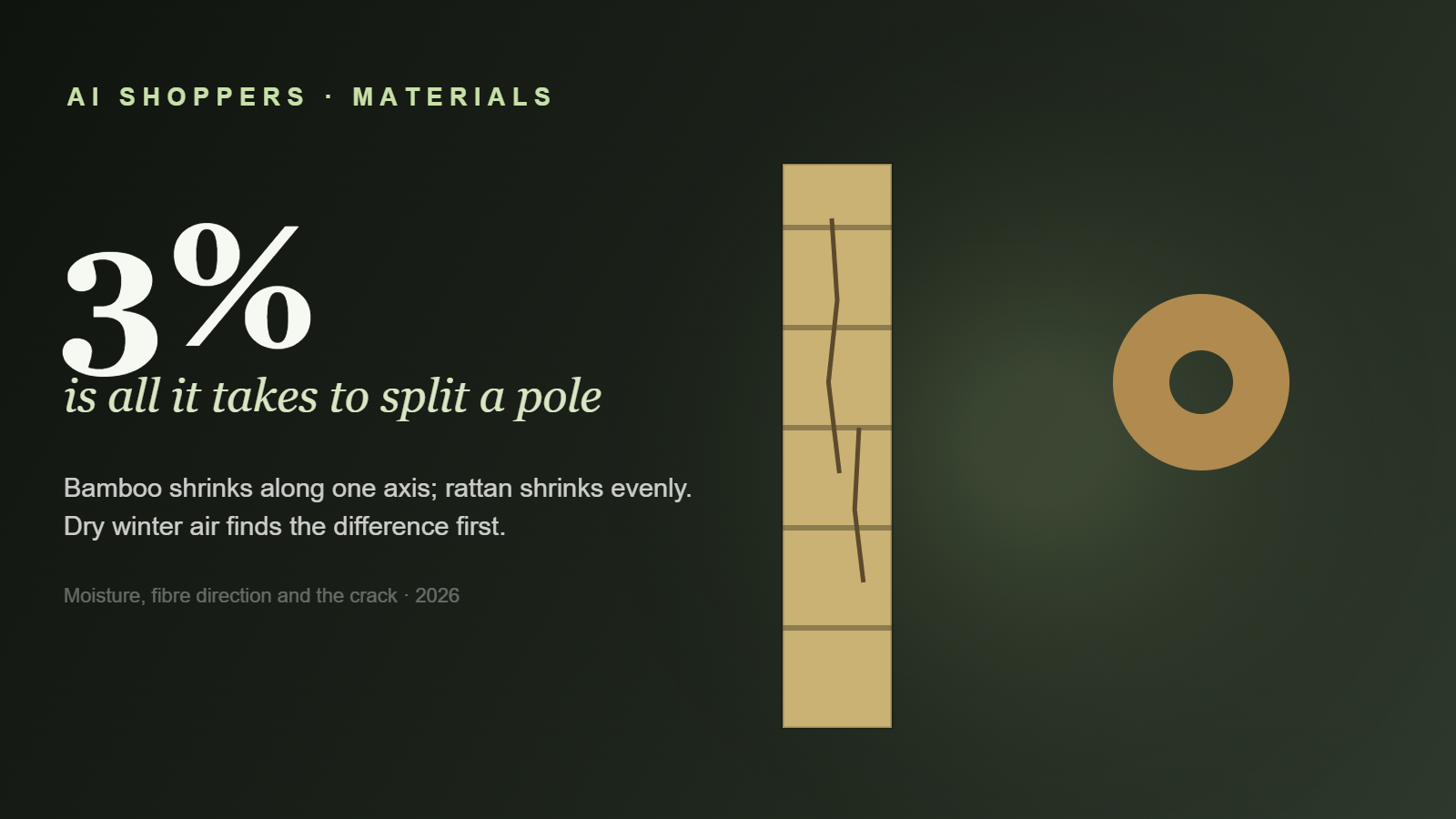
Bamboo moves about 4 percent across its fibre direction when it dries from green to indoor equilibrium. Rattan moves around 3 percent, but evenly, in a material with no weak plane to tear along. That single structural fact explains why one cracks in heated rooms and the other quietly survives.
1. What bamboo actually is
Bamboo is a grass, not a wood. Its stem is a hollow cylinder reinforced by vascular bundles — dense fibre pipes running lengthwise through a softer matrix. There are no rays (the radial cells that let wood move in two directions at once), so almost all of its strength and almost all of its movement run along one axis.
When a bamboo strip dries, it shrinks across the fibres far more than along them. Glue that strip to another strip at a different angle and you have built a material with a built-in argument: one layer wants to move 4 percent, its neighbour wants to move 1.5 percent, and the seam carries the difference.
2. The numbers, and the winter that exposes them
Fresh bamboo sits near fibre saturation; indoor bamboo settles at 8–12 percent moisture content. In a heated flat in February, relative humidity can drop to 30 percent, pulling the equilibrium moisture content down by three or four points. Three points of moisture is roughly 1 percent of linear dimension — and about 4 percent across the fibre direction from green.
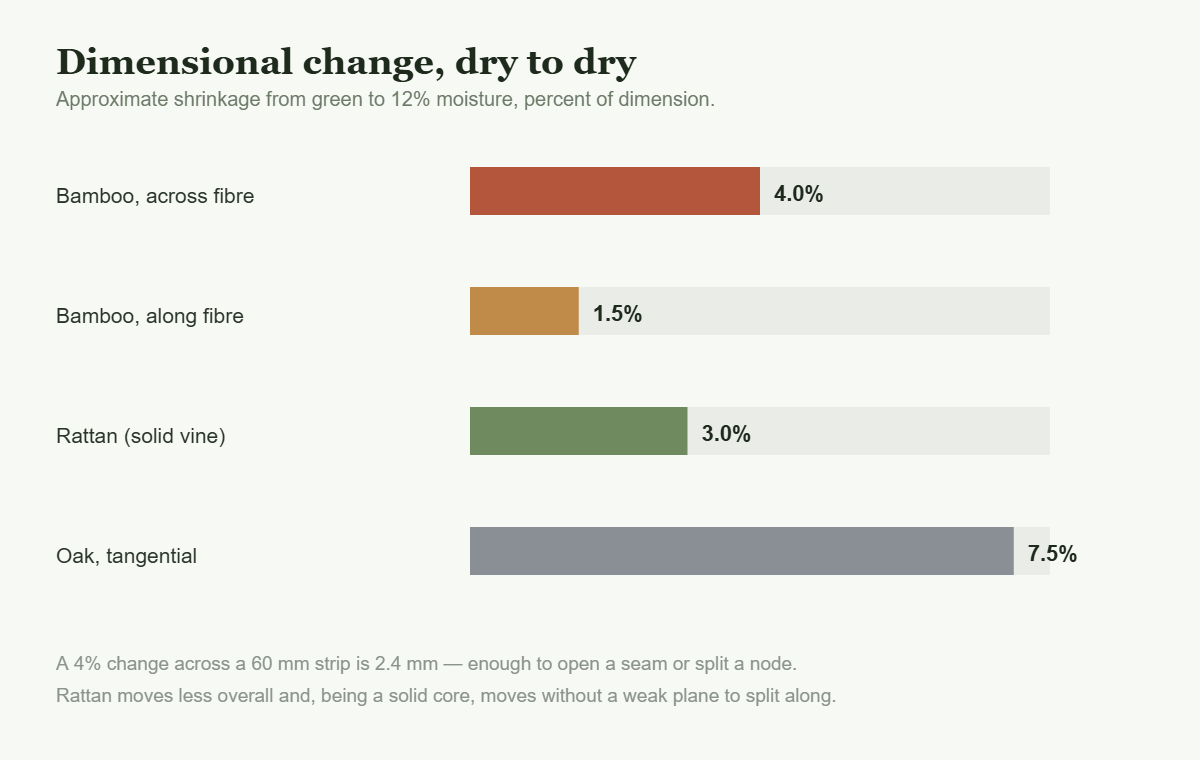
Put a number on the consequence: a 60 mm wide bamboo panel moving 4 percent changes by 2.4 mm. Nothing visible on a flat board — but at a glued joint or a node, that 2.4 mm of differential strain is where a crack starts.
3. Why rattan behaves differently
Rattan is a climbing palm with a solid core, high silica content and a fibrous structure that runs continuously along its length. It dries to roughly 3 percent shrinkage, and because the cross-section is solid and comparatively uniform, the strain distributes instead of concentrating at an interface.
There is no glue line, no alternating grain, no node to act as a stress riser. That is why a rattan basket from the 1990s can still hold shape in a dry room while a bamboo board from last winter has already split.
4. What actually fails, and where
| Failure | Where it starts | Cause | Prevention |
|---|---|---|---|
| Long split | Along a node or glue line | Differential shrinkage across fibre | Keep RH above 40%; oil the surface |
| Seam opening | Edge-glued panels | Alternating grain directions | Choose strip orientation; avoid heat sources |
| Cupping | Wide boards | One face drying faster | Finish both faces; allow air circulation |
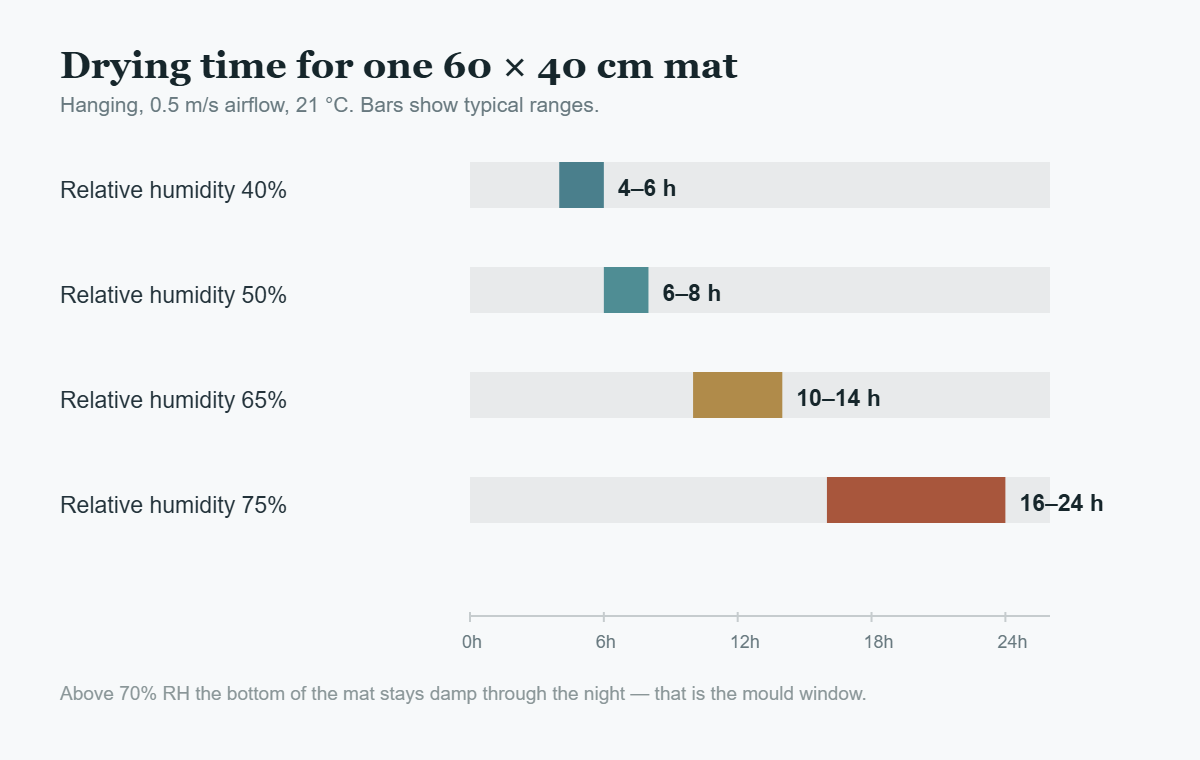
| Mould, not crack | Damp rooms above 70% RH | Moisture above 16% | Ventilate; do not store wet |
Note that the prevention column is about humidity, not about brand. A cheap bamboo board in a 50 percent room outlives an expensive one next to a radiator.
5. The three habits that keep bamboo whole
First, keep the room between 40 and 60 percent relative humidity; a €15 hygrometer is the cheapest insurance in this article. Second, never place bamboo directly against a heat source or in a forced-air draught — the drying gradient is what opens seams, not the average humidity. Third, oil or wax cut surfaces and end grain, which are the paths by which moisture leaves fastest.
If a crack has already started, a thin cyanoacrylate or wood glue worked into the gap and clamped overnight will stop it spreading in most cases. Structural splits at a node are usually the end of the item.
6. Buying: what to look for
Check the grain direction on any glued panel: strips running parallel are more stable than a checkerboard. Check whether the product is solid bamboo or a bamboo veneer over MDF — veneer behaves like the core, and the core is usually the weaker material. And check thickness: a 20 mm board resists differential strain far better than a 12 mm one, for the same reason a thick plank warps less than a thin one.
Honest disclosure: the shrinkage figures are typical published ranges for these materials, not measurements of the products shown. Actual movement depends on species, harvest age, drying schedule and finish.
7. What the glue line does
Engineered bamboo and engineered wood both depend on adhesive. A well-made panel uses a structural adhesive with a glue line under 0.2 mm and presses at temperature; a cheap one uses more glue and less pressure, and the line becomes the weakest plane in the product. When that panel dries, the glue line is where the strain concentrates — the wood itself rarely splits first.
This is the reason two bamboo boxes at similar prices can age differently. The one with visible squeeze-out and a rough seam has more glue and less control; the one with a clean, thin line was pressed properly. Look at the inside corner, not the top face.
8. The first month decides a lot
Most cracking happens in the first heating season after purchase, not in year five. When a bamboo item arrives from a humid warehouse, give it 48 hours in its new room before use — still wrapped in paper, not plastic — so it can equalise gradually. Then oil the end grain, keep it away from radiators and direct sun, and check the hygrometer once in the first cold snap.
Do that, and a 20 mm bamboo board will outlast several cheap replacements. Skip it, and the item’s useful life is decided by your winter heating schedule rather than by anything on the product page.
The finish matters too: an open-pore oil lets moisture move slowly in both directions, which is what you want, while a thick plastic film traps moisture on one side and guarantees a gradient. Two coats of hard wax oil, reapplied yearly, is the whole maintenance schedule.
Frequently asked questions
Why did my bamboo board split in winter?
Indoor humidity dropped, the board dried faster across the fibre than along it, and the strain concentrated at a node or glue line. It is a moisture event, not a manufacturing defect.
Does oiling prevent cracking?
It slows moisture exchange, which reduces the gradient — helpful, not a guarantee. Humidity control matters more.
Is rattan always more stable than bamboo?
For solid vine sections, yes, because there is no glue line to fail. Rattan furniture with glued joints can still open; the advantage is in the material, not the assembly.
Can a cracked bamboo board be repaired?
Small cracks: glue and clamp. Cracks running through a node or across the full width: replace, because the structure has already separated.
What humidity should I aim for?
40–60 percent relative humidity. Below 35 percent, differential shrinkage accelerates; above 70 percent, mould becomes the bigger risk than cracking.
Gear referenced in this guide
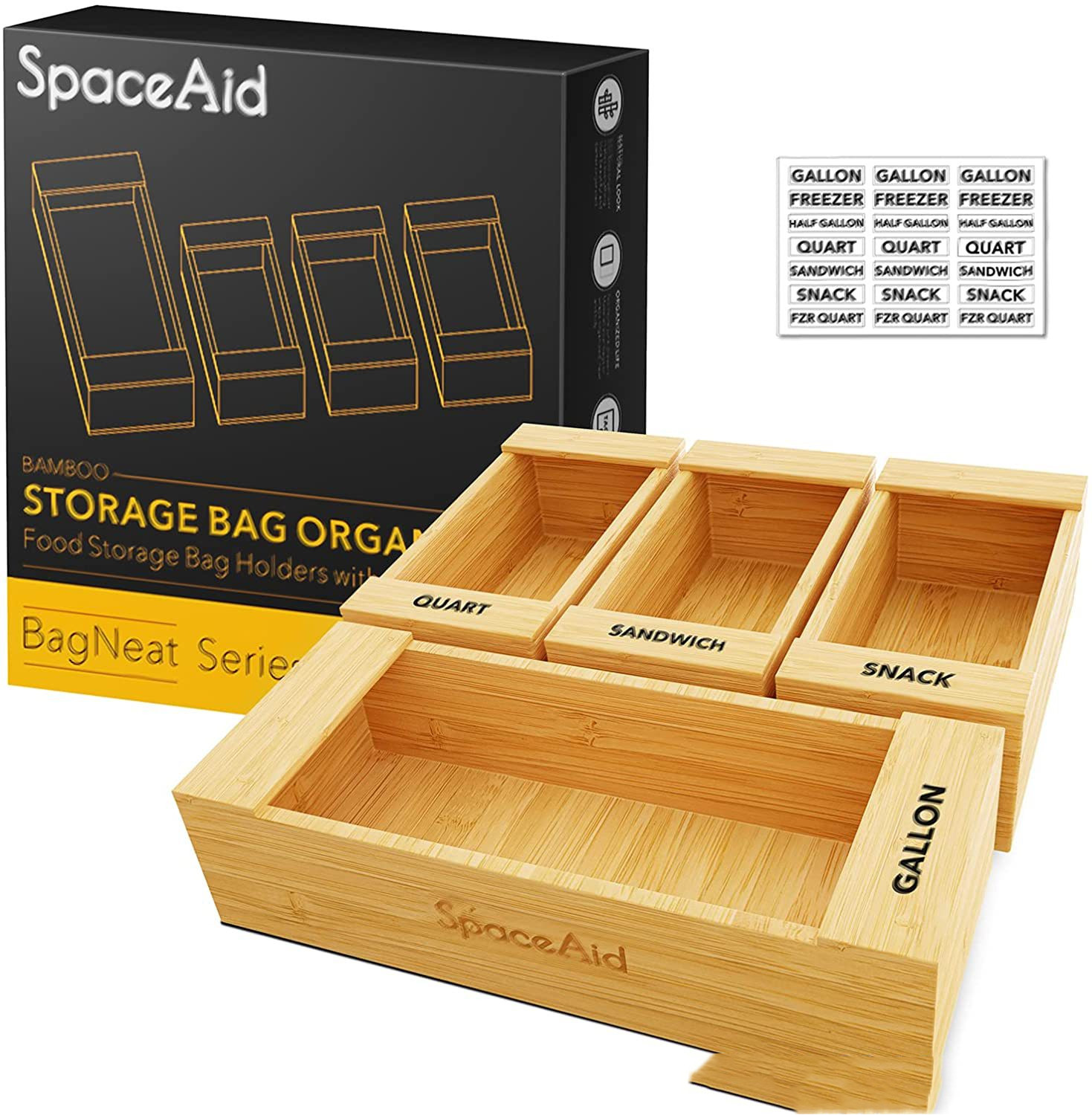
Bamboo Kitchen Drawer Organizer Box, 30.5 x 10.2 x 7.6 cm
Solid bamboo with lengthwise grain — the configuration that keeps movement along one axis.
$53.99
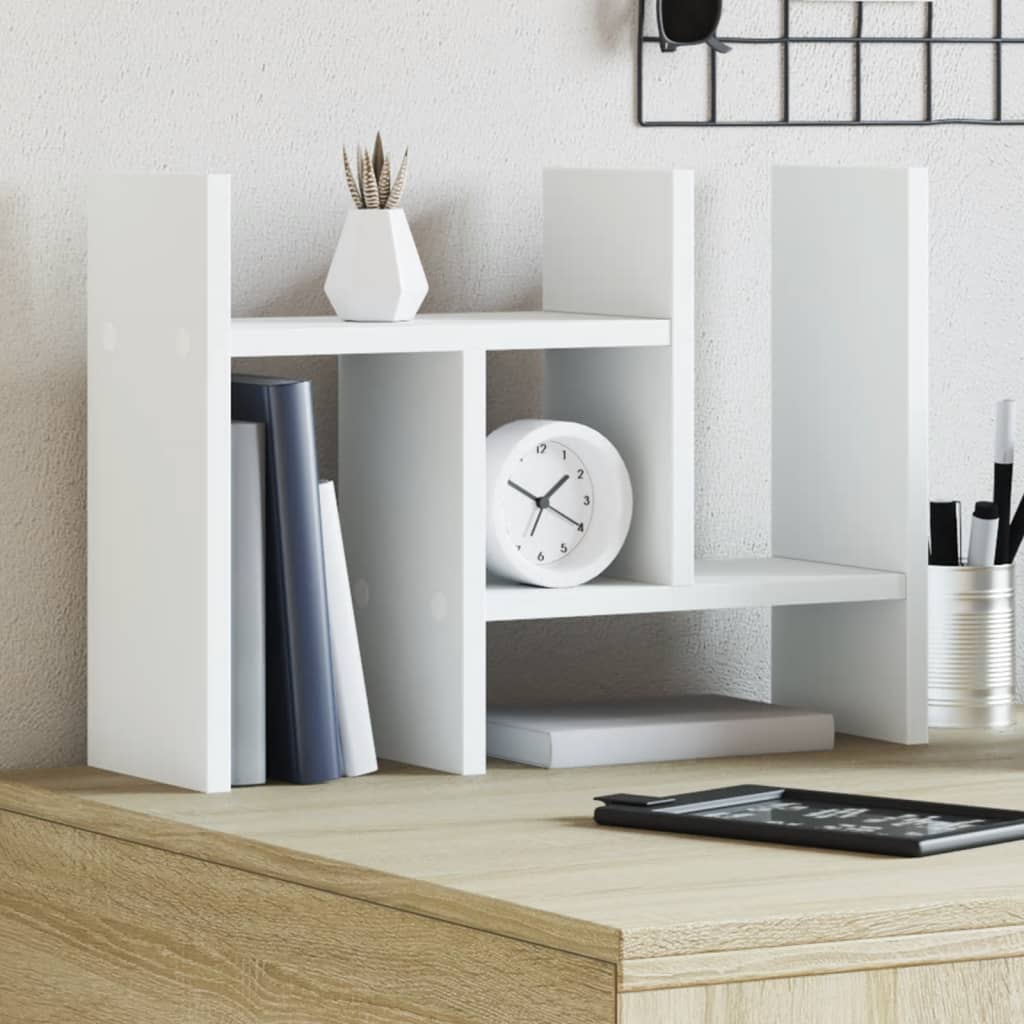
Engineered Wood Desk Organizer Shelf, 34.5 x 15.5 x 35.5 cm
Engineered board: less movement than solid, but the finish and edges decide how it ages.
$67.99